

This post is different from the usual. It’s been on my mind as the World Cup approaches and I’ve started playing baseball again in my late middle age.
I love soccer! It’s a great game. I like watching it, I like playing it.1 I root for Ajax in the Champions League (when they’re in) and sometimes Barça (when they’re not). I love the international game even more. Argentina and the Netherlands and God save me if they ever play each other. I’ve even occasionally watched the NYCFC.
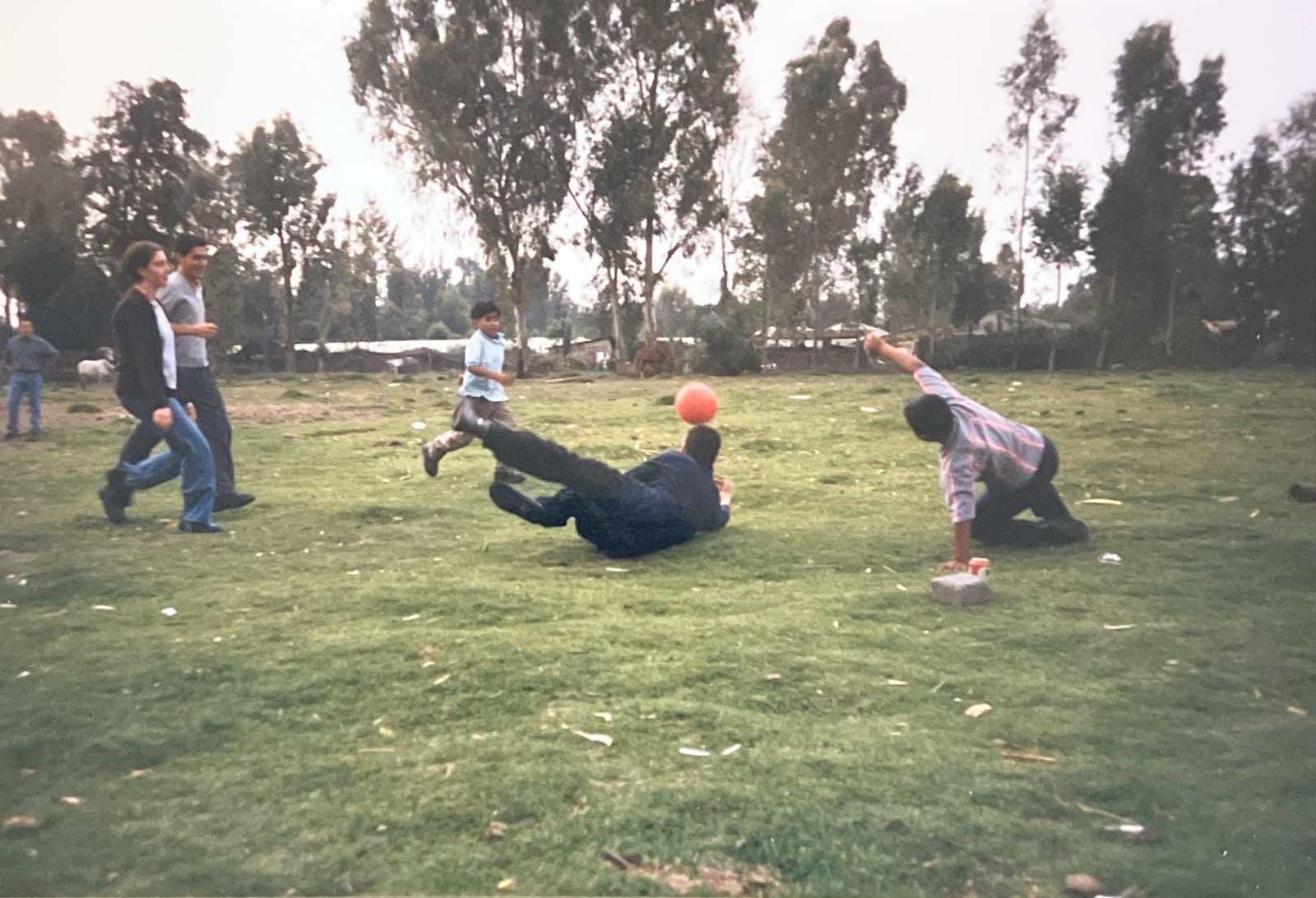
But the truth is (sorry) I like playing baseball orders of magnitude more than soccer. And I generally like watching both baseball and “American soccer” — what my daughter charmingly calls football of the NFL variety — a little bit more than soccer, at least outside the fervor of the World Cup.
Why is that?
Well, the truth is that soccer really is different from American sports in some fundamental ways. That makes it a taste that is actually kind of hard to acquire, despite the sport’s near universal appeal across the globe.
Professional fouls
What’s a professional foul? Well, I discussed it here in the context of European politics, so let me quote myself:
A professional foul in soccer is where a player decides that taking the penalty for a foul is better than letting the opposing play succeed.
An iconic case of a professional foul was in 2010 when Luis Suárez saved Uruguay’s bacon by slapping a ball away with both hands that was otherwise going to hit the net. Sure, he was sent off and Ghana got another penalty kick, but if he hadn’t done that the match would have been over and with it Uruguay’s World Cup hopes.
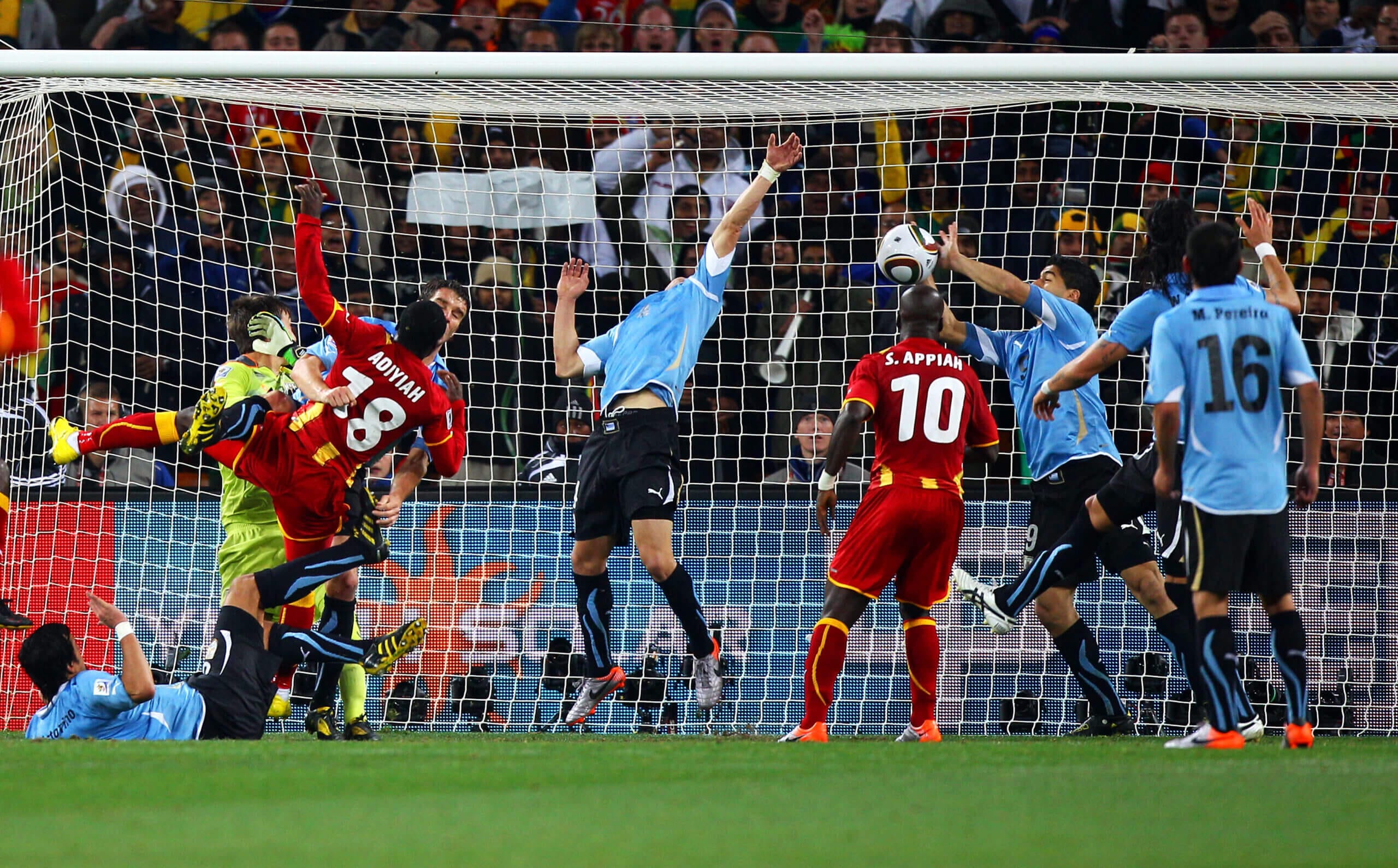
I was watching the match in Cambridge, Massachusetts, and the Americans around me were outraged. Even the Uruguay fans looked a little weirded out. But Matias Mori, the Chilean guy I was drinking with, well, he was plussed. (Is that a word?) Unphased. Unbothered. So was Luis Suárez. His teammate, Diego Forlan, had this to say when the two countries were about to meet again in 2022:
It’s not a revenge match for us. If Ghana see it that way, that’s on them. They’ll use it for motivation so that they can say, “This is our chance for revenge against Uruguay.” That’s valid. [But] the rules say that if you use your hand to handle the ball inside the box it’s a penalty. And what happened? It was a penalty and [Suárez] was sent off. What was the result? A penalty for Ghana and they missed it. Done. End of story.
Here’s the problem for Americans: our big three sports are all set up so the concept of the professional foul just doesn’t make sense. (I’m skipping the fourth one, hockey, until the very end of this post.) It’s literally not possible in two of them and feels very different in the third. So when you see a player deliberately breaking the rules, it comes across as, well, cheating.
Take American football. The rules kill the whole logic of the professional foul at the root. First, plays stop discretely, so there is rarely a need to commit an infraction to halt a developing threat. Second, penalties are compensatory, completely undoing the benefit of the foul and adding a little more pain on top. Soccer doesn’t have that — the penalties go up with severity, but they aren’t designed to neatly undo the tactical advantage. (How would you even do that in a continuous game like soccer?) Finally, when both of the above break down, the team that was fouled can choose whether to accept the penalty or accept the play’s result. You just can’t say “this is worth it” in advance, because the other side decides whether your foul helped them or not.
Baseball goes even further. I was talking this over with a bunch of people at a bar (where else?) and I suggested that maybe some plays at the plate would qualify as a sort of professional foul? A “play at the plate” is when a runner is sliding towards home and the catcher tries to tag him out. But sometimes, you know, maybe the catcher will body check the runner, even though body-checking is against the rules.

Only baseball short-circuits the logic. If a player without the ball obstructs the runner, then the run will be awarded anyway. If the catcher has the ball and roughs up the runner (without tagging the runner with the ball), same thing, and the catcher would be tossed from the game. (Not to mention that the benches would clear and somebody would get punched in the face. Although I guess a catcher would have protection in a bench-clearing program situation.) There isn’t even a pithy phrase for roughing the runner (like, uh, “roughing the runner”) because it just doesn’t happen on purpose. The same is true for near-miss cases like catcher’s interference or obstruction: the foul gives the other guy a base and why the hell would you do that on purpose?
Now, you might think that basketball is similar to soccer. After all, there is the intentional foul. Here a defender deliberately fouls somebody to stop the clock and force free throws instead of allowing a three-pointer or losing possession. That’s the same thing, right?
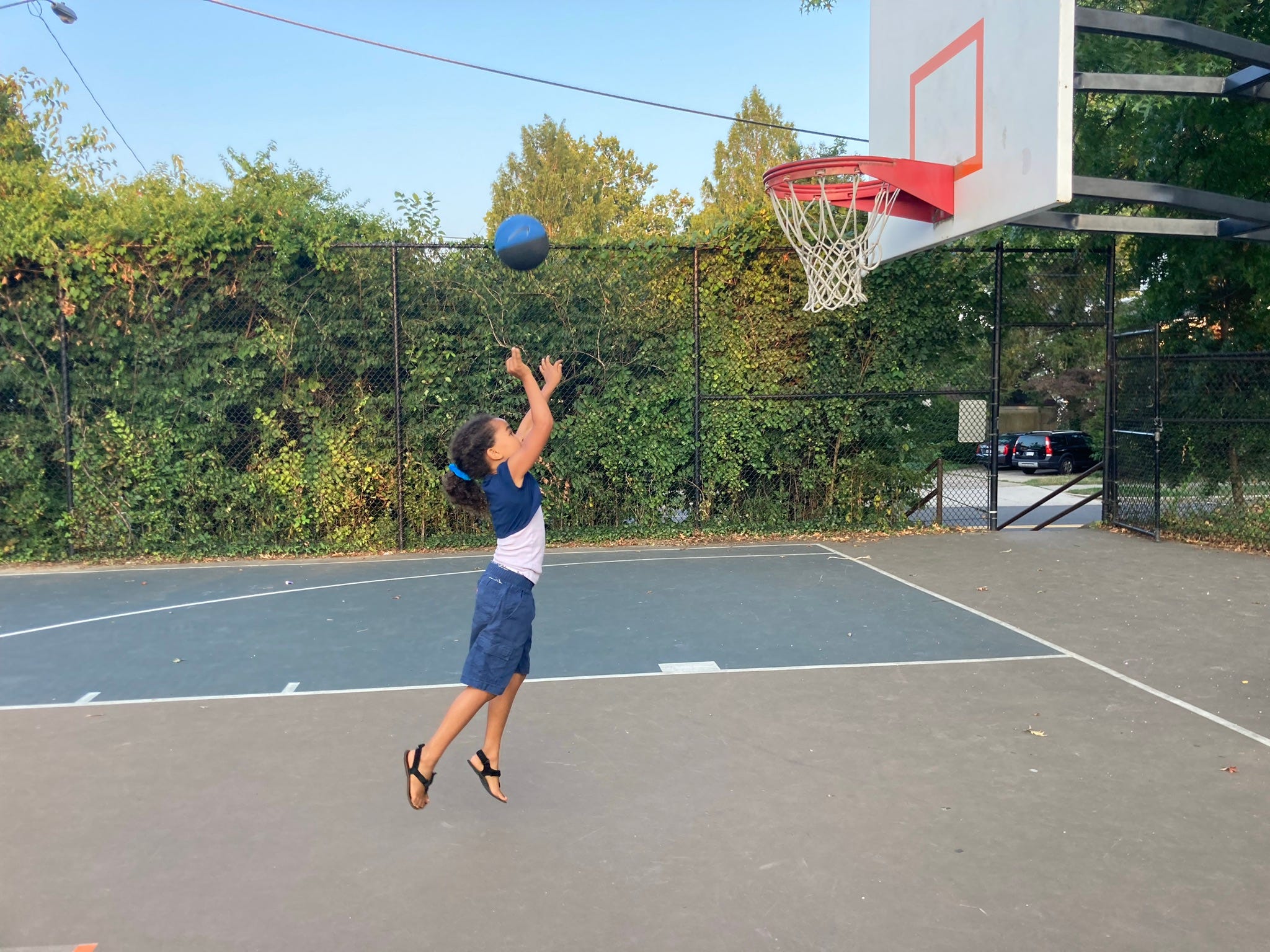
Yes, yes it is … but it doesn’t feel like it. There are three reasons for this. First, there is a LOT of scoring in basketball. So an intentional foul feels less portentous than a professional foul. Second, there is a LOT of scoring in basketball. People who love basketball generally find soccer interminable. The reverse also holds: basketball isn’t boring, not at all, but I have had a lot trouble really getting into it because there’s too much scoring. You don’t get the kind of drawn-out drama that characterizes American football, baseball, and soccer.2 Third, basketball has a much more stop-and-go quality than soccer. So penalties can be well calibrated to the crime: free throws, bonus rules, clear-path fouls, and take-foul penalties are much more exact than yellow cards, red cards, advantage rules, and stoppage time.

Time-wasting as a tactic
Time-wasting works in soccer for the same structural reason as the professional foul: time itself is a scarce defensive resource. A team with a lead can convert possession into minutes burned. Shielding the ball in the corner, slow restarts, goalkeeper delay, well-timed mysterious cramps — they all cut into the opponent’s remaining attacking opportunities while keeping the ball notionally in play. Stoppage time only weakly compensates, so the trade is predictable and repeatable. So wasting time remains central to match management.
American football looks similar on the surface but that collapses under inspection. Yes, teams manage the clock, but they do so through explicitly legal mechanisms: kneel-downs, runs up the middle, forcing the opponent to burn timeouts. There is no analogue to soccer’s grey-zone delay, because the rules precisely specify how time can be consumed and when the clock stops. You can’t just hang out with the ball or stall indefinitely inside a play. “Clock management” is part of American football strategy. But soccer’s time-wasting, well, that comes across to an American football fan as just more cheating.
Now, baseball doesn’t have a clock but something a lot like soccer’s time-wasting once almost killed the sport. Before 2000 or so, there was an unwritten rule against pitchers and hitters deliberately slowing the game. But as that taboo broke down — in part because computers showed that delay did in fact reduce risk — delay turned into a science. The hitter would dawdle to try to break up a pitcher’s rhythm, the pitcher would stand around or make endless pickoff attempts to cool a hitter’s hot bat. The whole game slooooooooooooooowwwwwwwwed down.
But once the league recognized that what had once been an idiosyncrasy had turned into a systematic tactic, they banned it. Poof, give the pitcher 20 seconds to throw the ball, limit pickoff attempts, make the batter get into the box quickly, and make the penalties severe enough that no sane person would run out the clock. And that was the end of that.
And basketball? Well it’s nothing like soccer, superficial resemblances to the contrary. There’s a shot clock. Once a team gets the ball, it has 24 seconds to make a shot. You can’t just exist with the ball. Moreover, when there is a timeout the clock stops one-for-one. No vague stoppage time.3 So teams manage the clock but within very tight constraints. Soccer has no equivalent. If the ball is in play, the main clock is running. That’s why go-slow tactics work.

But Americans have to get used to the deliberate delays. If you grew up with the sport, or learned to love it like I have, then you think of soccer as mostly continuous action; aren’t the American sports the ones with all the breaks? But it doesn’t seem that way if you’re new to the game. Soccer really is an acquired taste, like good beer or fine wine. Alla yous out there in the wider world think it’s just fun natchully. Nopety nope nope.
Screwing up as an offensive strategy
Okay, I really mean “setting up set pieces,” not “screwing up.” But to an American unversed in the ways of the beautiful game, deliberately screwing up is what it looks like.
In soccer, teams sometimes don’t try to score right away. Instead, they try to win corners or free kicks, which are special restarts near the opponent’s goal. These situations matter because everyone stops, lines up, and the attacking team gets to run a rehearsed play. In a corner kick, the offensive team gets to kick a dead ball right into a crowded penalty area where chaos favors the attackers. Fans recognize this immediately. When a player shoots into a defender and knocks the ball out of play and sets up a corner, it usually isn’t a mistake.
This only works because soccer allows restarts to be unequal by design. A foul near the goal or a forced clearance creates a moment where the attacking side has an advantage it didn’t have seconds earlier. Teams try to create these moments deliberately and repeatedly. It helps weaker teams to score and makes a tied late game start to look like everybody’s losing both their minds and their ability to play. They’re not! It’s part of the drama!
But it doesn’t read that way to an American sports fan.
The whole thing mostly doesn’t compute in baseball. What, you gonna deliberately hit a foul ball in order to … what? I mean, players sometimes do hit a whole bunch of foul tips instead of striking out, but that’s the opposite of a frantic mess and they certainly don’t look incompetent, even to somebody with little idea what’s happening. The hitter would genuinely prefer to get on base!

There is one situation where stuff like this would have made sense in baseball: the infield fly. That’s where a batter accidentally pops the ball up and it comes down in the infield, near the bases. A player should just catch the ball, one out, end of story. But if there is more than one opposing runner on base, well, then you might wanna deliberately let the ball hit the ground, pick it up, and then try to get both (or all three) of ‘em out. So baseball simply declared that if a pop-up is gonna hit the infield, it’s just an automatic out. No reason to incentivize a player to deliberately screw up.
American football once had a faint version of this in the onside kick. Normally, after a score, the ball is handed to the other team. The onside kick let a team gamble instead: kick the ball a short distance and try to recover it themselves. It was risky, but it created a special, high-stakes situation. Over time, the league decided this was too disruptive and changed the rules to make it almost impossible. That’s why set pieces remain key to soccer strategy — and why nothing quite like them survives elsewhere: the football and baseball created rules to kill similar tactics.
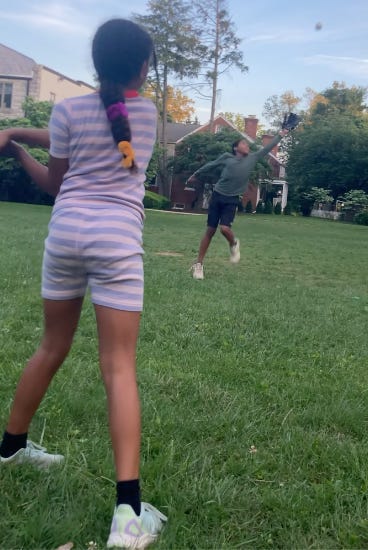
And basketball? Well, I know a young American lady who likes likes to watch soccer but plays baseball and loves everything about basketball. She told me that she dislikes soccer set pieces. They just seem “wrong.” So I asked her why and she said, “In basketball, a bad shot is just, like, a bad shot.”
The reason, once again, is the shot clock. In basketball, once a team has the ball, it’s got a fixed amount of time to do something with it. If you don’t shoot in time, the ball is automatically handed to the other team. That forces every possession to resolve itself. You just can’t deliberately fail in order to get a better kind of possession next. “A bad shot is just, like, a bad shot.”
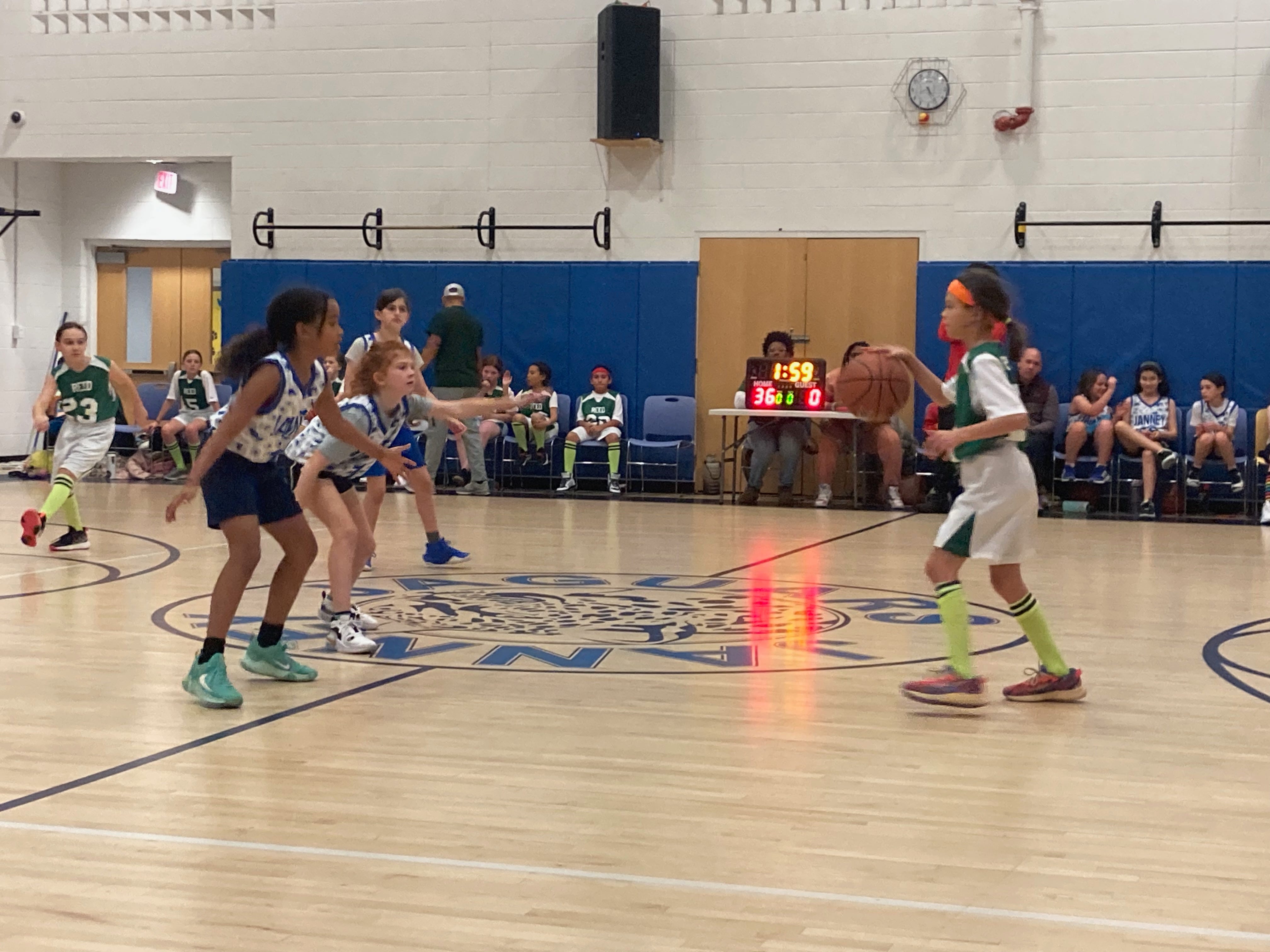
From a basketball perspective, deliberately shooting into a defender to win a corner looks like intentionally missing in order to get rewarded with a better chance. In basketball, if you throw the ball off a defender on purpose and it goes out of bounds, you usually lose the ball. You do not get to reset the play with an advantage. So the idea that “screwing up” can be productive runs directly against how basketball fans understand offense.
My old friend Scott just reminded me that there is one circumstance in basketball where bouncing the ball off a defender is accepted. Imagine the ball has just gone out of bounds, and your team has a player looking to pass it in. He has five seconds, but because the other team has five people covering his four teammates, he can’t find a decent passing opportunity. So he might deliberately try to bounce the ball off the lower body of the nearest defensive player hard enough to have it go out-of-bounds again. His team keeps possession and gets to try again. But it doesn’t necessarily lead to a better advantage and, in Scott’s words, “It’s a clever, athletic play: smart and fast.” To a basketball fan (hypocritically or not) that doesn’t seem like a screw up.

Set-piece hunting still feels perverse to basketball eyes … even ones that have already been seduced by the beautiful game.
The offsides trap
I have to mention soccer’s infamous offsides rule, right? If you’ve heard it all, then go ahead, skip down, just subscribe first, okay?
The offsides trap sounds like a trick but it’s really a powerful collective weapon that more resembles a dance than anything else. Properly executed, it really is beautiful, but it depends upon a rule that kinda sounds random if you don’t understand it.
Very briefly: the offsides rule means attackers are not allowed to receive the ball if they are closer to the enemy goal than the last defender at the moment the pass is played, not counting the goalkeeper. (The reason is that otherwise players would have an incentive to just hang around the goal waiting to kick something in and that would be boring. It’s kinda the equivalent of baseball’s pitch clock and infield fly rule.) Defenders exploit this by stepping forward in unison just before the pass, leaving the attacker suddenly — and illegally — ahead of play. The result is that an attack that looked alive is erased by timing and coordination alone, even though the ball was kicked into the goal.

If it works, the offensive play is invalidated even before it starts. It’s brilliant, sporting time travel, totally magical to watch. But if you don’t understand why the offsides rule exists, it just comes across as a random WTF thing, where a bunch of players make a strange forwards move and then that awesome-sauce goal you just watched is overturned by that weird dude at the end waving a flag.
Baseball once flirted with something that looked, from a distance, like an offsides trap: the defensive shift. Teams would stack fielders on one side of the field based on where a hitter was likely to hit the ball. Nothing illegal was happening. The pitcher threw, the batter hit, the ball was live. But the defense had moved in advance to where the danger was expected to appear. For Europeans, think of it as the back line sliding ten meters early, not to catch anyone offsides, but to smother the pass before it arrived.
But the shift differed from the trap because no time travel was involved. The offsides trap lets the defense say, “this move never existed.” The defensive shift only let them say, “this move is less likely to work.”
Hitters, see, could beat the shift. Wee Willie Keeler, a short professional baseball player from Brooklyn, explained how: “Hit it where they ain’t.”4 If the batter beat the shift, then he beat the shift. The shift changed probabilities and turned singles into outs more often than before, at the cost of making other hits more damaging. That is a fundamentally different mechanism from the offside trap, which erases the attack altogether.
Moreover, Major League Baseball (MLB) reacted once the shift became too common. It got to be that it was turning the game into one of outs and home runs with none of the exciting stuff in-between those two extremes, squashing the offense and confusing casual fans. So the league changed the rule to say that infielders hadda stay on their side of the infield until the pitch is thrown. Baseball saw anticipatory collective defense and put the kibosh on it. Soccer saw the same thing and made it a central feature of the game. (Not that I’d know how you’d get rid of it even if you wanted to — and I wouldn’t want to!) But it’s off-putting to Americans not raised on soccer.
Bottom of the ninth
I guess I should draw some deep conclusions here about the American character or the European spirit or whatever. Or do talk about a bunch about hockey. (Why don’t hockey fans automatically like soccer? Hockey players do the opposite of diving, man, and the game is like soccer on 50 milligrams of speed. Goddamned game has a position called the “enforcer.” I don’t need to say more.)

But no, I’m just gonna hope I’ve made my point, which is that soccer is a great great game, but there are real genuine structural differences that mean that an American just isn’t gonna automatically turn it on and like it.
I will conclude, however, with one deep point about a country that is neither the United States, nor in South America, nor Europe. Mexico, los Estados Unidos Mexicanos, is obviously the perfect country, sports-wise. They love basketball in Chiapas and Chihuahua, baseball is played from Cancún to Tijuana, the NFL is popular enough to consider giving the capital an expansion team, and I don’t have to talk about soccer. I’ve even seen people watch hockey and like it. Como México, no hay dos.
They just gotta start winning at something and not just playing it.
Even if I haven’t played it in — oh wow — eleven years.
An uncharitable observer — I’m looking at you, Jeff — would say this is really because I’m short. I’m no Alejandro Kirk (hurra, el Capitán!) or José Altuve (f—k Altuve) but they show that short guys can play decent baseball. My riposte is that I also like American football and I was never ever gonna get good at that, you schmuck.
Me, I love that soccer has vague stoppage time! Same reason I hate the robo-umpire and don’t even like video replays in baseball. The uncertainty is part of the fun.
Another short baseball star! Dude was 5’4”. That’s 163 for the rest of the planet.