

“It’s easier to imagine the end of the world than the end of the American Empire.”
—Daniel Bessner
Daniel Bessner is a tenured professor at the University of Washington and the author of Imperialist Realism: Politics and Culture at the End of the American Century. (And he’s from Rockaway, Queens!) I admire his work and often disagree with it. He has a Substack, and his penultimate post made me reconsider something I’d considered obvious: the United States is engaged in a Second Cold War with the People’s Republic of China (PRC).
That sounds like the Platonic ideal of intellectual exchange, right? Except it wasn’t. I had reservations that I thought weakened his overall thesis. The exchange that followed exacerbated my worries about the state of academia: its political homogeneity can leave even great scholars unwilling or unprepared to take on arguments coming from their right.1
I may be unusually sensitive to this because I have switched political teams several times. I learned new information, had circumstances change on me, or ran into stronger logical arguments. I was a Democrat (channeling my hippie parents and stepfather, despite the latter’s involvement in organized crime), then a Republican (disorganized crime in the 1980s, man!), a Democrat again (I’m fighting this war for what, exactly?) and now again a Republican (thanks to the Great Awokening and the Biden administration). The last shift is the only one where I can even partially claim, “I didn’t move, the party did.”2 Usually it was because I learned something or the world changed.
This has earned me no credit with some of my more-to-the-left friends. My friendship with Jeff Strabone — now professor of English at Connecticut College — survived my obnoxious use of the term “fucking egalitarian” when we were in high school together in the 1980s, but didn’t make it out of what I thought were comparatively mild disagreements about academia in the 2020s. That pains me. (Jeff! Gimme a call, man.)
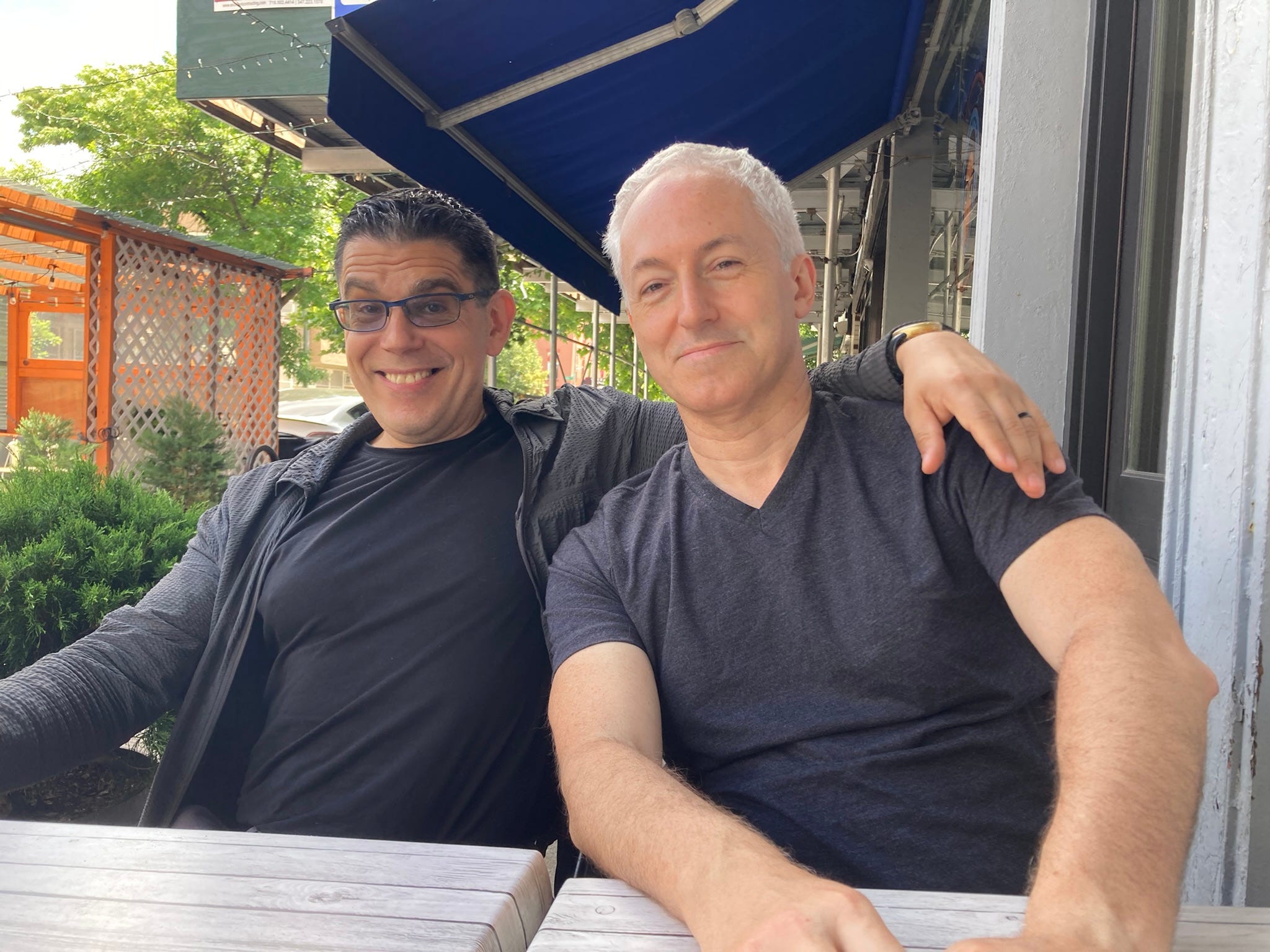
No matter how repellent a friend’s politics might become, I can’t imagine cutting off contact. Persuasion is impossible once you stop talking to one another. There are limits — if somebody takes up arms against the citizenry or the nation, then all bets are off — but disagreement alone shouldn’t be enough to end a friendship.3 Sure, she actually thinks that eating Irish babies is a good idea, but how am I gonna fight that by refusing to talk to her?
The weaknesses I saw in Bessner’s post were things that might cause people who didn’t share his priors to dismiss his arguments — Bessner is a socialist, and a real one, a Marxian “falling rate of profits” socialist. The man, to his credit, called himself socialist back when it was still a fighting word. But that could make him overlook flaws that would be more obvious to someone with different priors.
Here are the four of his propositions that I thought weakened his overall argument. (“Problematic” is a good and useful word that I refuse to use because it’s become bizarrely political.)
The “duck and cover” drills of the 1950s were intended as propaganda exercises, rather than to save lives. Bessner:
Though millions of children performed these drills, the U.S. government didn’t design them to protect America’s kids. Instead, they were created to persuade an exhausted population recovering from World War II that it needed to ready itself for another long war. The government, of course, knew the drills would do nothing to spare children’s lives. But scaring the shit out of everyone was a good way to keep the country motivated, alert, and committed to very high defense spending.
The Truman administration made serious nuclear threats, unlike modern states. Bessner again:
In the era of the duck and cover drill, the Americans were a genuine menace. President Harry S. Truman made a nuclear threat during the Korean War of 1950-1953, Secretary of State John Foster Dulles made one in 1954 when he warned the United States would resort to “massive retaliatory power” against an adversary if it felt it needed to, and President Dwight D. Eisenhower made one during the first Taiwan Strait Crisis of 1954-1955. But neither the United States nor any other nuclear state does that anymore. Trump’s occasional allusions to launching nukes are mere saber-rattling that even he doesn’t seem to take seriously. No one, not even our own mad king, wants to return to a world of escalating nuclear tensions.
The Cold War mobilization was largely manufactured rather than a response to a genuinely threatening adversary; civilian efforts weren’t serious but rather consisted of, well, buying stuff:
A struggle conceived in those terms made it easier to live a meaningful life in service of a grand and just project. Each time you bought your Borden milk, Armour hot dogs, and Coca-Cola at the grocery store, you were demonstrating the superiority of democratic capitalism over authoritarian communism. Every American was a participant in this war, every American was a soldier.
Those who argue that we are indeed today involved in a second Cold War do so for psychological reasons, mainly to assuage their own egos, or maybe guilt over having avoided real service:
When members of the foreign policy Blob, Ivy-League professors, and Silicon Valley titans pontificate about the world-historical stakes of the “New Cold War” with China, what they’re really doing, whether they know it or not, is making a not-very-convincing case for their own significance. Elites need to feel like soldiers, too, apparently.
Here is why I thought these points weakened his argument.
Point (1) hinges upon motive, which requires evidence. How does he know that the people who created the duck-and-cover drills thought they were only propaganda exercises? He didn’t present documentary evidence. I argued that the drills would save thousands of children’s lives — nuclear weapons aren’t magical, but have blast radii, known ancillary effects, and clear limitations. (I wrote about the limits of tactical nuclear weapons here.) Kids far away from a blast, particularly before the H-bomb, should look away and protect themselves from shrapnel. Why hook a strong argument that the current Cold War is “fake” to a weak argument that the response to the last one was fake?
Point (2) appears to be a tendentious reading of the historical record. The scene he refers to was a news conference after the Chinese People’s Liberation Army poured across the Yalu. The transcript is available and here it is:
Q. “Will that include the atomic bomb?”
THE PRESIDENT. “That includes every weapon that we have.”
Q. “Mr. President, you said ‘every weapon that we have.’ Does that mean that there is active consideration of the use of the atomic bomb?”
THE PRESIDENT. “There has always been active consideration of its use. I don't want to see it used. It is a terrible weapon, and it should not be used on innocent men, women, and children who have nothing whatever to do with this military aggression. That happens when it is used.”That doesn’t seem to support Bessner’s interpretation. Moreover, the Truman administration made it clear that it wasn’t a threat the very same day, putting out a press release that read:
The President wants to make it certain that there is no misinterpretation of his answers m [sic] questions at his press conference today about the use of the atom bomb. Naturally, there has been consideration of this subject since the outbreak of the hostilities in Korea, just as there is consideration of the use of all military weapons whenever our forces are in combat. Consideration of the use of any weapon is always implicit in the very possession of that weapon. However, it should be emphasized, that, by law, only the President can authorize the use of the atom bomb, and no such authorization has been given.
In addition, Truman fired General MacArthur when the latter insisted that we needed to use atomic bombs on the Chinese side of the Yalu to stop their advance and liberate North Korea.
And Bessner is wrong that modern states don’t make nuclear threats: India, Pakistan, the Russian Federation, and North Korea have all done so. India even uses the phrase “massive retaliation.” Once again, why hook a strong argument that the PRC is not a threat to a weak implication the USSR wasn’t one either?
Point (3) makes civilian participation in the Cold War sound superficial, but whatever else you think about the early Cold War, American sacrifices between 1948 and 1960 were anything but superficial. I wrote half of an entire post about that. More than one in every five men born between 1924 and 1934 signed up or was drafted to fight during the Korean conflict — not counting those in service when it started — and we kept conscription and high taxes for two decades thereafter. Bessner’s statements about Borden/Armour/Coke seem more aimed at the Bush administration’s post 9-11 exhortations to “go shopping” than anything that happened in the 1950s. Once again, if the argument is that the current “Cold War” is tepid herbal tea compared to the dark Irish coffee of the first one, then attaching an empirically incorrect statement denigrating the scale of the American people’s efforts to contain Communism in the 1950s only weakens the thesis.
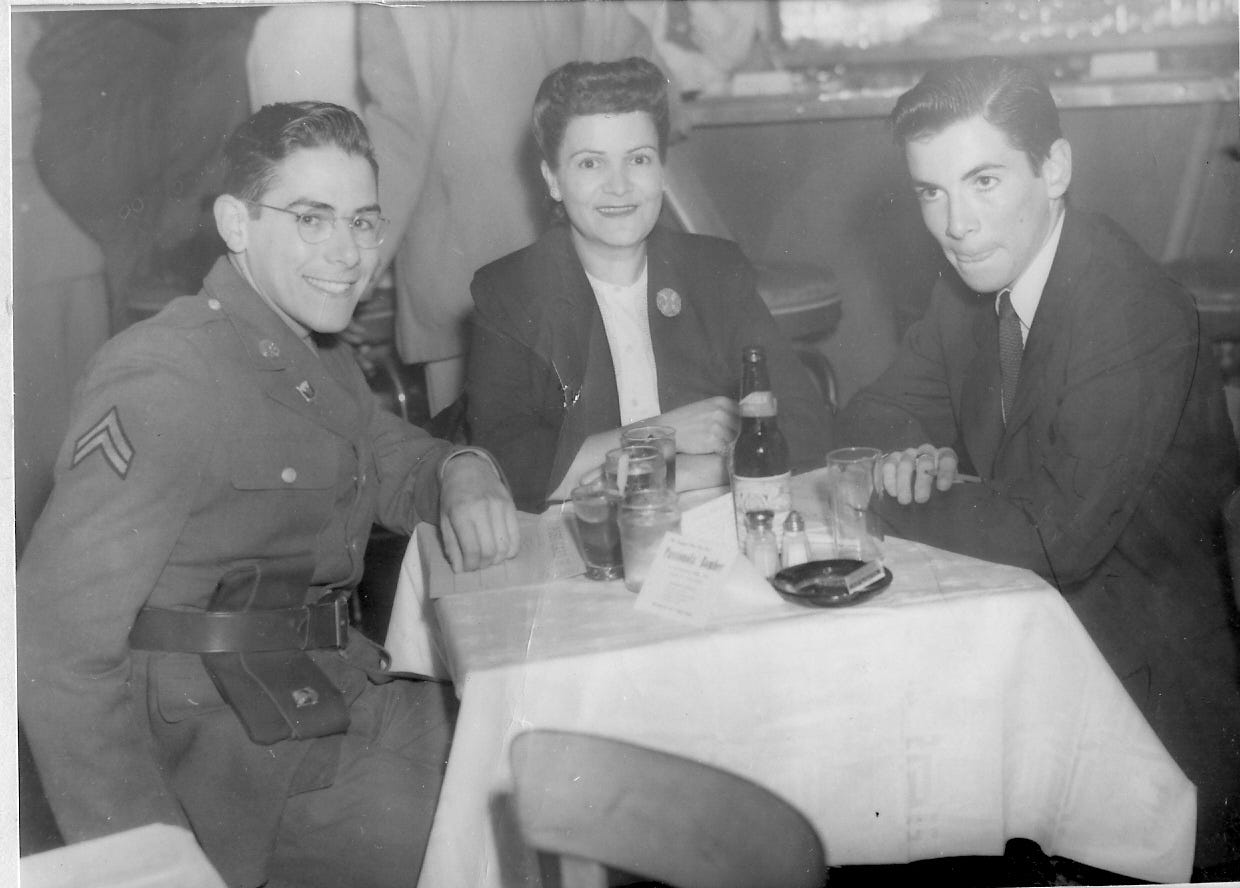
My father, my grandmother, and my uncle Norman — a typical American family between 1945 and 1965 His last point is about the motivations of people he doesn’t know making arguments that he doesn’t agree with.4 He can’t know what’s in their hearts. It’s a bad idea to cast aspersions on the motivations of people who disagree with you — and I was (until reading the essay) one of those people. Why make it harder for people to change their opinion by insulting them?
The reaction was not what I expected.
Hi Noel--thanks for responding, I can’t respond in super death [sic] but I’ll make some points.
1) I’m sure some people took duck and cover drills seriously. A lot of people didn’t and thought they were silly, because they were. Just because you were trained in the army doesn’t mean their social function in the Cold War wasn’t important to why they were instituted. I think you’re being too generous to the people who instituted these drills.
2) Truman still made a nuclear threat. That was aggressive, despite post-threat mitigating factors. Americans were consciously using nuclear blackmail even if they didn’t want to use nuclear weapons. The MacArthur point doesn’t really relate.
3) The Soviets were never prepared or interested in invading Western Europe. See Radchenko’s latest book.
4) I never said people don’t make nuclear threats. I cite Trump making a nuclear threat.
5) And you’re wrong in my opinion on who is responsible for the Cold War. It was the US. The Cold War was not “forced” on the US. The threat was very much exaggerated. The Cold War was an American choice. See here: https://www.theideasletter.org/essay/whose-fault-was-the-cold-war/
6) Psychological motivations aren’t trivial, they’re human.
I was a bit disappointed. I appreciated the courtesy, but he didn’t grapple with my points:
He didn’t have any evidence that the people who made the policy didn’t think that it would save lives. He categorically dismissed the evidence I mustered to show that the duck-and-cover drills were in fact useful. He simply asserted “because they were.” He added: “Just because you were trained in the army doesn't mean their social function in the Cold War wasn't important to why they were instituted.” A true point, but it wasn’t as if my argument consisted solely of an assertion of authority. I could be wrong; this isn’t how to show that.
I didn’t understand his rebuttal that Truman was “still aggressive.” I mean, he just wasn’t. You can read the news conference yourself.
It is true that the Soviets didn’t want to invade Western Europe. I don’t mean to be snarky when I say that the best evidence for the proposition is that they didn’t. Nonetheless, the main problem with his argument is that one of the reasons that they didn’t was that the United States stood ready to defend Western Europe, with atomic weapons if need be.
Bessner said this in the original post:
President Harry S. Truman made a nuclear threat during the Korean War of 1950-1953, Secretary of State John Foster Dulles made one in 1954 when he warned the United States would resort to “massive retaliatory power” against an adversary if it felt it needed to, and President Dwight D. Eisenhower made one during the first Taiwan Strait Crisis of 1954-1955.
But neither the United States nor any other nuclear state does that anymore. Trump’s occasional allusions to launching nukes are mere saber-rattling that even he doesn’t seem to take seriously. No one, not even our own mad king, wants to return to a world of escalating nuclear tensions. [bold face mine]
Am I being uncharitable?
Radchenko blames Stalin for the start of the Cold War. That doesn’t make Radchenko correct, of course, but it puts the burden on Bessner to show why he’s wrong. The review essay that Bessner pointed me to argues that Radchenko misinterprets his own evidence, but doesn’t discuss security dilemmas or the way Stalin went about securing his position: no mention of the Czechoslovak coup or the crises in Greece, Turkey, and Iran, let alone the Berlin blockade. It appears to assume its own conclusions.
Psychological motives are indeed human but it is presumptuous to state that people who disagree with you are motivated by a desire to pretend to be soldiers rather than genuine disagreement. It’s a circumstantial ad hominem, focused on the putative motives behind an argument rather than the substance of the argument itself. And it’s unnecessary, because Bessner’s overall thesis about Cold War II is quite strong.
The next go-around didn’t get much further. Bessner said that Herman Kahn, the famous author of On Thermonuclear War, denigrated the duck and cover drills. I asked him for evidence that Kahn had said that. He replied, “The Kahn reference is a gloss on where he advocated for serious civil defense like underground bunkers and heavily criticized the Eisenhower admin for what he considered inadequate civil defense measures like d and c.”
I pointed out that it was quite the jump from “Kahn thought 1950s civil defense was inadequate” to “Kahn thought 1950s civil defense was useless.” I said, somebody might think that a 65-mph speed limit doesn’t go far enough, but it would be silly to conclude that said person also thought 65-mph speed limits were useless.
I got this message: “I said he didn’t take them seriously also I’m done responding”
This is not the response I would expect from a scholar accustomed to serious pushback. I could be wrong about how much intellectual challenge Bessner normally encounters from his right — the University of Washington actually has a lot of political diversity. Nonetheless, Bessner didn’t engage the substance of what I wrote. The closest was when he pointed me towards a review essay that assumed its own conclusion.
This isn’t the first time that I’ve been dismissed by somebody on the “opposite” side of the political spectrum. A few weeks before this exchange, Brad DeLong responded to a post of mine about the Supreme Court’s recent decision affirming the unitary executive theory. Ironically, Brad and I agree that it would have been better and more constitutional had the decision gone the other way. I just didn’t agree that it showed a “highly, deeply corrupt” Supreme Court that laid down decisions that were “NOT THE RULE OF LAW.” He went on to say, “PRETENDING THAT THAT IS WHAT IT DID IS, I THINK, BENEATH YOU.” [Capitals his.]
I gave him a point-by-point response explaining why I disagreed, including what evidence would change my mind. Brad didn’t answer any of it.
Instead, in a separate comment, he seized on a throwaway line where I admitted that I thought Roe v. Wade was badly decided, an opinion I share with the late Ruth Bader Ginsburg.5 First, he told me that the Founding Fathers had written the Ninth Amendment because they anticipated “people like you.” Then he informed me that he was “not persuaded or impressed” and said that the real answer to “what’s wrong with the reasoning in Roe v. Wade?” was that “some people do not like the outcome.” He stated that Roe v. Wade flowed ineluctably from the premises that this is a free country and abortion is a medical procedure. Then came a discursion into miscarriages, failed implantations, IVF embryos, ovulations, twenty billion male orgasms, and a discussion of people who think that women who use IVF ought to be hanged.
My objections to his argument that John Roberts was staging a partial coup got lost in a farrago of abortion arguments and what came across as veiled insults. I wrote an angry response and decided not to post it. The line that best captures my reaction was this: “One reading of your intellectual strategy is that you agree with my counterpoints but cannot possibly cede the table to someone you consider guilty of ideological ungoodthink.” That was written in anger, and it was almost certainly unfair. But it is how he appeared to approach me, as someone unworthy of actual engagement beyond some drive-by pot shots.
Now, Professor Bessner didn’t come within a light year of Prof. DeLong. But I can’t help comparing both exchanges to a discussion I had with the great A.G. Hopkins, who contacted me to try to reconcile my interpretation of the Cuban revolution with the rest of the literature. Prof. Hopkins and I probably do not share similar politics — I say “probably” because there’s much I agree with in his latest book — but neither of us would have known that from our discussion.6
It struck me as symptomatic of a problem in academia: outside economics and political science (but very often there as well!) scholars generally encounter relatively little serious criticism from other credentialed scholars to their right. By “criticism” I mean the normal panoply of academic tools used to get at the truth: arguments over falsifiable claims, concrete evidence, and the bounds of reasonable interpretation. The impulse, therefore, can be to dismiss arguments from the right flank rather than do the work of refuting them.
That’s not because “conservative” arguments are necessarily strong! It is because too few scholars expect professional criticism from that direction. Changing one’s mind is always personally and professionally hard, but changing one’s mind to the right brings an additional social cost in modern academia.
As I said, I’ve changed political teams more than once, and in more than one direction.7 In other words, while I can empathize with someone who formed fixed political beliefs when young and stuck with them, I can’t sympathize — especially not when you’re an associate professor with tenure.
To return to where we started, I like and respect Bessner’s work. The particular essay in question made me rethink some basic assumptions — and one of his newer posts is genuinely brilliant. But his responses were superficial and dismissive. He suggested that an academic conference would have been a better venue, but we don’t go to the same conferences, as much as I would love to see him in St. Louis this fall. In a world of limited resources, it’s disingenuous to suggest that the only way academics should interact is at large in-person meetings. In addition, it implies that he thinks of his Substack as a one-way means of communication, something far removed from the idea of an electronic “Republic of Letters,” in which people trade ideas.
My insights were fairly banal. What bothers me is that he didn’t take them seriously, tossing off asides as if they really mustered evidence or pointed out contradictions. And in my case, he can’t argue that I’m just an internet gadfly with no relevant credentials to discuss the Cold War.
Perhaps I am wrong that this is all a sign of scholars treating their premises as epistemically closed when they are not. As a (liberal) colleague pointed out, an alternative hypothesis is that they feel that they feel free to be rude because I’m not in the same ideological tribe. Or perhaps because I haven’t achieved the same heights of academic achievement. I’m not sure that’s much better — all I can say is that it didn’t occur to me until somebody else mentioned the possibility.
Or I could be wrong about the substance of the issues! That’s completely possible, maybe even probable. But I wouldn’t think that’s a reason to be dismissive, or in Brad’s case, dismissive and insulting.
But it might also be that these exchanges are indicative of a deeper problem that academia still hasn’t fully acknowledged.
Or maybe they’re just more willing to be rude. A liberal colleague of mine told me not to dismiss that hypothesis.
In another country that wouldn’t have to happen. Oh, wait, I vote in another country! And in Dutch elections, I pretty much always find myself voting for the Christian Democrats.
If you’re gonna push me on this, I would have fought a friend who joined the SS, but I also hope that I would have forgiven him afterwards.
To be fair, I regret having left the Army reserves, as many people who know me will affirm. So Bessner might be right about me! I really do wish that I were still a soldier! But it seems strange to attach that motivation to people you’ve never met, just because you think it somehow weakens their argument.
Our reasons are quite similar, although Ginsburg thought that you could find the right to an abortion in the Fourteenth Amendment, which seems strained to me. Reasonable people can disagree, I think.
His book is the single greatest work ever written on the American empire, by the way, and I do not mean that as hyperbole.
The advent of A.I. has pushed me back towards the left in recent years, along with, uh, Josh Hawley and Marco Rubio. When the principals of Bridgewater Associates share your leftward lurch, you gain some confidence it may be grounded in new realities rather than personal predilection or ideological flightiness. In other words, if hedge fund managers can move to the left, then I think that Prof. Bessner should be willing to abandon some of his beliefs.
The irony is that Bessner was a regular on Bloggingheads; the projects whole raison d’etre was bringing scholars and intellectuals from different sides of the aisle to do video conversations with each others
Look I'm just an internet gadly with no relevant credentials, but I stopped taking leftist academics seriously a long time ago.
The Occam's razor for their incomprehensible behavior is that they're uninterested in historical, scientific, and moral truth.