

In my day job, I spend a lot of time thinking about regulation. How are they made, why they’re legal, what can the executive branch do with a vague law and what can’t it do. In fact, when I was but a wee lad — okay, fine, a teenager who hid his nerdiness under a very aggressive exterior — the whole idea that an executive agency could pass a law by calling it a “regulation” bothered me, but I was equally bothered by the idea that bandwidth limits would make Congress unable to regulate private actors. In other words, I have been thinking about this very abstruse issue since well before I started teaching MBAs and executives about energy regulation. It’s enough to make me think sometimes that I should have been a law professor.1

So when the New York Times gets something wrong and unfairly impugns the Supreme Court, I sit up and take notice.
This piece goes as follows. First, it points out where Kate Shaw in the Times was being disingenuous about the Court—her example does not show any “unshackling” of executive power at all. Second, it explains the recent SCOTUS decision establishing the “unitary executive.” It’s a revolution in 149 years of constitutional practice, but won’t be the end of the world, especially if Congress does its job. Finally, it points out that the decision exempting the Federal Reserve from the unitary executive makes zero logical sense and is really badly argued … but does make sense if you start from the principle that the Court is afraid of sowing chaos and really does have no faith that Congress will step up to the plate.
SCOTUS has been consistent until now
On January 26th, Kate Shaw wrote in an editorial titled “Why Is the Supreme Court Unshackling the Presidency?” that while SCOTUS used to check Trump 45 it has been “unshackling” Trump 47 and letting it do whatever it wants. Her main exhibit is the putative contrast between the Court’s 2020 decision to stop the first Trump administration from unilaterally terminating Deferred Action for Childhood Arrivals (DACA) and its 2026 decision to allow the second Trump administration to unilaterally withdraw permission to stay in the United States from Syrian refugees.
This is not fair! These are not like things! SCOTUS is being consistent! Don’t do stuff like this Professor Shaw! America begs you.
Suspending DACA violated the Administrative Procedures Act of 1946
In 2019, the Trump administration decided to end the DACA program. Since it had been created by an Obama-era memorandum from the DHS Secretary that told ICE agents to exercise “prosecutorial discretion” when deciding whom to deport (given that the agency’s budget wouldn’t let it deport everyone), nobody doubted that the next administration could terminate it.
The problem was that the Administrative Procedures Act of 1946 (APA) sets out a slew of requirements that all “agency actions” must follow. Note the term “agency action”: these requirements apply to any action, whether it be setting up new procedures (which the Obama administration did with DACA) or repealing them (which the Trump administration tried to do).
The key requirement is here:
To the extent necessary to decision and when presented, the reviewing court shall decide all relevant questions of law, interpret constitutional and statutory provisions, and determine the meaning or applicability of the terms of an agency action. The reviewing court shall
compel agency action unlawfully withheld or unreasonably delayed; and
hold unlawful & set aside agency action, findings, and conclusions found to be-
arbitrary, capricious, an abuse of discretion, or otherwise not in accordance with law;
contrary to constitutional right, power, privilege, or immunity;
in excess of statutory jurisdiction, authority, or limitations, or short of statutory right;
without observance of procedure required by law;
unsupported by substantial evidence in a case subject to sections 556 and 557 of this title or otherwise reviewed on the record of an agency hearing provided by statute; or
unwarranted by the facts to the extent that the facts are subject to trial de novo by the reviewing court.
Congress passed the Administrative Procedures Act specifically because it was a little disturbed about the amount of regulatory discretion that it had handed off to executive agencies under the New Deal.
Given that the Trump administration didn’t even try to justify its actions when repealing DACA, SCOTUS correctly told it to go back to the drawing board. Note that the Administrative Procedures Act explicitly allows for judicial review and lets the courts interpret the bars to get over requirements (a) and (f).
Ending protected status for Syrian refugees violated no laws at all
The decision on Syrian refugees is not like this! None of this stuff applies! None of it!
The Department of Homeland Security (DHS) can grant “Temporary Protected Status” (TPS) to aliens under the Immigration Act of 1990.2 If you get TPS, you also get a work permit and freedom from deportation. Great! But granting or repealing TPS is not an “agency action” and it is not subject to judicial review. Don’t believe me? Well, go to Section 1254a, Subsection (b), Paragraphs 3 and 5 of the current version of the Immigration Act and see for yourself:
8 U.S.C. § 1254a(b)(3): At least 60 days before end of the initial period of designation, and any extended period of designation, of a foreign state (or part thereof) under this section the Attorney General, after consultation with appropriate agencies of the Government, shall review the conditions in the foreign state (or part of such foreign state) for which a designation is in effect under this subsection and shall determine whether the conditions for such designation under this subsection continue to be met.
8 U.S.C. § 1254a(b)(5): There is no judicial review of any determination of the Attorney General with respect to the designation, or termination or extension of a designation, of a foreign state under this subsection.
In short, Professor Shaw is being disingenuous when she says that SCOTUS is behaving differently in 2026 than it did in 2020. That is simply not true! DACA was an agency action that required establishing new procedures; both it and its repeal were subject to APA requirements and judicial review. But TPS is a straight-up delegated authority to an executive agency that can do whatever the hell it wants to do as long as it gives 60 days notice.
Abolishing independent agencies isn’t a specious idea
This brings us to the more recent decision to abolish independent agencies (except, oddly, the Federal Reserve).
The decision rests on three pillars.
The first is the opening sentence of Article II of the Constitution: “The executive power shall be vested in a President of the United States of America.” SCOTUS just interpreted that sentence to mean that once Congress has passed a law, it cannot hand its enforcement over to anybody but the President or an official whom the President can remove at will.
The constitutional convention of 1787 could have written something like the many state constitutions of the time that openly split up executive powers among several officials. (Most state and territorial constitutions still do this — only Alaska, Hawaii, New Jersey, Puerto Rico, and the USVI resemble the federal government.) So the fact that they failed to divide executive power in the constitution means that they didn’t want to allow Congress to limit executive discretion in the future.
The Decision of 1789, in which Congress inserted the following language into the act creating the Department of Foreign Affairs (now State):
That there shall be in the said department, an inferior officer, to be appointed by the principal officer thereof, to be employed therein as he shall deem proper; and to be called the chief clerk in the department of foreign affairs; and who, whenever the said principal officer shall be removed from office by the president of the United States, or in any other case of vacancy, shall during such vacancy have the charge and custody of all records, books and papers appertaining to the said department.
Italics mine. In that sentence, goes the logic, Congress acknowledged that the President had the right to fire cabinet officers even though they had been independently confirmed by the Senate. And it is true that James Madison argued exactly that on the floor of Congress:
If the constitution has invested all executive power in the president, I venture to assert that the Legislature has no right to diminish or modify his executive authority.
The logic is entirely self-consistent. It’s also very weak. Alexander Hamilton, for example, switched positions on the issue between writing as Publius in 1787 — it doesn’t get clearer than “The consent of that body [the Senate] would be necessary to displace as well as to appoint” in Federalist #77 — and writing as Pacificus in 1793. And in 1789, Congress never explicitly decided the issue; rather, it punted. Moreover, over time SCOTUS switched back and forth; there was no clear precedent from the early Republic.
It comes down to whether you think James Madison is dispositive on the issue. Me, I tend to think that Alexander Hamilton, trying to get people to ratify the Constitution, should be the real authority — either that or you gotta believe that the Constitution was ratified under false pretenses.
But “weak” doesn’t mean “specious.” The decision really is defensible and not obviously wrong. If you read anybody hyperventilating about a SCOTUS coup or calling them hypocrites, ignore them.
Or at least until we return to the issue of the Federal Reserve, below.
But “not specious” is entirely consistent with “not good”
Still, this is not a good idea. It won’t be the end of the world, but it doesn’t solve any problems.
Over time, the executive branch has accrued more quasi-legislative authority. This has been unavoidable. Congress can’t write a new law every time, say, somebody discovers that a new substance hurts human health or a financial institution figures out some new kind of product. But it can pass laws stating the conditions under which a substance should be limited or a financial product banned or whatever, letting the executive make the determination subject to Congressionally-determined procedures.
Congress, reasonably, didn’t want to hand all these new powers over to the President with no limit. So it did two things. The first was the “legislative veto”: when Congress granted new powers to the executive, it reserved the right to overturn those decisions with a majority vote.
The second was the independent agency, starting with the Tenure of Office Act of 1867, which restricted the President’s power to fire particular executive officers. Congress repealed the Tenure of Office Act in 1887, but that same year it created the Interstate Commerce Commission, which the President could not order around or threaten to remove.3
We’ve been doing this for 149 years, which is a long time.
And then SCOTUS threw a wrench into American practice. Twice. First, in INS v. Chadha (1983) it declared that the exercise of the legislative veto was the same as the passage of a law, so the President could veto Congress’s veto. This is why President Trump could declare all these emergencies and Congress can’t do anything about it even when a majority is willing.
Second, well, that happened yesterday.
It won’t be the end of the world. In fact, you can make a case that it will increase political accountability. It won’t be a free-for-all, the APA will still exist. And if Congress really wanted to, it could probably get away with quasi-privatizing some agencies that would probably allow for regulation outside presidential interference: the FAA comes to mind as a potential example.
But it does open opportunities for political pressure and favoritism and it does strengthen the executive at the expense of the legislature. I’m an energy guy, so let me give a few examples where Presidential control of the Federal Energy Regulatory Commission (FERC) would have led to a different outcome:
2001 electricity price caps: When rolling blackouts hit California, the state wanted to impose price caps to eliminate the incentives that power producers had to strategically take generators offline in order to spike power prices. President Bush was not a fan of the idea. Nonetheless, FERC allowed the price caps, and the administration reluctantly went along with the idea. Under the new regime, the Bush administration might have (mistakenly, IMHO) ixnayed the caps and prolonged the crisis.
2016 Jordan Cove LNG project: The Obama administration okayed the Jordan Cove project to export LNG outside North America in 2014, but FERC vetoed the project in 2016. Under the new regime, the project would have probably (and correctly, IMHO) opened on time with President Obama’s imprimatur.
2018 coal subsidy rule: In 2017, Energy Secretary Rick Perry sent FERC a proposed rule that would have mandated that power plants that could keep more than 90 days fuel on-site (e.g., coal and nuclear plants) would be able to sell their electricity on wholesale markets at cost-plus prices before any other cheaper sources could dispatch their power. FERC unanimously killed that idea on January 8, 2018. In the new world, that (terrible, IMHO) rule would have gone through once all the procedural t’s had been crossed.
2024 LNG export pause: The Biden administration “paused” all new LNG export applications in January 2024. In a 2-1 vote, however, FERC approved the construction of the Calcasieu Pass project on a 2-1 vote. Now, the DOE could still deny the export permit, but that would be hard to do once billions of dollars had been sunk into the project. In today’s world, the Biden administration could have kiboshed the whole thing.
In the first three examples, FERC stopped two (bad) Republican ideas and one (good) idea from a conservative Democrat.4 In the last example, it threw sand in the gears of a (bad) Democratic idea. The decision gives a lot of authority to President Trump. It also gives a lot of authority to a future President Ocasio-Cortez, which should give anyone happy about the decision a lot of pause.
In short, it’s a not-great idea. The logic is solid, but not uncontestable — the opposing case is also quite strong. It solves no problems and creates quite a few. It is also a departure from 149 years of American practice, so as a small-c conservative I really can’t condone it.
But like I said, with some creative legislation, Congress could bring back the old way. Frex, the legislative branch could create notionally “private” regulators and then use some creative methods (say, via the tax code) to force regulated companies to “voluntarily” affiliate with the regulators.
Only to do that, Congress would have to be creative and focused. Uh … I guess that could happen? Still, I wouldn’t put money on it.
Which brings us to the Federal Reserve
And now we come to the Supreme Court descending into incoherence because the implications of its own principles scared itself. Not because those principles are scary, but because the combination of those principles with a Congress that’s forgotten how to legislate on controversial matters is terrifying.
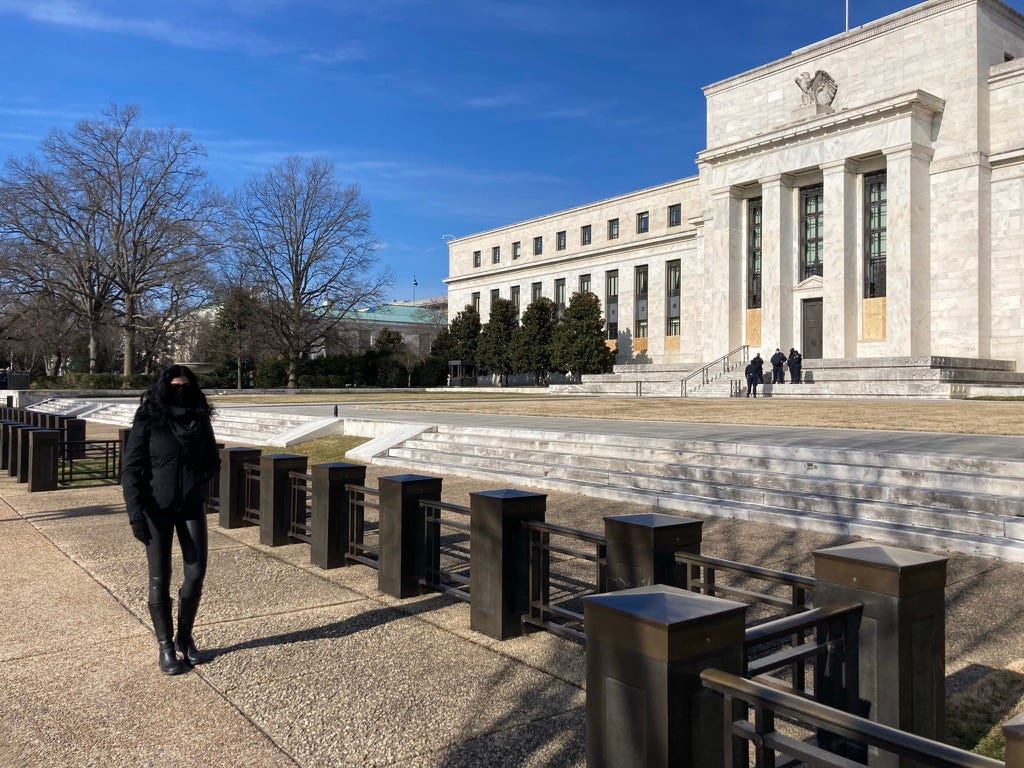
The Supreme Court majority upheld the independence of the American central bank, but only by waving their hands really fast and hoping no one would notice. Only Clarence Thomas, Brett Kavanaugh, and Amy Coney Barrett all did notice, albeit in very different ways.
The majority based Trump v. Cook on a bunch of precedents which involved government-chartered banks that carried out some of the functions of a modern central bank … but only some. The Bank of North America predated the Constitution, so I’m unclear on why it’s a precedent. The First and Second Bank of the United States carried out some central banking functions, but they did not exercise direct regulatory authority over the banking system.
The decision gets down to the main issue on page 22. The Court recognized that the Federal Reserve has a direct regulatory authority over financial institutions that have not voluntarily affiliated themselves with the Federal Reserve System. In his dissent, Justice Thomas uses that point to logically apply the doctrine of executive unity to invalidate the whole idea of central bank independence. In fact, Thomas’s reasoning is a lot like the reasoning that I laid out in Saving the Federal Reserve from the Unitary Executive.
The majority opinion, however, just waved its hands really fast. They don’t grapple with any of the issues Thomas raises. Instead, the majority waves its hands in a word salad that reminds me far too much of Roe v. Wade:
It is true, of course, that this tradition has not stood still; as JUSTICE THOMAS notes, the Federal Reserve is more powerful than its predecessors, managing a vastly more complex economy in a vastly more complex world. (In upholding the constitutionality of the Federal Reserve as currently structured and with its existing enforcement authorities, we do not suggest that Congress could assign the Federal Reserve additional regulatory powers that are attenuated from monetary policy.) We see no reason, however, why our central bank ought to be “trapped in amber” any more than any other aspect of our constitutional scheme. What matters is that the Federal Reserve remains “consistent with the principles that underpin” the First and Second Banks — namely, that monetary policy should not be subject to political interference. In our view, the Federal Reserve maintains the “balance struck by the founding generation” under “modern circumstances.” We thus look to history not as an end in itself, but (as we often do) to give “essential content to undefined provisions in the frame of our government.”
What does that even mean? It’s a word salad.
The parenthetical comment sort of dances up to the issue, which is that if you believe in the unitary executive then you can justify an independent central bank, but you simply have to strip said bank of some of its regulatory functions or figure out a new way to force all private financial institutions to “voluntarily” affliate with it. It’s not Mission Impossible! But it’s a job that SCOTUS seems to have been afraid of asking Congress to carry out. Instead it gave us a decision that makes no real sense.
I’m going to shamelessly toot my own horn, because my analysis actually dives into what the Fed does, unlike the terrible SCOTUS decision. Most legal analyses that purport to do the same thing actually don’t, or rely on their own idea of what the “unitary executive theory” should mean.

Justice Kavanaugh’s concurrence is at least honest that the reason why he supports the decision is simply the chaos that any other decision would create. Not only would markets panic, but you’d remove the guardrails stopping presidents from, say, financing their pet projects by printing money.
Justice Barrett, meanwhile, writes the best opinion in her concurrence. “The constitutional status of the Federal Reserve is entirely outside the scope of this case. The Government expressly waived any constitutional challenge to the removal restriction, so the parties did not brief it.” She pokes holes in the decision, mocks its brevity, points out all the questions it begs, and then ends by reminding the reader that the Court could have stopped the administration from summarily firing Lisa Cook without saying anything about the Fed’s constitutional status.5
In other words, it’s kinda nice that they left the Fed alone, but the decision really makes no sense. Either you gotta somehow finagle the Fed’s regulatory power or you gotta dump the unitary executive idea. But, hey, consistency is the hobgoblin of small minds and nobody trusts that Congress would be able to fix the problems that would arise from a consistent application of the unitary executive principle. That’s not because the problems are unfixable, it’s because nobody trusts Congress to do its job.

And that, ultimately, is America’s real problem.
With some reasonable exceptions, I’m pretty sure that I would have been a textualist. One of the exceptions would be when the writers of a bill made it pretty clear that they were just using throwaway language — and that’s the subject of this post.
The written law states that TPS authority lies with the Attorney General, but Section 557 of the Homeland Security Act of 2002 transferred that authority to the Secretary of Homeland Security. That change just didn’t automatically rewrite the rest of the U.S. Code.
And other countries learned from our mistakes! The Argentine Constitution of 1853 (still in effect) was written as such a carbon-copy of the American Constitution of 1787 that its Supreme Court used our Supreme Court decisions as precedents. Nonetheless, the Argentines deliberately inserted two clauses that codified what was then American practice:
Article 83, Section 2: “[The President] issues the instructions and regulations necessary for the execution of the Confederation’s laws, taking care not to alter their spirit with regulatory exclusions.”
Article 83, Section 10: “[The President] appoints and removes ambassadors and Chargés d’affaires,with the consent of the Senate; and he alone appoints and removes cabinet ministers, departmental officials, consular agents, and other administrative employees whose appointment is not otherwise regulated by this Constitution.”
It isn’t clear to me that Argentina benefited from Article 83.
I am not going to try to peer into President Obama’s heart, but he governed fairly conservatively. The stimulus was too small for the crisis, and it was President Nixon who declared “we are all Keynesians now.” His energy policy was “all of the above,” at least until 2015. His health care policy had been invented by Mitt Romney. The big exceptions were executive order 13583, executive order 13672, and the Clean Power Plan. Pretty much everything else, including Obamacare, would have fit comfortably into the Eisenhower, Nixon, or GHWB administrations.
Gorsuch and Alito make a similar dissent but in a more roundabout and less readable way.
Noel—
Slaughter is a strange kind of partial coup—and one that, for no good reason, hands a lot of power over the next two and a half years to a highly corrupt chaos monkey. It is not the ruke of law.
The Slaughter decision really is obviously wrong, and it is not defensible.
The ICC was established on February 4, 1887. Ever since then, "independent" agencies have been a thing: the Congress has delegated a portion of its power to legislate to agencies that fall under the executive branch, under the condition that those agencies have a technocratic board nominated by the president and confirmed by the Senate, that is insulated from the president's momentary whims.
Now you can argue that this mixture of powers that Madison does not anticipate is bad institutional design. But 140 years of political negotiations about making relatively win-win deals between factions and interests have been carried out under the shadow of that doctrine.
Now all of those deals have been upset, and extraordinary amounts of additional power have been handed to someone who can only be truthfully described as a highly corrupt chaos monkey.
THAT IS NOT THE RULE OF LAW.
A Supreme Court that wanted to do an institutional reform job would have structured things very differently. It would have done something like what it did in Brown v. Board of Education. It would have announced what it had decided the law was going to be going forward. Acknowledged that that was a big change, and told everyone to bring their arrangements into conformity with the new state of the law "with all deliberate speed". It would have told Congress to get to work revising which powers that independent agencies currently exercise would be reclaimed by the Congress and which ones handed over to the new, unitary executive. It might have set a deadline.
**THAT IS NOT WHAT THIS HIGHLY, DEEPLY CORRUPT ROBERTS COURT DID. THAT IS NOT WHAT IT DID AT ALL. PRETENDING THAT THAT IS WHAT IT DID IS, I THINK, BENEATH YOU.**
Thanks much. Hope you and yours are well, or, rather, as well as one can be in a world in which while one may well be, personally, quite comfortable, we live in a world in which no man is an island.
Yours, J. Bradford DeLong
Professor of Economics, Emeritus, UC Berkeley
brad.delong@gmail.com <https://braddelong.substack.com/about>
> **Noel Maurer**: '“Weak” doesn’t mean “specious.” The [Slaughter] decision really is defensible and not obviously wrong. If you read anybody hyperventilating about a SCOTUS coup or calling them hypocrites, ignore them...
<https://www.noelmaurer.com/p/unitary-except-at-the-fed> <https://braddelong.substack.com/p/i-am-glad-lisa-cook-rightly-gets>
Yes but Griswold follows on from decisions in the 1920s about the privacy of family and rights for raising children. It goes deeper than the propaganda Clarence Thomas puts out.
You're liberty isn't compromised by your children, you can give them up for adoption, and before adoption systems, the child was free to be abandoned into indentures labor.
US courts have consistently upheld the fact that no one is inherently obliged to physically support the life of another. That's why both a fetus BEFORE independent viability and say, someone dying if cancer with no money, do not have a right to life. Neither of them are viable on their own without a willing donor. It's because else would have to give free money, time and resources comrpomising on their constitutional liberty.
Striking down Roe V Wade would require a fundamental reset of how the US views obligations to life compared to liberty. The US has a lower life expectancy than other countries exactly for this deep rooted tradition that someone's liberty cannot be constrained at the expense of supporting life.