

I was a bit dumbfounded when we went to war with Iran earlier this year. It wasn’t just that the United States launched airstrikes — the Twelve Day War of 2025 hadn’t fazed me — it was the resemblance to Pearl Harbor. Just a bolt out of the blue. I’m not alone: Andrew Sullivan went so far as to tell Megan McArdle that the sneak attack on Iran meant “the end of the Republic.”
My first thought was that Sullivan was overreacting. You might not like that Congressional authority over warmaking has dissipated, but it happened a long long time ago, I can still remember when. The scale of the miscalculations may be new, but the fact of a president unilaterally taking the United States to war is not. Calm down, Mr. Sullivan!
Then I started to write this. And I changed my mind.
Is Gulf War III a watershed?
To my surprise, I have to say yes. Let’s work backwards. We’re looking for a substantial war initiated by the president against a recognized foreign government, without an immediate provocation, Congressional authorization, or allied consultation.
The war with the Islamic State
The Obama administration (and later President Trump) conducted a fairly intensive air campaign against the Islamic State in Syria, Iraq, and Libya. Ground forces were also involved, particularly in aiding the Iraqi military. President Obama went to Congress in 2015 and asked for an authorization to use military force. When Congressional refused to act, the administration went ahead anyway, arguing that the 2001 authorization that allowed the U.S. to go after any entity or state involved in the World Trade Center and Pentagon attacks.
That said, there is clear and direct evidence that Thomas Jefferson himself would not have thought that the Obama administration needed Congress to go after the Islamic State. We’ll get into the evidence for that below in the section entitled “The small wars of Latin America,” but the basic rationale is that the Islamic State captured and killed four Americans in 2014-15 and openly targeted American interests.
Even if you disagree with the (different) logics of the Obama and Jefferson administrations, you can’t say that Congress and our allies weren’t consulted. There is little resemblance between the war with the Islamic State and Gulf War III.
Gulf War II
On October 16, 2002, Congress authorized the President to “use the U.S. armed forces” against Iraq if it didn’t comply with U.N. Security Council resolutions.
That’s pretty much the same as what Congress did on April 20, 1898, when it demanded that Spain withdraw its forces from Cuba and “directed and empowered [the President] to use the entire land and naval forces of the United States.” Two days later, 1898, President McKinley took his authorization and sent ships to blockade Cuba.
But then, two days later, on April 24, Congress declared:
That war be, and the same is hereby, declared to exist, and has existed since the twenty-first day of April, A.D. 1898, including said day, between the United States of America and the Kingdom of Spain.
That didn’t happen in Iraq. When hostilities began on March 20, 2003, Congress didn’t declare that war existed, even though our war aims were about as limitless as war aims could be. So why not?
I suspect that by 2003, after 60 years and several major conflicts without one, a formal declaration had become a weird, nebulous taboo.
That said, Congress was consulted in 2002, and members knew they were voting for a ground war and unconditional surrender. There’s just no resemblance to the current conflict.
The Afghanistan War
There has been so much commentary about the 2001 Authorization for Use of Military Force that I don’t have much to add. Suffice it to say that Congress was completely on board, and a formal declaration of war would have been meaningless since we did not recognize the Islamic Emirate as the legitimate government of Afghanistan. The Northern Alliance controlled the country’s U.N. seat and ran its embassy in D.C., even though we didn’t formally recognize it either.
Anyway, given that Congress was fully on-board and our allies completely consulted, it’s clear that the Afghan War doesn’t look anything like the air war on Iran.
The Kosovo War
On March 24, 1999, the United States began bombing Yugoslavia after the Rambouillet talks over Kosovo broke down.
But there were two differences between then and now. First, technically, President Clinton didn’t give the initial order to start the attack. Rather, it was a NATO operation, the entire alliance having agreed to fight. So it was that on March 22, 1999, the NATO Council gave Secretary-General Javier Solana authority to commence hostilities. The next day, Solana ordered General Wesley Clark to start bombing. (President Clinton gave a separate order on March 24, about 20 minutes before the first bombs hit their targets.) In other words, there was a great deal of allied consultation; if anything, the Europeans were the ones pushing for action.
And that’s the second difference: President Clinton did go to Congress! The day after Solana’s order and the day before the bombing started, the Senate voted 58-41 to authorize “military air operations and missile strikes in cooperation with our
NATO allies against the Federal Republic of Yugoslavia.” (Sponsored by one Senator Joe Biden.) The House couldn’t get its act together, however, and it failed to vote until April 28, at which point it deadlocked 213-213. The obvious reason why the draft resolution authorized airstrikes but not “war” was that the Senate clearly wanted to restrict the administration from using ground forces.
So while it is true that the Kosovo War happened without Congressional approval, it wasn’t because President Clinton just opened hostilities on a whim.
My old Congressman, Tom Campbell (R-California) decided to put a declaration of war on the floor. He opposed the war — he simultaneously introduced a resolution demanding a cessation of hostilities within 30 days under the War Powers Act.1 Representative Campbell introduced both into Congress on April 12. He capitalized on the fact that both Republicans and Democrats claimed that the war required Congressional approval. Campbell wanted to force Congress to choose.
The declaration of war lost 427 to 2. Clinton hadn’t asked for it, the allies did not want to declare war, and members feared it would authorize a ground invasion. But Campbell’s withdrawal resolution also bombed 290 to 139, and as previously mentioned the House then deadlocked 213-213 on approving the Senate authorization of airstrikes.
Kosovo is a pretty weak precedent for Gulf War III. Congress was deeply involved and only failed to produce an authorization because of its own internal mismanagement and half-hearted lobbying by the Clinton administration. In this case, however, it is easy to understand why Congress preferred to authorize airstrikes over a full declaration of war — no one wanted to give the President a blank check. You can imagine something similar happening at any point in American history.
Gulf War I
On January 12, 1991, Congress declared, somewhat bloodlessly:
The President is authorized, subject to subsection (b), to use United States Armed Forces pursuant to United Nations Security Council Resolution 678 (1990) in order to achieve implementation of Security Council Resolutions 660, 661, 662, 664, 665, 666, 667, 669, 670, 674, and 677.
Which gives the game away. Congressional authorization was constitutionally necessary, but U.N. authorization held the coalition together. A declaration of war risked making the conflict look too much like a unilateral U.S. action. I am not sure that the logic is correct, but the Bush administration clearly believed that it was. (And as you’ll see below, the belief echoes some of the nebulous rationals behind President Truman’s decision to eschew a declaration of war in 1950.)
The small wars of Latin America
In 1989, we invaded Panama. For the details, go here. (It’s a wild story!) The invasion happened while Congress was adjourned and it was long over by the time they came back into session. If that’s all you knew, you’d say that it looked a lot like President Trump’s actions against Iran.
Panama was the first time that we invaded with the open intention of deposing a sitting government. Grenada was different because the Governor-General invited us to intervene; other small wars involved invitations or governments that had already collapsed.
But Panama wasn’t a break with constitutional practice in the slightest. And I’m not invoking vague precedent — I’m invoking constitutional practice in the way that the framers of the Constitution considered it. You see, Manuel Noriega had been stupid enough to declare war on the United States, after his troops attacked American servicemen. Not even Thomas Jefferson would have argued that we needed a declaration of war under those circumstances.
Seriously, not even Thomas Jefferson. In 1801, Tripoli, one of the four North African “Barbary States,” declared war on the United States. When the cabinet debated the proper U.S. response, President Jefferson accepted Treasury Secretary Albert Gallatin’s argument that, in Jefferson’s notes, “the Exve cannot put us in a state of war. but if we be put into that state either by the decln of Congress or of the other nation, the command & direction of the public force then belongs to the Exve.” Jefferson explicitly rejected Levi Lincoln’s counterarguments.
In addition, Noriega was not Panama’s official head of state. After his regime stole the ‘89 election, Washington recognized Guillermo Endara as the rightful President, who was sworn in on a U.S. base.
So we needed no declaration for two old fashioned reasons: (1) Panama declared war on us; and (2) we weren’t at war with the “real” Panamanian government. (Nineteenth-century legal theory allowed war against an unrecognized entity without formal declarations.)
In that sense, none of the countless “small wars” of the 20th century were precedents, because we were there either because the local government agreed or because the country had already collapsed into chaos or wasn’t recognized as legitimate.2 Under those circumstances, declarations of war just don’t make sense. The recent even smaller war in Venezuela fits into one of those categories: neither the Trump nor Biden administrations recognized Nicolás Maduro as the legitimate president. (Admittedly, that makes it weird that we’ve recognized Delcy Rodríguez, but that doesn’t affect the legal dodge.)
Iran is different: it has neither declared war on us nor collapsed into civil war, and we recognize the Islamic Republic.
The 1986 raid on Libya
OK, this one looks a bit like Gulf War III! Other than all the differences. It followed a specific provocation: Libyan agents in East Germany organized the La Belle nightclub bombing aimed at American servicemen. President Reagan then consulted our NATO allies. They mostly said “no,” but he did consult them.
And to quote Joseph Stalin, quantity has a quality all its own. In this case, the quantity was very very small. The scale of the raid on Libya just doesn’t compare to the air and sea war with Iran.3
The 1958 deployment to Lebanon
I’m not sure that this one belongs in here, since we were there at the behest of the Lebanese government and the 14,179 soldiers and Marines we landed never engaged in hostile operations. (Even if they had, against whom would Congress have declared war?) Still, it’s worth noting that Congress had already given its blessing to what became Operation Blue Bat in 1957:
The United States regards as vital to the national interest and world peace the preservation of the independence and integrity of the nations of the Middle East. To this end, if the President determines the necessity thereof, the United States is prepared to use armed forces to assist any such nation or group of such nations requesting assistance against armed aggression from any country controlled by international communism.
In other words, Congress had already been apprised of the situation in the Middle East and asked to pre-approve military deployments. This doesn’t look at all like Gulf War III.
Oh, it might be worth noting that Congress never repealed Public Law 85-7, although I guess that a lawyer might argue that the reference to “international communism” has rendered it moot.4 Then again, the People’s Republic of China is still formally a Communist state, so it should tread lightly in the Middle East …
What about Vietnam?
Well, on August 7, 1964, Congress declared that because of the “deliberate and systematic campaign of aggression that the Communist regime in North Vietnam has been waging against its neighbors” it “approves and supports the determination of the President, as Commander in Chief, to take all necessary measures to repel any armed attack against the forces of the United States and to prevent further aggression.”
The immediate pretext may have been pretty flimsy, but the resulting Congressional resolution was not. The resolution was clear that it was about North Vietnam’s actions in the South and not just the putative attack on U.S. vessels. In other words, the Vietnam War was constitutional.
The more important reason to avoid declaring war on North Vietnam, however, was that we didn’t want to provoke the Chinese into thinking that we were contemplating an invasion of the North. Attorney General Katzenbach laid out the logic in 1965:
I believe it is a fair, although not uncontroversial, summary of nearly two centuries of history to say that the power to “declare war” is the power to confer substantially unlimited authority to use the armed forces to conquer and, if necessary, subdue a foreign nation.
I’m going to get back to that below, because as a matter of domestic history Katzenbach was completely out to lunch. Nobody at the time thought that the declarations in 1812, 1846, 1898, and 1917 committed the United States to conquering or forcing unconditional surrender on its enemy. We didn’t want to take London in 1812, we weren’t going to invade Iberia in 1898, and we happily accepted an armistice in 1918.
But everything indicates that the Johnson administration believed that the Soviets and Chinese shared Katzenbach’s view. In November 1965, a presidential memorandum explicitly stated that we should do nothing to “provoke” China. Later on, the U.S. reassured the Chinese via the Polish government that we had no intention of invading North Vietnam, overthrowing its government, attacking China, or seeking a wider war. A declaration of war on North Vietnam risked undercutting all of this in a way that the more limited Tonkin Gulf Resolution did not.
We’ve searched for a convincing precedent for the air campaign and blockade against Iran and haven’t found one. Either Congress gave approval, or there were genuine constitutional or diplomatic reasons to obviate a declaration a war. Kosovo is an exception only if you squint very hard and Congress was consulted. That leaves the Libyan raid as the only real exception, but it’s a pretty small one.
Still, if our brief historical review indicates that Congress mattered (at least until 2026), why did formal declarations disappear?
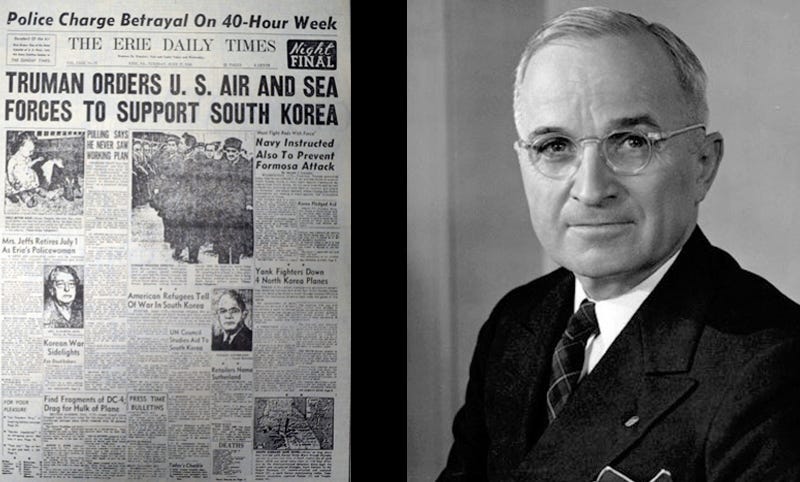
The break occurred in 1950, and it appears to have involved an astonishingly rapid post-1945 shift in the meaning of a declared war in the minds of American and British politicians.
The Korean War (1950-53)
Let’s get one thing clear: the Korean War was enormous. Only Vietnam comes close and everything else since then has been a sideshow. (Even Gulf I.)
Conscription. The United States drafted 1,529,539 young men between June 1950 and June 1953 and picked up another 1.3 million volunteers. That means that at least one out of every 4½ men born between July 1924 and December 1934 served during the war, not counting those who were serving when the war broke out or those who had already served during WW2. For what it’s worth, my father was in that age group:

The wartime experience of the young man on the left was far less common than the wartime experience of the young man on the right. Tax hikes. Strap yourself in and prepare to see a different (and in this respect incomparably better) country. The Revenue Act of 1950 raised the bottom income-tax rate from 16.6% to 20%, the top rate from 82.1% to 91%, and the top corporate rate from 38% to 45%; later legislation pushed the corporate rate to 52%.
Industrial mobilization. The Defense Production Act let Washington allocate raw materials and impose price controls and the National Production Authority directed resources across sectors. Pure central planning.

The Korean War involved mobilizing a total of 5.7 million servicemen during the conflict, of whom 1.8 million served in theater. Combined with the Cold War buildup, it required economic resources consisting of 16% of GDP, killed more than 33,000 Americans in battle, and lost 1,041 aircraft in combat. In terms of national effort, this is more akin to the First World War than anything since 1945.5
By that standard, the current war with Iran is a rounding error! And that applies to what Iran has experienced as well. The Korean War killed ten percent of the North’s population. A postwar CIA estimate reported that the fighting destroyed 90% of the DPRK’s coal production, 80% of its iron industries, all of its oil refining, and 60% of its light industry. Electric power output declined from 8.2 GWh in 1949 to 1.0 GWh in 1953.6 Iran has experienced nothing like what happened to North Korea.
The idea that the United States would have the political will to fight a conflict of Korea’s huge scale but somehow be afraid of formally declaring war would have made no sense to American politicians between 1789 and 1941. So if we want to understand how declarations disappeared, Korea is the place to look.
So why no declaration of war in 1950?
The last U.S. declaration of war had only been eight years earlier, so it wasn’t like it had become an unused muscle, the way it was by 2003.
Let’s knock out some hypotheses.
The Truman administration thought that a U.S. declaration of war would undercut the United Nations. Reasonable, but there is no documentary evidence that anyone in the administration thought a declaration would undercut the Security Council.
The U.S. didn’t recognize North Korea, so there was no state to declare war against. Officials raised that issue, but only well after the decision had been made not to ask for a declaration. In September 1950, Dean Rusk stated that the U.S. “had not recognized North Korea for any purpose,” but we’d been fighting for two months by then. British foreign secretary Anthony Eden told Parliament, “We are not engaged in a war with the Republic of North Korea because we do not admit that there is such a state,” but that was two years into the conflict.
Congress opposed the war. Absolutely not. On June 27, 1950, two days after the invasion, Truman called in a delegation of Congressional leaders. None of them opposed going to war. Senator Tom Connally even said: “If a burglar breaks into your house, you can shoot at him without going down to the police station and getting permission.” And Congress would go on to hike taxes, expand the draft, and pass the Defense Production Act. There was no doubt that a declaration would have passed.
Nobody in Congress wanted a declaration. No, Senator Robert Taft himself stated that one would be necessary. “Without protest, at least from this body, we would have finally terminated for all time the right of Congress to declare war, which is granted to Congress alone by the Constitution of the United States.” He went on to clarify that he supported going to war, he just didn’t support doing it without a Congressional declaration.
Taft’s objections produced an odd July 3 discussion in the White House. Senator Scott Lucas warned President Truman that going to Congress would be “practically asking for a declaration of war.” Truman replied that was the point. The idea was then dropped. The State Department then published a long and unconvincing memorandum arguing that no declaration from Congress was needed. (Page 173.)
In short, Senator Taft asked the obvious constitutional question, offered the administration an easy solution, and the surviving record doesn’t show Truman’s advisers giving any substantive reasons why that solution was unacceptable. It just didn’t happen.
Two hints suggest that World War II changed the meaning of a declaration of war. Before 1945, a declaration simply announced that a state of war existed; it carried no necessary implication about the aims or scope of the fighting.
A memo put out by the State Department two days after the invasion gave a declaration of war a very different meaning:
The consequences of the declaration of a state of war are clear from the terms of the resolution. With its approval by the President, we start down a road from which there is no turning back. We pledge all our resources, human and material, to winning the war. We will to fight until one of the parties capitulates or there is a negotiated peace.
Now, that argument is nonsensical. The idea that a declared war means fighting until a negotiated peace directly contradicts the statement that “there is no turning back.” The memo just assumes both that a declaration of war implies unlimited aims and that it would inevitably mean going to war with the Soviet Union.
But it does indicate a shift in the meaning of a formal declaration of war. The author isn’t making a legal argument; he is saying that declaring war is now seen to mean total war for ultimate victory, a la World War II. The historical fact that declarations of war had never before meant that in American history isn’t relevant to him; the emotional reaction in 1950 to such a declaration is.
There is other evidence that formal declaration of “war” had become taboo between 1943 and 1950. Dean Rusk recalled that officials eschewed a declaration in 1950 because they wanted to avoid “major mobilization of the manpower of the country” and “unconditional surrender as a war aim.” Neither statement makes sense given the resources committed to Korea or the history of earlier declared wars. But it does make sense if the meaning of the phrase had changed for Rusk to mean only a national effort on the scale of the Second World War and with the same unconditional aims.
American and British diplomats likewise called it “undesirable to label U.N. measures against aggression as ‘war,’” lest that “lower the U.N. to the level of the aggressor.”7 Historically that doesn’t make any sense either — the U.S. declared war on Japan in 1941 without anyone thinking that it “lowered the U.S. to the level of the aggressor.” But history wasn’t relevant. The valence of a declaration of war had changed.
It seems that in a time that was squeamish about very few things, the idea of a formal declaration of war had become taboo. Invoking it also invoked visions of the bombers flying and the atom bombs unleashed. And so we went to war with North Korea (and eventually its Chinese ally) with only implicit support from Congress — no declaration of war no matter how many young men were drafted or how high taxes rose. Thus endeth the formal declaration of war.
Still, the war in Korea doesn’t look like the war on Iran. North Korea started the war; Truman went to the United Nations; and the war was initially popular. Korea may have created the appearance of presidential precedent, but it was not remotely analogous to Trump’s unilateral and unpopular initiation of war with Iran.
Yes, Gulf War III is a watershed
If the current war’s only distinguishing characteristic were a lack of Congressional authorization, or the absence of a declaration of war, then there really might have been little special about it. But it turned out that there really isn’t anything like the current conflict: a presidentially-initiated attack carried out with no Congressional or allied discussion, no apparent constitutional basis, and no immediate provocation. In short, the attack violates the existing norms; not just the ones before 1945.
The counterfactual is sobering: even if Truman had obtained a declaration of war in 1950, later wars in Vietnam, the D.R., Panama, Yugoslavia, and Afghanistan would still have proceeded without full and formal declarations. The two wars against Iraq might have seen explicit declarations of war, but in our world Congress authorized the use of force. If those two precedents didn’t give President Trump pause, I don’t see why two declarations of war against Iraq would have.
In short, even had Korea and the earlier two Gulf wars been accompanied by declarations of war, there still would have been plenty of false precedent lying around for a commander-in-chief to pick and use to start a war. With or without a declaration, Congress’s only serious tools for stopping unilateral presidential action are to either cut off the funding or impeach the executive.
In other words, the declaration of war died a very strange death, but had it lived I doubt that it would have saved us from ourselves.
In 1999, I was living in Mexico and voting absentee in Florida, but I had lived in Campbell’s district prior to moving south of the border.
A partial list would include Grenada in 1983, the D.R. in 1965, Cuba and Mexico in 1917, the D.R. in 1916, Haiti in 1914, Nicaragua in 1912, and Cuba in 1906.
The episode may have provoked Libya to bomb Pan Am Flight 103 in 1988.
Congress repealed a 1955 authorization allowing U.S. forces to defend Taiwan in 1974. The text of that never-used authorization, I should add, was pretty broad:
The President of the United States be and he hereby is authorized to employ the Armed Forces of the United States as he deems necessary for the specific purpose of securing and protecting Formosa, and the Pescadores against armed attack, this authority to include the securing and protection of such related positions and territories of that area now in friendly hands and the taking of such other measures as he judges to be required or appropriate in assuring the defense of Formosa and the Pescadores.
There is some evidence at the link that had we actually started fighting the People’s Republic over Taiwan, President Eisenhower would have asked for a formal declaration of that a state of war existed. Eisenhower never made the more sweeping claims put forward by Bush and Obama that he could engage in offensive actions without Congressional approval. They all asked for Congressional approval, but only Eisenhower said, “[A] suitable Congressional resolution would clearly and publicly establish the authority of the President as Commander-in-Chief to employ the armed forces of this nation promptly and effectively.”
Vietnam, tragically, saw more American deaths than Korea.
Consumption declined more since Korea’s Chinese “ally” used 0.6 GWh of Korean electricity in 1953. (Table 7.)
Irajpanah, Katherine, and Kenneth Schultz. “Off the menu: Post-1945 norms and the end of war declarations,” Security Studies 30.4 (2021): 485-516.