

Big political earthquake in America, system collapses all around, A.I. still progressing at exactly the rate that made it hard for me to sleep in the 1980s. (I’ve been terrified that the machines would wake up and make us obsolete for a rather long time.)
So what do I do? Write a post about a minor issue that won’t happen!
Remember the U.S.-Canada trade war? It’s still on.
Right now, the President is imposing tariffs under the little-used Section 338 of the Tariff Act of 1930, something we here at TPTM predicted back in May 2025. At a recent Hoover Institution conference, I heard whispers that more than 11 GOP senators would be willing to sign on to a Section 338 repeal, which would be a large enough margin to override a veto. But even if that happens, the administration has imposed tariffs under other trade laws. Canada’s retaliated, but the trade relationship is currently a mess.
So Canada and the European Union have now agreed to negotiate … something. It’s not clear what. “Associate membership” is a phrase, not a thing, invented by the European president, Ursula von der Leyen. All serious observers expect the talks to underwhelm. Even labor mobility is being watered down to just “the yutes.”
But should Canada aim higher?
Forget the “legal” question. If all 27 European governments wanted Canada to join, then Canada could join. Article 49 says that any “European State” may apply, so it would require some creative lawyering, but lawyers can be nothing if not creative.
For example, Canada and Denmark share a land border on Hans Island:

The political questions are what matter.
Is European public opinion in favor of Canadian accession? I doubt it. Passing the Canada-Europe Trade Agreement (CETA) has been a bear — it still hasn’t been fully ratified and its trade provisions are now passing their ninth year of “provisional” status. The only reason it isn’t dead is because the French and Cypriot executives have decided to sit on their legislatures’ “no” votes instead of officially notifying Brussels.1 If I had to guess, an actual Canadian application would probably go through if European political leaders wanted it, but it would be the opposite of a sure thing.
Regulation with representation
But let’s look at the more interesting question. Would Canadian voters want to be Europeans if they knew what it involved? Right now, the idea looks popular. Nanos found 57% support in April. Abacus reported 49% support in September. That same month, Research Co. found 53% in favor of opening formal accession talks.
Donald Trump has scrambled NAFTA and its successor (which the Canadians quaintly call “CUSMA”). Canada’s currently facing some painful trade barriers, higher than Europe. Unless North America reinvents its relationships from scratch, on a full treaty basis, free from executive interference, that egg is not going to be uncooked.
Moreover, North America is organized on an imperial hegemonic basis: Washington decides, the others take the ride. That includes, in this case, the decision to blow up any sense of North America as a bloc. Europe does things differently. Canadian ministers would sit in and vote in meetings of the European Council.2 The Council operates on a double majority: 55% of the states (sixteen countries if Canada joins) representing 65% of the Union’s population. Canada’s got about 9% of the population, so while it wouldn’t be able to veto, it would have a significant voice. Canada would also get something like sixty seats in the European parliament (currently 720 strong).
Regulation with representation! Of course, Canada could get that in North America by dint of joining the United States, but I hope I don’t need to explain why that’s unattractive to the median Canadian.
Add it up, and it sounds like that should make joining the E.U. a no brainer, right? Weeeeeellllll …
Manufactured trade
Becoming part of the E.U. would allow Canadian manufacturers to seamlessly sell to Europe. But CETA already cut most tariff barriers to zero. And after a short-term blip there was basically no impact on Canadian exports to the European Union.
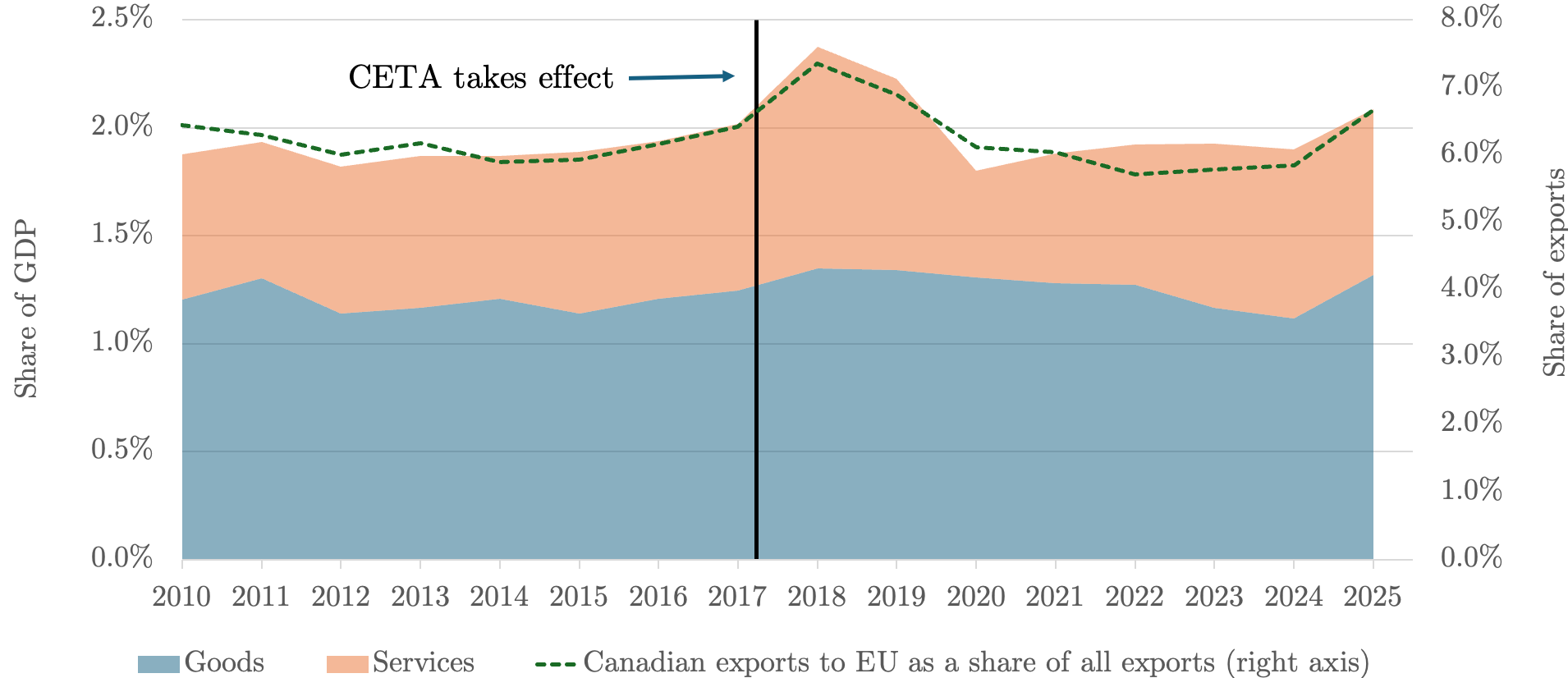
Still, accession is different. It would mostly eliminate remaining rules-of-origin, customs, and regulatory frictions, and that could potentially be large. The most generous finding that I have been able to find about the effect of the European Union on trade between European countries is around 50% over fifty years. Now, for some countries the same study found faster growth: it calculated that British trade with the mainland doubled in only fifteen years. So if Canada replicated the British experience, the increase in its exports to Europe in 2041 would amount to only two percent of GDP.
But Britain is right next to Europe. Canada is on the other side of the Atlantic. The actual impact would be far less than two percent of GDP. An official study conducted as part of the CETA talks concluded that “deep integration” between the two would raise trade by 23%. Even at face value, that’s only about 0.5% of Canada’s GDP, and the commensurate income gains would be smaller still.
Not nothing, but not exactly an economic revolution. It’s unlikely that many Canadians would feel E.U. accession in their pocketbooks.
Agriculture
But becoming European won’t be smooth sailing. Canadian agriculture would be in for a rough ride. Consider the following over-quota tariffs (from Chapter 2 and Chapter 4 at the CBSA):
Milk, 1–6% fat: 241%. minimum C$34.50/hectolitre;
Butter: 298.5%, minimum C$4/kg;
Cheddar: 245.5%, minimum C$3.53/kg;
Whole fresh chicken: 238%, minimum C$1.67/kg.
This ain’t nothing: The OECD estimated that commodity-specific support for milk came to 28% of gross farm receipts in 2022–24 and 22% in 2023-25.
So let’s think about your typical Canadian dairy farm. In 2024, they reported C$1,318,750 in operating revenue and C$1,064,460 in operating expenses, for an annual net operating income of C$254,290. Opening up the market will crush those margins.
Canadian dairy farmers don’t get a lot of direct subsidies (Figure 7.3). Rather, Ottawa helps them via quotas, protection, and price supports. Joining the E.U., therefore, would replace implicit transfers from milk drinkers with explicit payments from Canadian taxpayers.
A ballpark estimate, taking the OECD calculation at face value (and assuming that European output would flood the Canadian market), means that you’d need a cash subsidy of C$370,000 per farm. Right now, the European “Common Agricultural Policy” would give each farm about C$70,000, with support from other E.U. programs coming to C$30,000. If the European Union let Canada imitate Finland and negotiate an opt-out from subsidy limits, then Ottawa could cough up an additional $200,000 per farm. So … total support would probably come close. But cash support is much more obvious than higher dairy prices and a C$700 million hit to the federal budget ain’t beanbag.
And that’s just for the dairy sector!
But Canada being a big continental nation, the regional impacts are going to be very different. Prairie export crops already make up two-thirds of Canada’s ag exports to Europe: wheat, oilseeds, soybeans, peas, lentils, and beans. Joining the E.U. is gonna look a lot more attractive to a Saskatchewan grain operation than a Quebec dairy farm.
Canada probably doesn’t need or want another debate with diverse regional implications; the country has had enough trouble with the debates it’s already got.
Taxes
Under European rules, VAT needs to be at least 15%. Right now, only New Brunswick, Newfoundland, and Prince Edward Island hit the target, although Quebec is close enough at 14.975%. But the rest? Nova Scotia up one point. Ontario up two points. Manitoba and B.C. up three points. Saskatchewan up four points. And Alberta? Tripled, from 5% to 15%, at least if you take the rules at face value.
That’s not gonna be an easy sell, even if you cut other taxes to compensate. VAT kinda hits you right in the pocketbook. You think some Albertans are pissed off now? Just wait until their sales taxes triple.
Business access
Canada has a lot of nationalist laws on the books. This might seem surprising from a country whose prime minister once declared “the first postnational state,” but it’s not surprising at all from a normal English-speaking national state trying to maintain an identity separate from the American behemoth next door.
All those laws would have to go for Canada to become European.
The airline market would have to open completely to European competitors. Canadian control requirements in telecoms would disappear. No more federal reviews of foreign takeovers if the buyer happens to be European. And the banking sector? Upended. Canadian law limits large bank ownership to no more than 20 percent of any class of voting shares or 30 percent of any class of non-voting shares. Gone. The CEO and a majority of the board of directors of every bank or federal insurance company have to be Canadian residents. Gone, although Canada could still require the bank’s head office to be in Canada. Canadian content rules? Gone. Canada could still protect, say, French-language content, but it would have to stop demanding quotas of Canadian citizens in the production. CRTC rules on streaming services? Gone.
Negotiating all of this is going to be a mess, unless Canada simply agrees to treat all European entities as equivalent to domestic ones.
Trade with America
Problem number one is that Washington can still impose tariffs on Canada, regardless of Canada’s juridical status. Just because the European Union takes Canada over doesn’t mean that Washington needs to recognize that. So the insane tariffs we’re currently applying would stay in place unless American politicians or American courts said that they can’t.
Still, in practice the U.S. would be likely to treat Canada as just another part of the European Union. But it’s not clear that would be better for Canada. For example, USMCA-compliant Canadian exports are exempt from Section 301 tariffs; European goods are not. (Go to page 47,362, and no, an A.I. didn’t find that page number for me.) Steel and aluminium tariffs are sectoral, not national, so Canada would still be subject to those. America has imposed a 25% tariff on non-U.S. content added to automobiles in Canada, whereas European cars face a blanket 15%. That makes European treatment seem better, but roughly 64% of the value of Canadian cars comes from the United States (see page 134), so the effective barriers are lower.
In other words, becoming part of Europe won’t guarantee better treatment by America.
More seriously, it would preclude North American reconciliation. At best Canada could hope for the same treatment as Europe. Free trade would be killed dead, no matter who occupies the Oval Office after 2029.
Canadian politics
Getting closer to Europe would exacerbate a lot of internal Canadian divides, whether as a fully-integrated part or with an “association” agreement that was more than just folderol.
Quebec would discover that Brussels has opinions about agricultural protection and provincial economic policy just as a newly elected Parti Québécois government demands a direct role in the negotiations. It might find itself a bit less sympathetic to joining, unless it saw E.U. membership as a stepping stone to leaving the Canadian confederation, which wouldn’t go over particularly well in English Canada.
Alberta would learn that Brussels has opinions about carbon policy. Alberta has a kind-of sort-of carbon “price” of C$95 per ton. But emitters can buy credits for up to 90% of their liability for only C$40, and the province exempts about a third of power plant emissions. Given that E.U. carbon permits cost about C$130 right now, Alberta would be in for a shock … in addition to the sales taxes.
So Canada’s two most troublesome provinces would find that being European was a worse deal than being Canadian.
And while Canada would be influential within European councils, it wouldn’t be that influential. You could still pass legislation without it. Many Britons did not take well to the representatives from other countries determining their domestic policies, despite Britain’s representation in Brussels. I suspect that Canadians will feel likewise.
TLDR
Ottawa might prefer domination by a European confederation in which it has a voice to domination by an American federation that really doesn’t think about it at all. Hell, were I a Canadian, then I’d take that deal. No regulation without representation!
In the abstract, an argument can be made for joining the E.U. There’s no promise what future American administrations might do. It is marginally possible that Canada might be able to get an auto pact exemption to E.U. rules. Access to European markets might offer all sorts of benefits to Canadian firms. Increased competition could bring huge benefits to Canadian consumers. (Have you ever booked a domestic flight within Canada?)
But in the real world, it’s a nonstarter. The benefits are too small and the changes too drastic. And American voters have just supplied a fairly emphatic lesson in consequences and personal responsibility to a party that not long ago believed in both. That may be a good enough reason for Canadians to remain moored to the American ship rather than striking out across the Atlantic.
I’ve long argued (and will continue to argue) that radical changes in political boundaries can produce win-wins all around. But the evidence leads me to conclude that a European Canada isn’t one of them.
Technically it’s called the Comprehensive Economic and Trade Agreement, but that’s just silly.
Technically, the Council of the European Union, with “European Council” reserved for meetings attended by heads of government and not merely the relevant ministers. This does matter, because in most European parliamentary systems ministers have real autonomy; they’re not just instruments of the prime minister.