

Let’s take the President-elect literally and seriously for the moment.
How much is Greenland worth?
First you need to ask: to whom? As with most transactions, there is a buyer and a seller. The buyer would be the federal government of the United States. The seller (depending on how the deal is structured) would be the Greenlandic people.
Second you need to ask: what is being bought? The answer isn’t “Greenland.” It’s sovereignty over Greenland, which is a different thing. The federal government will get the benefits that come from sovereignty, which are quite a bit less than, say, all the income and resources on the island.1 Those benefits are in part economic—the flow of net revenues, potential ownership of subsoil resources, and any spillovers to mainland residents—and part strategic.
The view from America
The financial case
Let’s start with the flow of revenues. This is likely to be zero for some time. Why, you ask? Aren’t there mountains of resources under the ground that the Greenlandic government could transfer to the federal government in return for some crazy large sum of money?
Well, yeah, but. In 2014, the Greenlandic government spent a lot of resources figuring out the optimal system for taking future oil and mineral production.2 It came up with two estimates of the total value of taxes and royalties on hydrocarbon and mineral production in Greenland. The first estimate calculated that mineral rights would generate tax revenue around US$300 million once mining began. Oil and gas rights would bring in an additional $1.6 billion every year. Assuming that oil and mineral prices rise with inflation and using the TIPS rate on 30-year Treasury bonds, that gives you a net present value of roughly $38 billion.3
In a separate study, researchers estimated that mining production would provide an (inflation-adjusted to 2024 dollars) flow of approximately US$570 million per year in additional revenue.4 That estimate would raise the NPV of minerals alone from $7 billion to $11 billion and the total value to $43 billion.
But. There are three big “buts” here. The first is that you really should add in a risk premium. It’s not like Greenlandic mining is a sure thing. The weather is awful and the geology is unforgiving. There’s a reason why the boom hasn’t happened already and a lot could go wrong.
The second is that the federal government is unlikely to get all the revenues. The Committee for Greenlandic Mineral Resources estimated that 57% of the revenues would come from higher corporate income tax revenues; only 43% would come from royalties and direct mining taxes.5 So unless the Trump administration negotiates away the future Commonwealth of Greenland’s right to tax hydrocarbon and mining companies, the value of the resource rights would be only $28 to $34 billion. If the federal government takes all corporate income tax revenue for itself, then the value of Greenland’s subsoil resources comes to between $46 and $54 billion.
The third is that the Danish Realm and the European Union subsidized Greenland to the tune of $872 million in 2023. The breakdown was $601 million in a direct block grant to the Greenlandic government to use as it sees fit, $219 million in other Danish spending to support “realm” services (defense, the weather service, customs and border enforcement, air traffic control, etcetera), and $52 million from the E.U. — to which Greenland does not belong, even though Denmark does.6
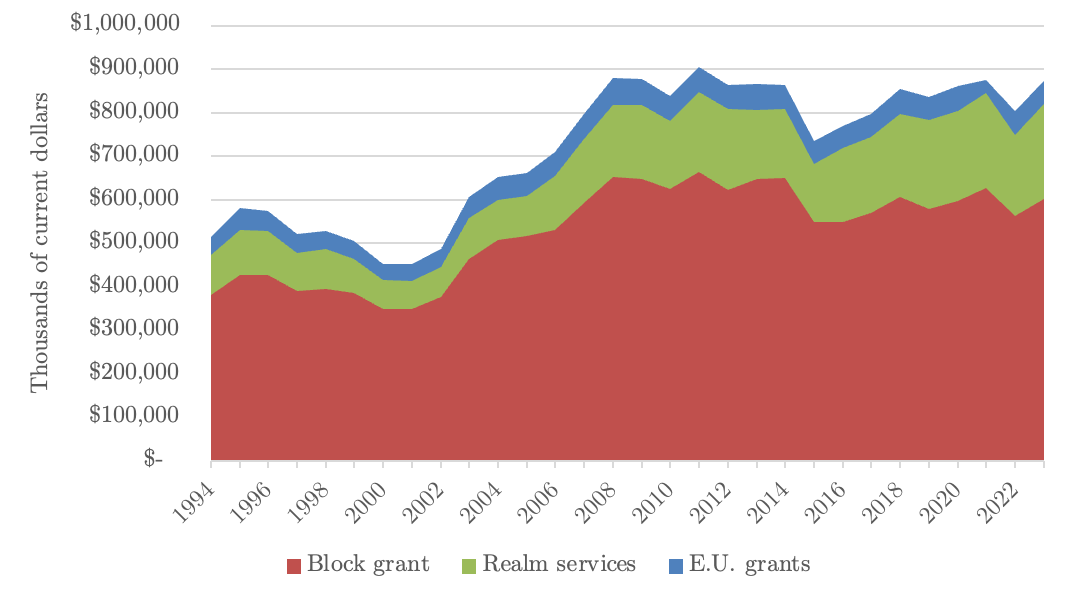
I don’t think that the U.S. would really need to spend an extra $219 million to extend federal services to Greenland — there are big economies of scale in those things, except maybe customs and air traffic control. But I doubt that Greenlandic voters would agree to a lump sum payment that cut off of the block grant and relinquished all future taxes and royalties on oil and mining. We should therefore subtract the subsidies from the projected federal revenue stream.
But we would also have to make a further deduction, because there is economic risk. The projected oil and mining boom might go bust. To account for this risk, bond spreads on oil and gas companies generally exceed treasuries between 100 and 200 basis points. Let’s call it an additional 1.5 percentage points.
The two above factors have a huge effect on valuations, reducing the value of the subsoil rights to something between $16 and $20 billion dollars.
There may be some other economic value from overflight fees and spillovers to the mainland, including expanded tourism. Spitballing, call that an extra billion dollars.
So your best bet for the overall economic value of sovereignty over Greenland is somewhere between $17 to $21 billion.7 If that money were distributed evenly among Greenlandics, then it would come to an offer of something between $295,000 and $360,000 per man, woman, and child on the island.
That’s a lot of money, over a million bucks for a family of four, and not too far from the $485,000 per person that I suggested when I looked at this issue in 2019.8
The strategic case
Greenland’s value to the United States, however, isn’t fully economic. After all, in a peaceful open world, American consumers of Greenlandic minerals wouldn’t care if they were buying from an American operation or a Chinese mining company.
We don’t live in that world.
Now, the U.S. currently enjoys some de facto sovereignty for defense purposes. In the words of the Defense of Greenland Treaty: “The Government of the United States of America may enjoy, for its public vessels and aircraft and its armed forces and vehicles, the right of free access to and movement between the defense areas through Greenland.”9
The problem is that the treaty can be revoked. If a foreign power made a sufficiently enticing offer, then Greenland could declare independence, withdraw from NATO, and throw the U.S. out.10 In addition, global warming means that the northwest passage will eventually open for shipping, and it seems like a good idea for Washington to keep that route under American control.
Let’s list the things the U.S. military could do with Greenland:
It could see a return to the basing of U.S. Air Force bombers and fighters, even on a permanent basis. (…) It could be used once again to station air defenses, to provide a forward line of defense against Russian bombers and missiles, although these could now include ballistic ones. There is even the possibility that the United States might choose to have long-range ground-based strike capabilities in Greenland. (…) Expanded port access in Greenland would also provide valuable and highly strategic maritime power projection points into the Arctic, as well as the North Atlantic. Those ports could be especially useful as operating locations for icebreakers.
A reinforced U.S. military presence in Greenland would very likely also address capabilities for a potential land war with Russia here and in the wider region. (…) Greenland is today considered a soft target by some. This is compounded by the fact that, while the U.S. Army is only slowly returning to more robust preparations for warfare in Arctic conditions, Russia is far more capable of fighting in northern latitudes and is introducing a variety of weapons systems that are optimized for this kind of environment.
The vital Greenland, Iceland, United Kingdom Gap, better known as the GIUK Gap, is a critical bottleneck through which Russian submarines need to pass to effectively patrol the North Atlantic. (...) With Russia operating increasingly capable submarines, the GIUK Gap is once again of fundamental importance, and having anti-submarine warfare capabilities in Greenland would further bolster this effort.
Moreover, as we mentioned above, there is a lot of stuff under the ground up there. That stuff can provide public revenues, but it can also provide critical inputs for U.S. industries. If Greenland is outside American jurisdiction, then the only way to insure access for those materials is to bid for them against, say, the People’s Republic of China. It makes perfect sense that the U.S. government would prefer to have the ability to simply ban their export under the Trading with the Enemy Act or other legislation.11
So having Greenland be an American territory provides an insurance value.
How much is that worth?
Probably at least as much as the U.S. was willing to pay for Greenland in 1946, when the Truman administration offered $100 million for it and nobody thought that it had any economic value. You could simply adjust that for inflation, of course. That would get you an insurance value of $1.7 billion in 2024 dollars.
That calculation is too low, however. Sovereignty over Greenland provides insurance, correct? Well, the United States has a lot more to insure today than it did in 1946: in nominal terms, the U.S. economy is 137 times bigger today. If you want to insure $137 it will cost you 137 times more than it would to insure $1. So to get the same level of insurance in 2024 that you had in 1946 means that you need to pay 137 times more: $13.7 billion instead of $100 million.
The problem is that the 1946 memo in which Secretary of State Byrnes laid out the rationale also includes references to potential mineral resources.12 That muddles the issue. The memo is mostly about security, however, and suggests that existing mining operations (cryolite) would be worth an additional $5 million, on top of the $100 million. It also compares the $100 million cost directly with the $80 million cost of an aircraft carrier.
One way to square that circle is to simply declare that half the value of the purchase was strategic. After all, economic issues take up far less than half the length of the memo.
Bottom line: a low value of $23 billion ($17 billion for the mineral revenues net of subsidy payments plus $6 billion in insurance value, rounding down) and a high value of $35 billion ($21 billion for the revenue stream plus $14 billion insurance value). Per person, that’s between $404,000 and $614,000 — well over a million dollars for a family of three.
Assuming that President Trump can convince Congress to offer something in that range, can he convince the Greenlandics to accept it?
The view from Greenland
“Damn the Americans, why don't they tyrannize us more?”
—Manuel Quezon
Countries have in the past made massive sacrifices in the name of self-determination. For example, Comoros voted 95% in favor of independence from France in 1975, save the island of Mayotte. Unsurprisingly, Comoros is still one of the poorest nations on Earth, whereas Mayotte — a French department — is seeing its living standards converge rapidly with the Hexagon.13 Comoros, in fact, had to face a rebellion on Anjouan island where the rebels raised the Tricolor and asked Paris to make them a French overseas collectivity.
On the other hand, other places have foregone independence because it didn’t make economic sense and their people enjoyed full civil rights. Puerto Rico comes to mind, but there are currently no serious secession movements in any American territory.
How strong is Greenlandic nationalism? A reputable 2017 poll indicated that Greenlandics opposed independence if it would lead to a lower standard of living. A not great 2025 poll just indicated that they support becoming an American territory. In other words, I don’t really know. Given the evidence, I have trouble believing that Greenlandic voters would pass up more than $400,000 per person, but I do not know.
Are there any benefits for Greenlandics from joining the United States beyond whatever cash payments the federal government agrees to? That’s less clear. I can think of three possible benefits:
Access to the bigger U.S. market for tourism, other exports, and any Greenlanders who want to leave;
Increased investment due to increased certainty from being under the American umbrella;
Reduced risk of war or malign foreign influence, although some of that risk would be … uh … war with the United States. (Nice country you got there, shame if anything should happen to it.)
Under current American law, Greenlandics would not have to relinquish their Danish passports even if Congress extended U.S. citizenship to all of them. So U.S. citizenship would have no downside.
How likely are these benefits to materialize? It’s impossible to say. American territories are generally richer than comparable areas — Puerto Rico is much richer than the Dominican Republic; the northern tier of U.S. states is richer than Canada; Guam and the CMNI are much richer than the other Pacific islands; American Samoa is much richer than Samoan Samoa. But we don’t really know if those examples will travel to Greenland.
Increased investment is likely, especially given federal support. That will raise incomes. But not all Greenlandics will be super happy with a tourism boom or explosive growth in mining.
In short, any benefits for Greenland besides the cash payment are relatively speculative. The implication is that the Greenlandic negotiators should demand the highest price that they think the Americans will pay.
There is one other things to keep in mind about linking with the United States: the U.S. Constitution would not automatically apply in full. I cannot stress that enough. Greenland could keep laws and customs that do not conform to mainland practice, much as the Commonwealth of the Northern Marianas Island (CNMI) limits non-Chamorro land ownership and basically had its own immigration law until 2009. (When somebody tells you that Greenland would need to abolish its health care system to conform to the mainland, the they are mistaken or lying.) The fact that the Constitution does not apply in full also means that U.S. could grant Greenland the right to secede — say unilaterally with a three-quarters supermajority or some such or a simple majority with Congressional approval or whatever it would take to ease Greenlandic fears of sellers’ remorse.
The view from Earth
Isn’t it setting a bad precedent to allow a bigger country to buy its neighbor?
No. If you’re worried about violent territorial expansion, well, Mr. Putin broke that precedent in 2014, when he annexed Crimea. Between 1945 and 2014, most expansionist countries set up quasi-states, the way Armenia created the Republic of Artsakh (until Azerbaijan conquered it in 2023) or the Russians set up “independent” enclaves in Transnistria, Abkhazia, and South Ossetia. But that genie left the bottle in 2014, and really took flight in 2022.
Joseph Blocher and Mitu Gulati have argued that the world would be a better place if we created an actual “market for sovereign control.” Legitimizing and establishing rules around territorial trades, they argue, would reduce the risk of international and civil war and improve governance. “A market should be able to point toward practical solutions by helping to identify the legal, political, ethical, or other obstacles that prevent welfare-enhancing border changes. International law remains haunted by the problem of borders and sovereign control. Our framework suggests one way to improve them.”
If you accept their argument — go read the paper! — then the implication is that a Greenland purchase would set a positive precedent for the world.
Of course, if the Trump administration chooses to apply coercion beyond tariff threats, then none of this applies.
Anyway, I can’t quite convince myself that this will happen. But I don’t have the same tone that I did in 2019, when I used words like “boneheaded” and “daft” and illustrated my post with the following picture and caption:

In a world where A.I. threatens to make everything incomprehensible, a return to 19th century verities almost comes as a relief.
Yes, in the abstract the federal government could go Communist and nationalize everything in Greenland. In reality, there is the Fifth Amendment. In Turney v. United States (1953) the Supreme Court held that the Takings Clause applies to American actions within foreign countries against foreign citizens as long as the affected party has close enough ties to the United States. Turney stated that a Philippine corporation located in the Philippines enjoyed Fifth Amendment protection from actions by the U.S. Army Department that in effect seized some of the value of their property. (In 2007, Atamirzayeva v. United States provided a limit on the protection.) A future Commonwealth of Greenland would have an even closer connection than the Philippines, being an American territory populated by American nationals.
In case of link rot, the document is Government of Greenland, “Greenland’s oil and mineral strategy 2014-2018,” FM2014/133 (Feburary 8, 2014).
The currently nominal rate on 30-year Treasuries is 4.9%. The TIPS rate, which adjusts for inflation, is 2.6%. That implies an expected inflation rate of 2.3% per year. The projected government revenues are on page 8 of the report mentioned in footnote (2).
The Committee for Greenlandic Mineral Resources to the Benefit of Society, “To the Benefit of Greenland,” Grønlands Universitet (2014), p. 18.
No taxation without representation! American territories don’t get to vote, so they keep all income tax revenue. Of course, the feds just tax ‘em in other ways. It’s not a constitutional principle so in theory the Trump administration could negotiate this.
I used an exchange rate of 6.6 krone per dollar, from FRED, to convert the figures from the Statbank Greenland.
The federal government would gain the most revenue if it extracted full royalties and applied federal corporate income taxes to mining operations on the island. As noted in footnote (5), the latter would be a break with tradition, but it would not be unconstitutional.
I didn’t account for risk and used incomplete revenue projections.
The United States and Denmark modified the treaty in 2004. Note that “Thule Air Base” is now called Pituffik Space Base.
Article 14 of the Greenland Defense Treaty implies that it cannot be revoked without also revoking the NATO Treaty.
This argument is why it seems odd for the U.K. to abandon the Chagos Islands in return for a 99-year lease on the Diego Garcia air base. Mauritius can now allow Chinese vessels to operate in its territorial waters or establish bases on other islands of the archipelago. Moreover, lease agreements have been broken in the past, potentially putting a future government in the tricky position of going to war over a legally tenuous claim.
William Trimble, memorandum to Mr. Cumming and Mr. Hickerson, “Possible Solutions to the Question of Our Post-War Bases in Greenland,” 24 May 1946, Department of State, Office of European Affairs, Division of European Affairs, RG 59 (General Records of the Department of State), National Archives and Records Administration, College Park, MD.
Mayotte also gives its votes to the National Rally. Go figure.