

Greetings from northeastern Mexico! Driving around for the first time since 2010, one of the changes that struck me was a big increase in the number of trucks on the road.
The statistics back up my impression. Overall freight transport is up about 20%, but when you look at traffic headed to Texas, which would capture a lot of the traffic where I’m driving, it’s up more like 70%:
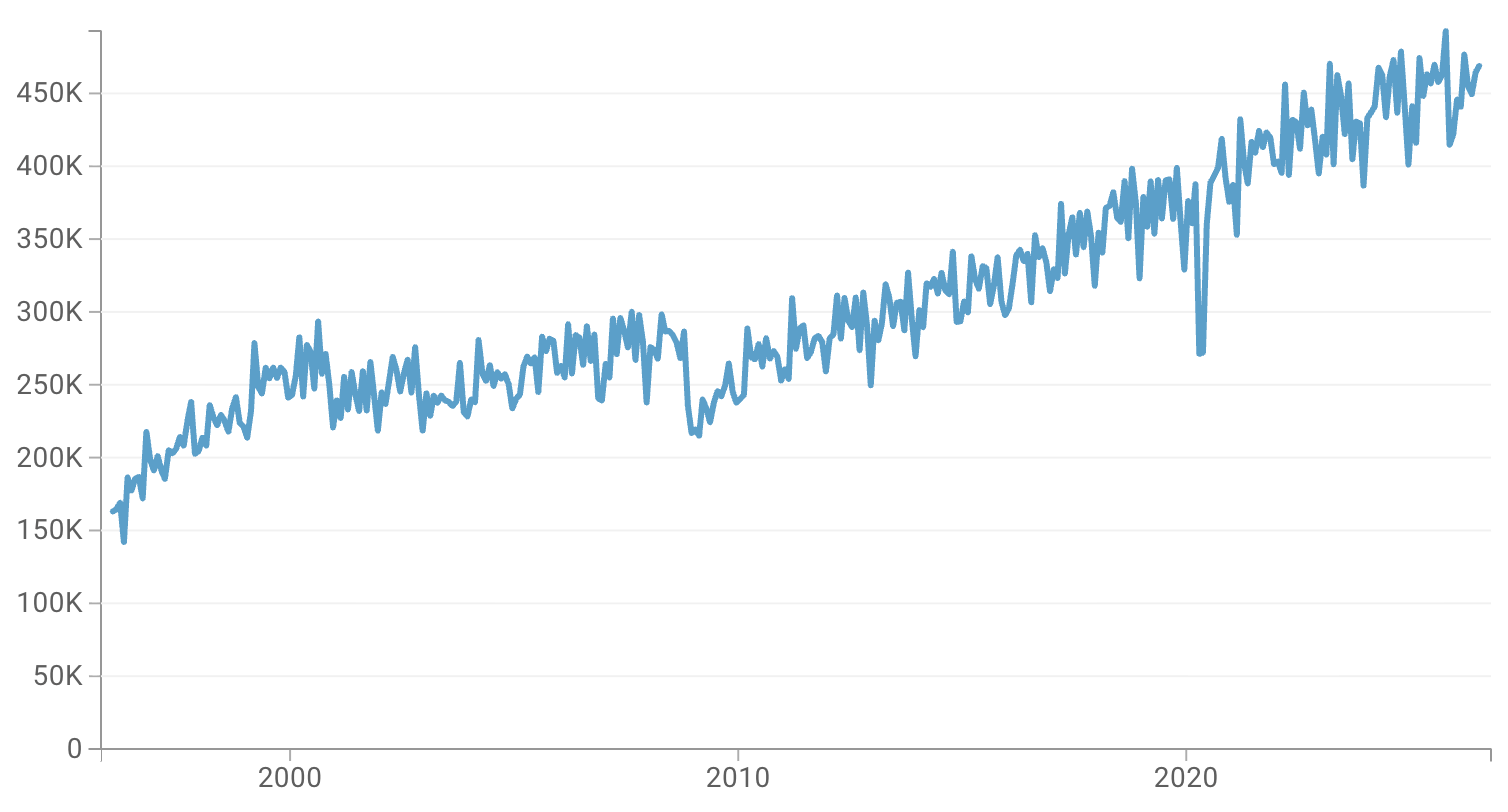
In other words, despite the Trump administration’s … uh … unpredictable trade policy, trade flows haven’t slowed.
What drives me crazy, however, is that the Trump administration’s willingness to think outside the box — hell, its willingness to cut the box into cardboard shreds and throw them into the trash — has created an opportunity to give the United States all the control it could want over North American trade, only the President appears singularly unable to grab it. Instead we’re getting a random mess of threats and demands, none of which makes sense even in the most crassly political ways.
What America needs
Here I’m not going to talk about what the Trump administration wants. I’m going to talk about what America needs. And what America needs is control over our partners’ trade policies.
The reason is simple: without that, the U.S. cannot reduce its dependence on China. I’m starting here from the assumption that Chinese trade policy and American dependence on Chinese supply chains are inflicting economic and strategic damage on the people of the United States. If you disagree with that premise, then the following argument will be a lot weaker — although the proposal does stand on other grounds.
We need to be able to insure that Chinese goods cannot enter the American market via Canada or (more likely) Mexico. That can happen via outright cheating: as in, customs authorities mislabel the import or allow it to be relabeled as domestic. So, poof, a Chinese export gets relabeled as Vietnamese and enters Mexico duty-free, or just gets relabeled as Mexican. Diego Marroquín lays out the issues quite eloquently.1 But it can also happen via transformation, where a Chinese import comes into Mexico and a Mexican firm transforms it just enough to qualify as a Mexican export. “Just enough” has rules, of course, but those rules can be gamed.
There are complicated ways to handle this problem. Our men in Washington, Diego Marroquín and Ryan Berg, lay them out here and here. But there’s a simpler one.2 A customs union would bring all three countries under a common external tariff and common trade policy. Once something was allowed in, it could freely circulate subject to varying health and safety regulations or product standards — a customs union is not a common market. So there would still be customs posts on the various borders. But any foreign goods would have already been checked under a common set of rules at the external border, so additional checks at the internal borders would just be icing on a cake.
What Canada offered
Our “negotiations” with Canada haven’t made much sense. The United Auto Workers isn’t much of a bastion of ideological free traders, yet it opposes tariffs on Canada for the obvious reason that Canadian autoworkers are unionized and earn high wages. The United Steelworkers and International Association of Machinists and Aerospace Workers feel similarly. In other words, there really wasn’t much of a dispute with Canada until the Trump administration came along.
Until the talks collapsed because of our ever-shifting mess of demands, we were converging on a rather complex kludge. From Diego Marroquín at CSIS:
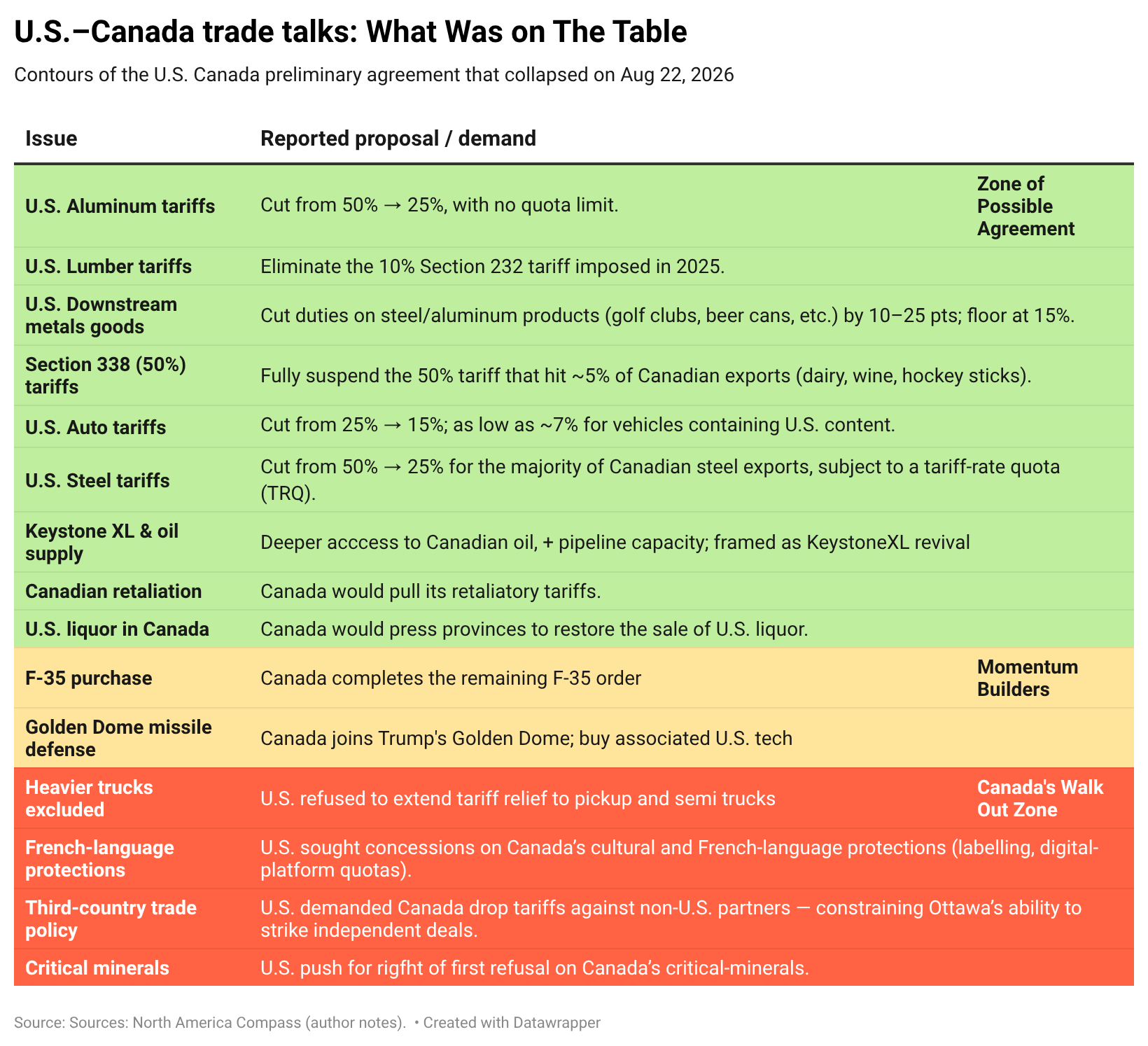
In general, it’s not clear what the Trump administration wants, let alone why it wants it. But it is pretty clear why Washington wants control over third-country trade policy and critical minerals.
And there is some reporting that indicates Canada was more willing to give that than the above chart implies. Prime Minister Carney offered a “Fortress North America” with common barriers to the outside and few restrictions within. In May, the Prime Minister explicitly mentioned autos, steel, aluminum, critical minerals, and energy.
This would be an amazing win for Washington.
The fact that the Trump administration is willing to upset the entire free-trade applecart makes it pretty clear that it could build the fortress on America’s terms if we took the Canadian offer at face value. We’d have to be a lot less obnoxious about it — which is okay with me, since it really should be “Lake New York” not “Lake America”; Lake Ontario is fine as a compromise. If we want to be pushy about names, we should just start referring to our northern neighbor as the Dominion of Canada, which would really be a win-win since “Dominion of Canada” is one of the coolest country names in the history of country names.
A North American customs union
Canada offered sectoral integration. But we’re America, dammit. We should settle only for a customs union.
That would put the United States in the trade driving seat. Consider the customs union between the European Union and the Turkish Republic.3 Under the rules, Istanbul has to align itself with European tariff rates, competition policy, intellectual property, and any agreed-upon technical standards. In other words, Brussels decides and Istanbul goes along for the ride.
An old-fashioned U.S. administration would be unable to get such a deal. There are two issues where we just have to strongarm Ottawa. (Mexico City provides a different problem.) Regular administrations have been unable to do that. But since this administration can credibly threaten to slice up the entire continental economy, it’s pretty easy to imagine the Canadians going along — not least because of the massive economic benefits, which we’ll get into below.
The soft wood problem
This issue has bedeviled American-Canadian relations since forever. Canadian provinces own most of the country’s forest land. They charge lumber companies a stumpage fee for the right to cut trees. The problem is that the provincial governments, unlike a private landowner, aren’t trying to maximize the return on their property. So they charge stumpage fees that are much lower than those charged by private landowners in the United States. The Canadian government argues that the provinces can charge whatever they want to charge, so the lower fee shouldn’t count as a subsidy. Washington disagrees.
The solution is just to strongarm the Canadians and insist that as part of the customs union, Canadian stumpage fees will need to track a market benchmark. Now, this is a provincial prerogative, and the feds couldn’t just order the provinces to go along. But it can force them to comply. In 2006, America and Canada came to a (not lasting) agreement on the softwood issue — Ottawa imposed export charges and restrictions on lumber, which they eased if the province complied with the international agreement.
To be fair to the poor Canadian lumberjacks, the numbers aren’t small from their point of view. British Columbia is where you’re gonna get the most opposition, and there the U.S. Department of Commerce estimates that stumpage fees would need to rise by an amount equal to somewhere between 3.1% and 5.9% of total sales. (Page 8.) That would imply a 24% to 46% rise in stumpage fees for B.C.4 Lumberjacks would no longer be okay, although they’d presumably still hang around in bars.
But given that the Canadian government thinks that a customs union with the USA would raise GDP by a more than 1%, they will be easy to buy off.
The dairy dispute
Dairy is usually a problem. In fact, when the U.S. government has had to tell state governments to cut it out with the trade restrictions, it generally involved dairy products. Trade with Canada has been no exception. But in 2017-18, when the first Trump administration renegotiated NAFTA, Canada capitulated to U.S. demands. With the Trump administration threatening to build a metaphorical wall along the 49th parallel, it’s hard to imagine that Ottawa wouldn’t fold again, elbows up or not.
Other Canadian content
The U.S. would probably have to give ground on the French language stuff, since that could actually split Canada, which no prime minister is going to risk. But that’s tiny. The digital services tax is one where I think Canada is completely in the right, both legally and politically, but whatever. It is what it is. Ottawa won’t go to the mattresses over it.
The U.S. will insist that “Buy America” stays in place. After all, U.S. law allows state governments to favor in-state suppliers unless Congress says otherwise (which it hasn’t) so Canada would just have to forget about imposing restrictions on federal procurement. If the United States doesn’t limit buy local provisions inside the federal union, then it will be a cold day in hell for Washington to agree to let a North American Customs Union limit them.
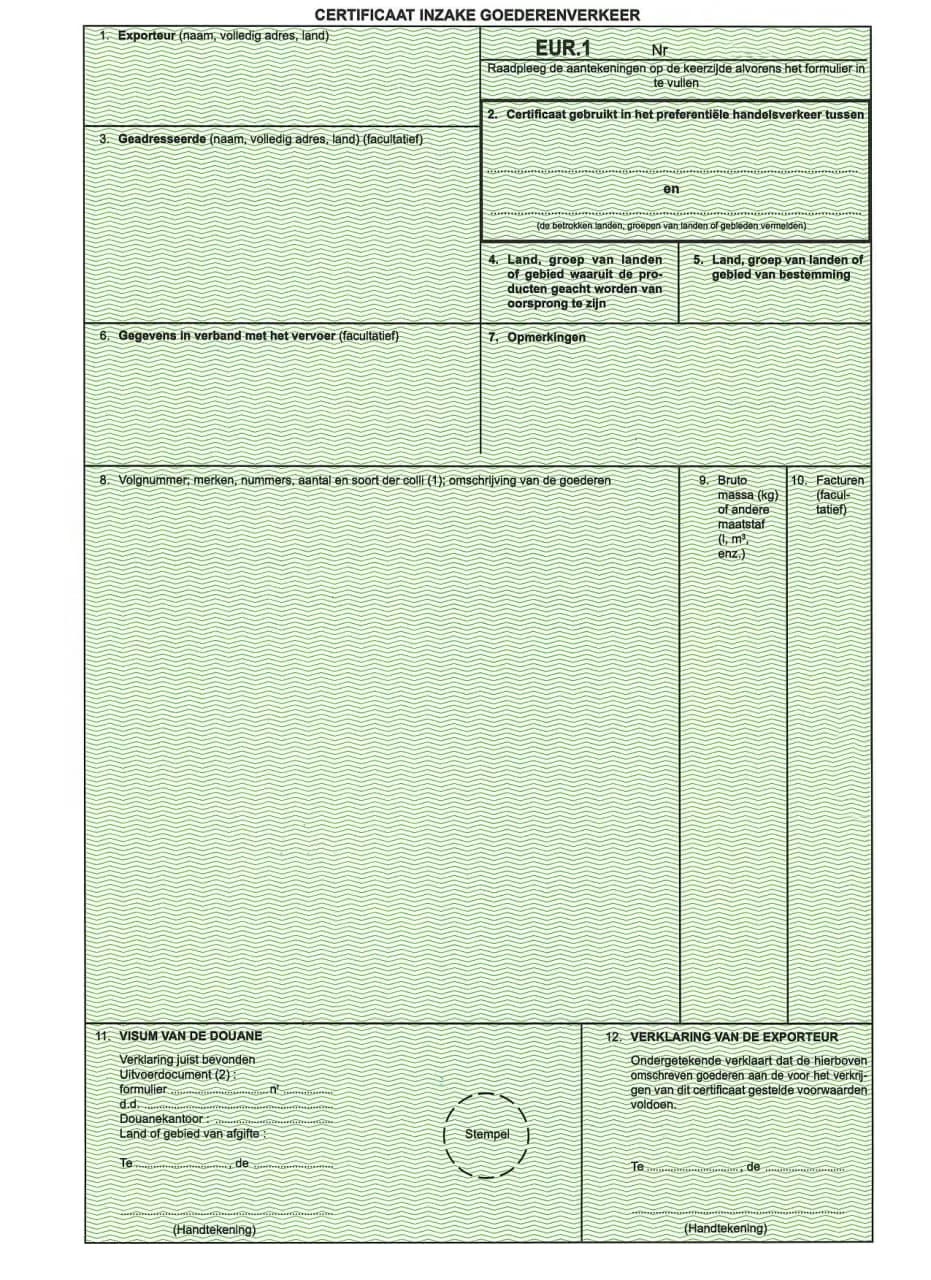
Finally, a customs union would be de facto game over for independent Canadian and Mexican trade policies. Under the Turkish-European customs union, the E.U. can sign whatever trade agreements that it wants. The resulting goods will then enter Europe tariff-free, and can be transported tariff-free from Europe to Turkey. The opposite doesn’t hold, however. A Turkish good could be sold to a European buyer, but they only way that European buyer could export it onwards tariff-free would be to forge a European certificate of origin. Since this blog prides itself on getting paperwork requirements right, this means the European would need to tear up the good’s ATR certificate and replace it with a EUR.1 certificate.
What that means for Canada and Mexico is that the United States could go ahead and sign FTAs with whomever, with only a requirement to invite the other two countries to participate, whereas Canada and Mexico would have to agree to “coordinate” their trade policies with the United States. They could sign whatever FTAs they want, but if the U.S. found so much as a molecule had been imported without paying the common external tariff it could exclude the whole good into which that molecule had been incorporated. And while the European Union trusts Turkey enough to have left a specific schedule of fines out of their customs union, it would be easy enough for a North American customs union to include a list of very serious penalties against the exporters’ government — in addition to the penalties on the exporter, who would have committed criminal fraud — were such fraud to be discovered by officials in the other two countries.
What’s in it for Canada
Oh my. It’s just pure awesome-sauce, even with all the limits and restrictions on sovereignty.
First, a massive chunk of paperwork burdens on Canadian exporters just goes away. Right now, most imports from Canada don’t bother to take advantage of the USMCA zero-tariffs because the paperwork burdens are too high. How high? Well, the Federal Reserve estimated that paperwork costs came to somewhere between 1.4% and 2.5% of the gross value of transborder shipments. That’s, uh, a lot. And if you don’t believe the Fed, well, the Canadian government confirms it. (Or just go talk to anyone with the bad luck to run an export business in any USMCA country.) A customs union isn’t a common market, so there will still be paperwork … but much much less than under a so-called free trade agreement.
Second, firms can now just buy the best product without worrying about complicated rules-of-origin. If an import faces a prohibitive tariff under the customs union, then you just don’t buy it. (I would hope most Chinese imports would eventually face this, including Chinese imports fraudulently routed through third countries.) If it doesn’t face a prohibitive tariff, then you buy it and you use it, no second thoughts. Emanuel Ornelas (São Paulo School of Economics) and John Turner (U. of Georgia) don’t quantify the benefits but they demonstrate the theory here.
Add it all up, and you’re talking benefits worth more than 1% of Canada’s GDP. But there’s another benefit: certainty. A customs union would be a law or treaty passed by Congress. Its enforcement and adjudication would be out of executive hands. No sudden exemptions or presidential whims. The common external tariff would be effectively under U.S. control, and Congress might even delegate some of that setting to the President, in order to retaliate against foreign dumping or negotiate new trade agreements. But none of it would apply to trade within the customs union.
What about Mexico?
All the same benefits apply to Mexico, only more so. Its GDP is estimated to rise almost 5%. But let’s not trust these big mushy models. We have direct evidence that the costs of NAFTA compliance paperwork ate up around 40% (!!!) of the preferential margins enjoyed by Mexican firms. On top of that, non-administrative costs gobbled up 3% of the exports’ gross value. If you want to drill down further, when the USMCA tightened up the rules of origin, the value of automotive exports that didn’t bother to comply with the new rules jumped, allowing researchers to back out costs of 1½–2½ percent of traded value. A USITC study used even more granular data to calculate that USMCA changes imposed costs around $200 per vehicle.
In other words, Mexico has even more to gain than Canada.
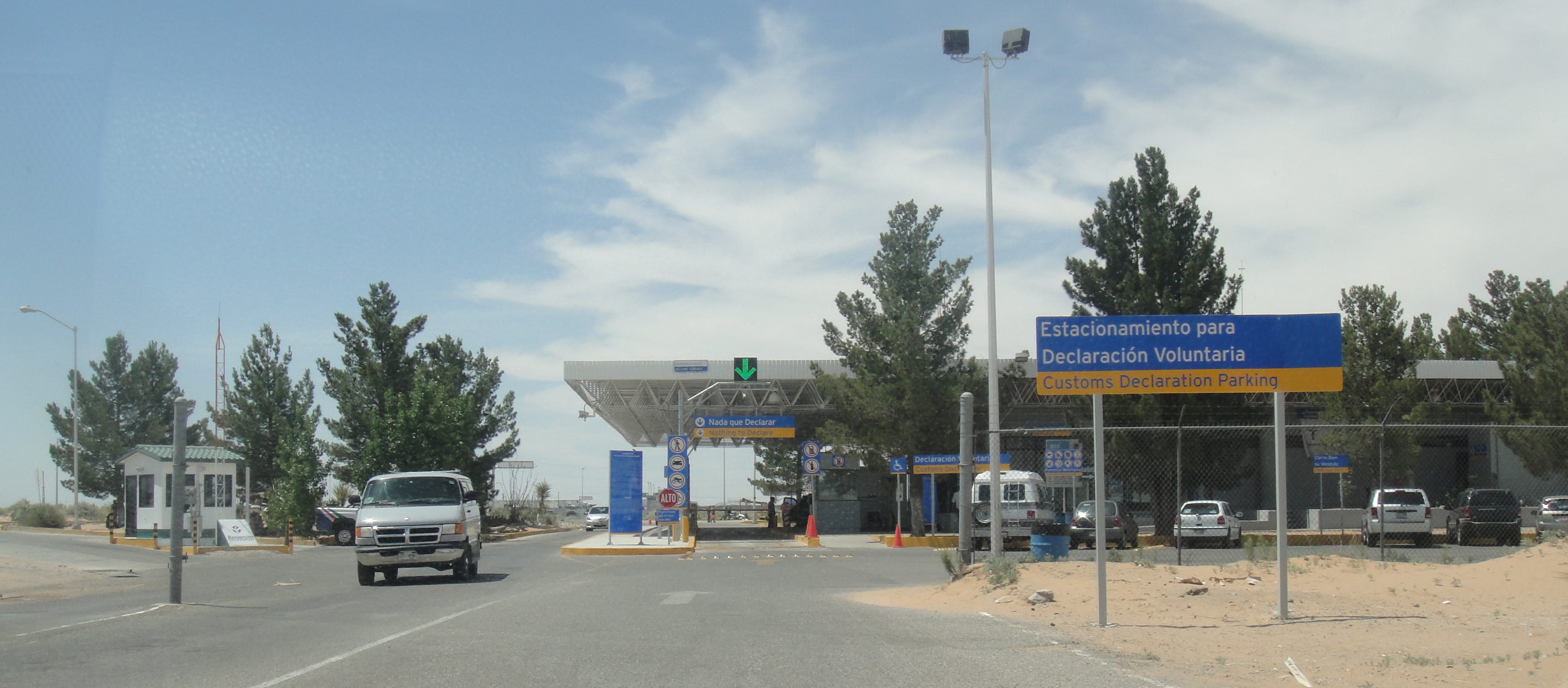
But the U.S. could also get a commensurately bigger benefit from Mexico out of a customs union. Namely, it could get direct American oversight of Mexican collections. The big benefit to the U.S. of a customs union is control over its partners’ trade policies, right? De jure control is great and all, but this is the nation of “obdezco, pero no cumplo” — I obey, but I do not comply. Mexican customs have faced some major problems with corruption that mean that Mexico City’s commitments might not be entirely enforceable where the rubber hits the road. For example, the ongoing “huachicol fiscal” scandals involve customs officials declaring that fuel imports from the United States were actually other kinds of petroleum product in exchange for bribes. And that scandal doesn’t involve just a few bad apples: it covers the customs posts in Tampico, Ensenada, Manzanillo, Lázaro Cárdenas, Guaymas, and Veracruz, including their heads.
Huachicol fiscal is only one out of many sad examples: systematic undervaluing of textile imports (sometimes for less than the value of the raw material!), letting in 600 tons of Asian imports in ostensibly empty containers, and large-scale exporting of protected animal species to foreign buyers.

You don’t want Beijing subverting the North American Customs Union (or Fortress North America or the Trump Trade Treaty Area or América Mexicana or whatever) by bribing Mexican officials. So what you do is tell Mexico that American “observers” will be running around their customs posts, while allowing Mexican officials to do the same thing north of the border. Mexico saves face, America gets to make sure that the customs laws are enforced, both countries benefit from lower corruption.5
We have seen the enemy, and it is US (of A)
Given that the benefits from these arrangements are so obvious, why hasn’t the Trump administration already tried to strongarm our partners to joining? Well, the real answer is probably that the President doesn’t want freer trade with anywhere unless it becomes part of the United States. But there are several concrete problems for this particular administration:
Congress. You’d need to get Congress involved in this agreement. That would give Canada and Mexico the certainty they need that the U.S. would stick to its side of the agreement. But the Trump administration has not proved the best at negotiating with Congress, even when an initiative should be able to get bipartisan support. (Some of this is due to Democratic resistance to anything with Trump’s imprimatur.)
Power. The President has made a lot out of his ability to use tariff rates as a weapon against foreign governments. A customs union would remove this tool from the White House. And for better or for worse, Washington has used this tool quite a bit over the past few years:
2019 against Mexico over migration: After threats of escalating tariffs, Mexico agreed to deploy the National Guard on its southern border to prevent northwards migration. The second Trump administration went back to this playbook in 2025, this time putatively over drug smuggling, and also applied it to Canada.
2025 against Mexico over water: Mexico has consistently delivered less water from the Rio Grande than required under a 1944 treaty. President Trump threatened to blow up trade, and Mexico acquiesced.
2025 against Canada over the digital services tax: President Trump broke off USMCA talks over the tax; the Canadian government caved and abolished it. (We’ll ignore here that I think the Canadian tax was a good idea; the fact is that the Trump administration used trade threats to get what it wanted.)
2026 against Canada: The Trump administration was cheesed off (sorry) about Canada’s agreements with Europe that putatively favored European cheese over America. It was also bothered by provincial bans on American alcohol and a 25% tariff on the value of American cars not produced in the region formerly known as NAFTA. So far, Canada hasn’t backed down on these.
Autarky. The Trump administration actively wants to protect American factories from Canadian and Mexican competition and views bilateral trade deficits with Canada and Mexico as a problem. This doesn’t make a whole lot of economic sense — most North American production facilities are complementary, Canada is a high-wage country, and NAFTA’s “sucking sound” sucked out production to Mexico a long time ago — but the administration acts like it believes it.
I sadly fear these factors mean that a customs union is off the table. More so when you count all the ships that the President’s rhetoric has burnt in Canada.
But the irony is that it’s President Trump’s willingness to throw the baby out with the bathwater that has made a customs union possible. His threats have created enough leverage to overcome otherwise strong Canadian and Mexican opposition, and the huge economic benefits — combined with the loss of future U.S. leverage — give both governments a good reason to say yes.
Maybe reason can still prevail. Don’t patch, tweak, and extend — a customs union would be an even greater flight of the American eagle than the annexation of Greenland, and we have a unique opportunity to make it happen.
I know someone who knows who she is smiling and saying “the 51st state, duh.” My solution is simpler and easier than that.
I would be completely fine with calling the country “Turkia” or “Turkya” instead of “Turkey.” But insisting on the Turkish spelling and the Turkish pronunciation is a bridge too far. It’s already annoying enough to have to write “Czechia” instead of “Checkia.”
The calculation is a little convoluted but not complicated. In 2022, B.C. charged a stumpage fee of C$33.90/m³. (See page 22.) It produced about 8.4 billion board feet of lumber (page 10). One cubic meter of forest produces about 276 board feet, implying that B.C. lumberjacks used about 30.4 million m³ of forest land. 30.4 million × C$33.90 = C$1.03 billion, which comes to about 13% of the C$8 billion in lumber-mill sales. Commerce’s estimates, therefore, imply that the province would need to raise stumpage fees by somewhere between 3.1% ÷ 13% ≈ 24% and 5.9% ÷ 13% ≈ 46% to eliminate the subsidy.
Ironically, Leticia Abad and I have a paper indicating that this might not actually work, as cited in the New York Times, but don’t let that stand in the way of a good Substack post.