

Argentina is not known for having a large black population.
Being a country of Europeans is a deep part of Argentina’s national identity. The census stopped recording race in 1869. A bit more than 80 years later, when Josephine Baker visited, she was surprised at the absence of black people. So she asked Ramón Carilio, the dark-skinned minister of public health, where the black population lived. Carilio felt free to joke, “There are only two — you and I.”
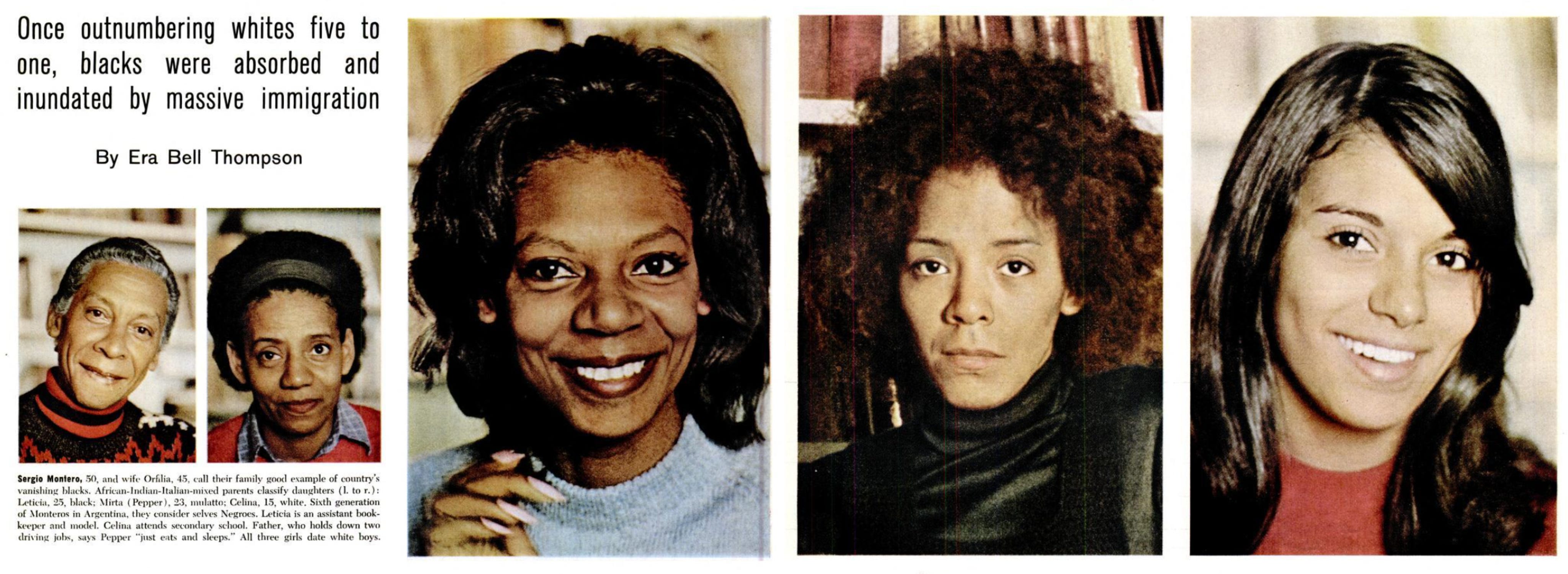
When Era Bell Thompson visited Argentina in 1973 to report on the black population there, she recorded one Argentine’s ironic complaint about the United States: “Argentines are lumped in with all the rest of the Spanish-speaking peoples, even though we are white.” Thompson had no problem finding black people, but she described them as “Not a viable, but a vanishing black people: relatively few in numbers, relatively free of racial discrimination and relatively content.”
Even now, some Argentines still joke — with somewhat less accuracy than in the past — that an Argentine is an Italian who speaks Spanish and wants to be British. The self-image dies hard: when María Lamadrid tried to board a flight from Buenos Aires to Panama in 2001, the Argentine border officials refused to believe that a black woman could actually be Argentine and accused her of using a fake passport.1
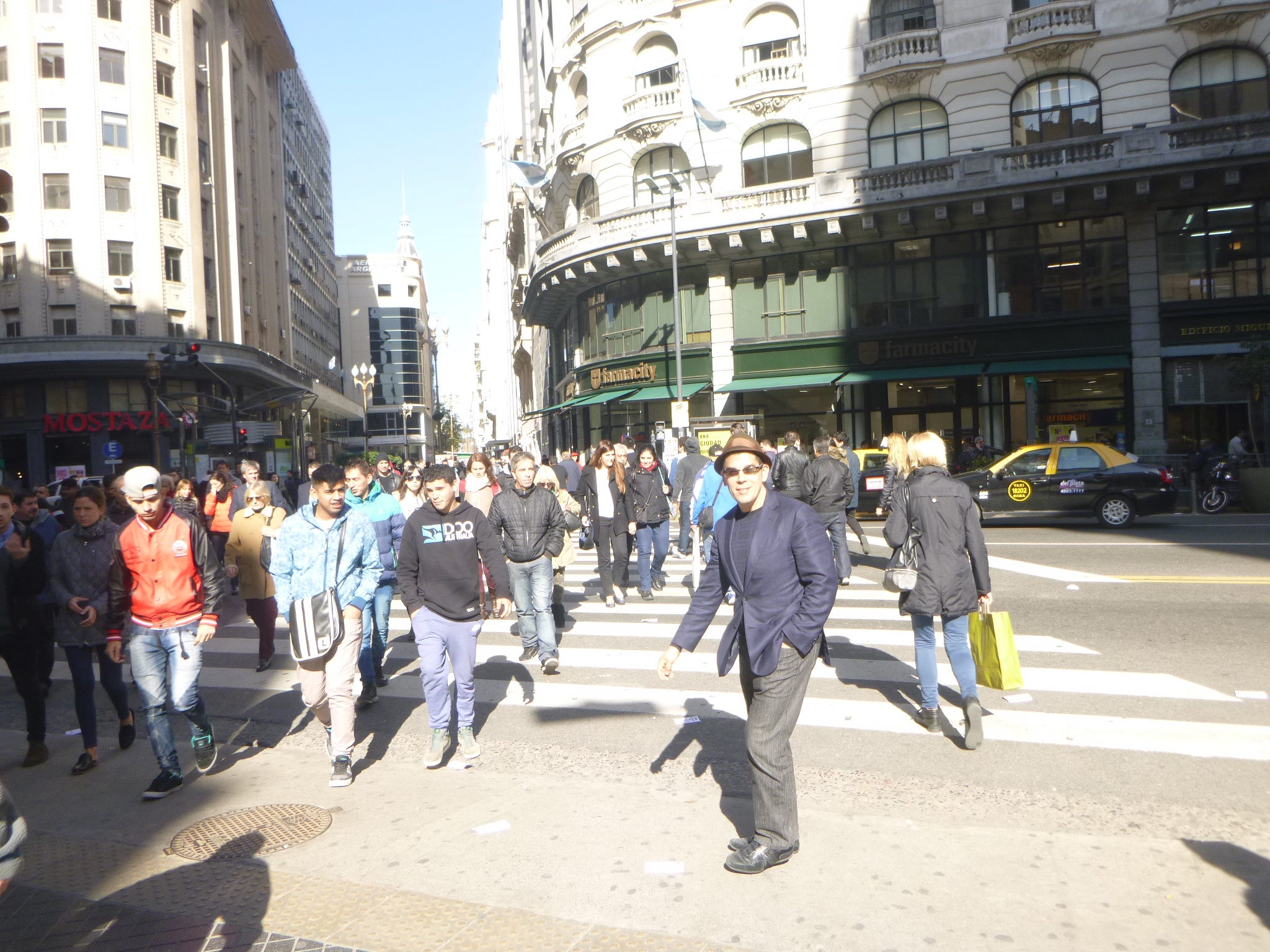
It’s true that there are relatively few Argentines who appear phenotypically African.
The problem is that we know that colonial Argentina was heavily African! And this is not some obscure recently-discovered fact; this has been well known, since, well, since Argentina was still a Spanish colony. Ebony magazine sent Thompson to Buenos Aires in 1973 because the past existence of a now-vanished African population was common knowledge. James Scobie wrote in his classic work, Argentina: A City and a Nation, “The disappearance of the Negro from the Argentine scene has puzzled demographers far more than the vanishing Indian.”
We know that colonial Argentina was heavily African! A census of Buenos Aires held in 1778 revealed an African population of 35%. (See Luis Wainer, La Ciudad de Buenos Aires en los Censos de 1778 y 1810.) As late as 1855, local B.A. surveys recorded race. George Andrews (page 41) estimated the total African population of Argentina in 1800 to be 69,000, roughly 22% of a total population around 310,000.
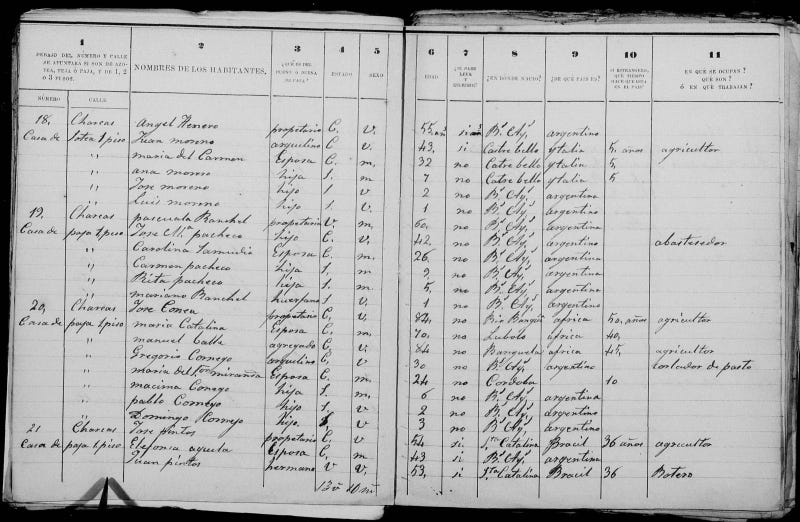
So what happened? One common story is that two somewhat deliberate events decimated the community. First, blacks were supposedly recruited in greater numbers to fight Paraguay in the War of the Triple Alliance, which killed large numbers of the male population. Second, yellow fever epidemics (particularly in Buenos Aires) did what conscription could not and further reduced the black population.
The genetic ancestry data cited in the last post, however, shows only about a 4% presence of African genetic markers. That is a lot less than 22%! Does that provide evidence of some great genocide or expulsion in 19th-century Argentina?
Probably not.
First, the starting population denominator of 310,000 is wrong. It doesn’t include the indigenous population nor a chunk of the far north. It’s not even consistent with a Spanish census undertaken in 1778. Fortunately, the Argentine government has made efforts to estimate the actual population in 1800, producing a figure of 552,000. That would reduce the African population share of the country to 12½ percent in that year.
Second, given the massive immigration to Argentina over the next 150 years, you’d expect the Afro-Argentine share to fall even if they had the same birth and death rates as the general population.
The population of Argentina grew by about 1.8% per year between 1800 and the first national census in 1869. (The link goes to the census; the data on the Argentine population is on page 686.) Now, there was some immigration to Argentina before 1869: by that year, 12% of the population was foreign-born, which implies a maximum rate of natural increase for the native-born population around 1.6%.
Let’s assume that the Afro-Argentine population increased at the same 1.6% rate as the overall population in 1800-69. That is a fairly high rate of natural increase for the time: it’s only slightly lower than the 2.2% rate of natural increase in the United States between 1800 and 1870, as estimated by Michael Haines. (See Table 1.) But we know that the rate of natural increase in Argentina was 1.3% per year in 1869-95 and 1.6% per year in 1895-1947, so 1.6% for 1800-69 is plausible.2

If you assume that the Afro-Argentine population continued to grow at the same rate of natural increase as the overall population after 1869 — a reasonable upper bound since Afro-Argentines were disproportionately located in Buenos Aires province and disproportionately urban — then you would have expected about 920,000 Afro-Argentines by 1947, roughly 4.5% of the total population of 15.9 million. By 2022, that number would have increased marginally, to about 4.6%.
And 4.6% is in the ballpark of what we see in the genetic data:
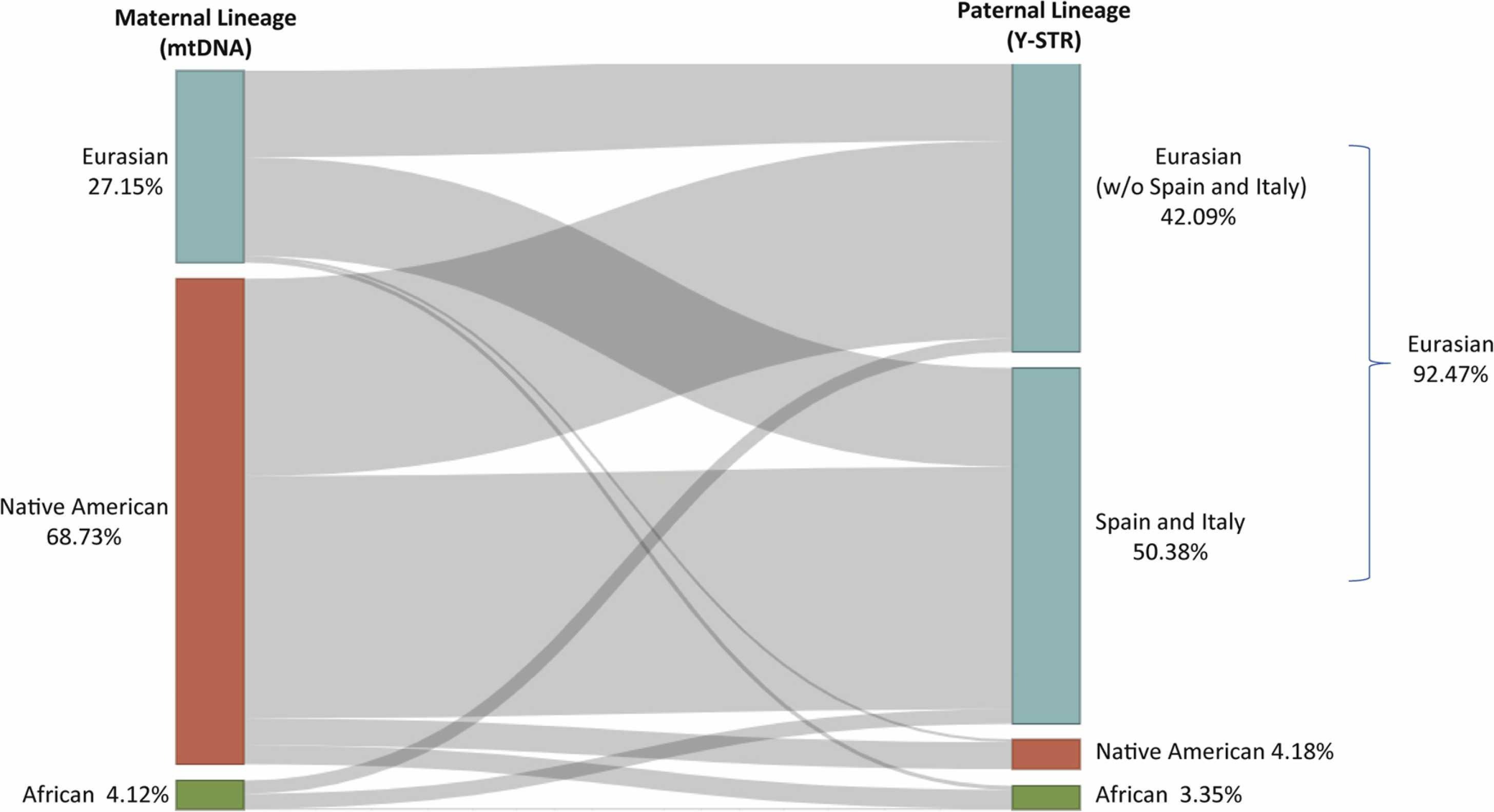
There still is room for some impact from differential mortality, particularly on the male side. But the observed admixture levels are within the range you would expect even if there had been no differential mortality at all, especially given the uncertainty around these estimates.
In addition, the evidence indicates a very large rate of exogamy: African y-chromosomes are overwhelmingly paired with Native American mitochondria and African mitochondria are overwhelmingly paired with European y-chromosomes. That implies that the African population was simply absorbed into the overall population. No need for genocidal wars or horrible plagues — just an open society.
You might think that there is an interesting class story here. But you would be wrong. Yes, it looks like African men married Native American women, whereas African women married European men. But that pattern was already built into the pre-1869 population! That population consisted largely of people with Native American mitochondria and European y-chromosomes. So the figure doesn’t tell you much about the social position of Afro-Argentines or how they were absorbed into the general population.
At most, the pattern suggests that the descendants of European immigrants were somewhat more likely to marry other descendants of European immigrants, which should surprise precisely nobody. Go listen to some Billy Joel songs. Or rewatch The Sopranos. And that’s just about Jews and Italians. Even if endogamy among the descendants of European immigrants had completely disappeared by 2022 you would still expect to see a pattern like the one in the figure.
So while there is a lot that we don’t know about the historical evolution of Afro-Argentine society and the terms of their integration into Argentine life — the Ebony article from 1973 is very worth reading! — there really isn’t much mystery about what happened to them. They melted into the Argentine melting pot.
Given Argentina’s economic situation in 2001, you have to wonder why the border officials thought that anybody would want to fake an Argentine passport.
Remember, a lower Afro-Argentine rate of natural increase means you’d expect their share of the population to fall even faster.
You might even say the Afro-Argentine population is...Hiding in Plain Sight! https://www.uapress.ua.edu/9780817360313/hiding-in-plain-sight/
Same thing happened in Mexico. During the colonial period, for many decades, Africans outnumbered European born individuals. Most Mexicans have about 1 to 5 percent Subsaharan ancestry