

In the one lonely comment to my last post — which got a lot of readership but not a lot of interaction — Yosef's Geo-Musings wrote: “Argentina (plus its neighbour Uruguay to a degree) is another country ‘where the gap between what is and what realistically could have been is so large.’”
I’m not sure that I agree with that, but it is true that Argentines tend to compare themselves with Europe, not with Latin Americans. They think of themselves as a nation of European immigrants.

But the genetic evidence complicates the country’s self-image. In fact, the genetic evidence shows a remarkable similarity to Puerto Rico!
Early DNA studies of Puerto Rico, from back when such things were new and neat, showed something a bit disturbing. Mitochondrial DNA, which is passed down through the female line, skewed Native American. But Y-chromosomes were entirely European and African. The implication is that something awful happened to the entire male Taíno population; they were either killed or denied the possibility of procreation. Likely both. Later studies upheld the results. Here is one from 2014, which sampled 326 people and found mitochondrial DNA that was 60% indigenous, 25% African, and 15% European, whereas male Y-chromosomes were 85% European and 15% African.
Argentine DNA samples also show a strong sex asymmetry, more like Puerto Rico that most people would expect. A 2010 study found that 54% of Argentine mtDNA came from indigenous sources while 94% of Y-chromosomes traced to Europe. These results are strikingly close to Puerto Rico (minus the large African admixture on the island) ... shockingly so for a country which received mass immigration from Europe in relatively recent times. More recent studies have confirmed this. A 2012 study from the Buenos Aires metropolitan area found that maternal lineages were 55% European and 44% Amerindian, whereas paternal lineages were 93% European and 6% Amerindian. A 2022 study of the entire country found that maternal lineages were 27% European, 69% Amerindian, and 4% African, compared to 92%, 4%, and 3% for the paternal lines.
More interestingly, while it was not uncommon for Argentines in the 2022 study to have Native American mitochondria and a European Y-chromosomes, it was vanishingly rare for someone to have an Amerindian Y-chromosome and European mitochondria, as you can see below:
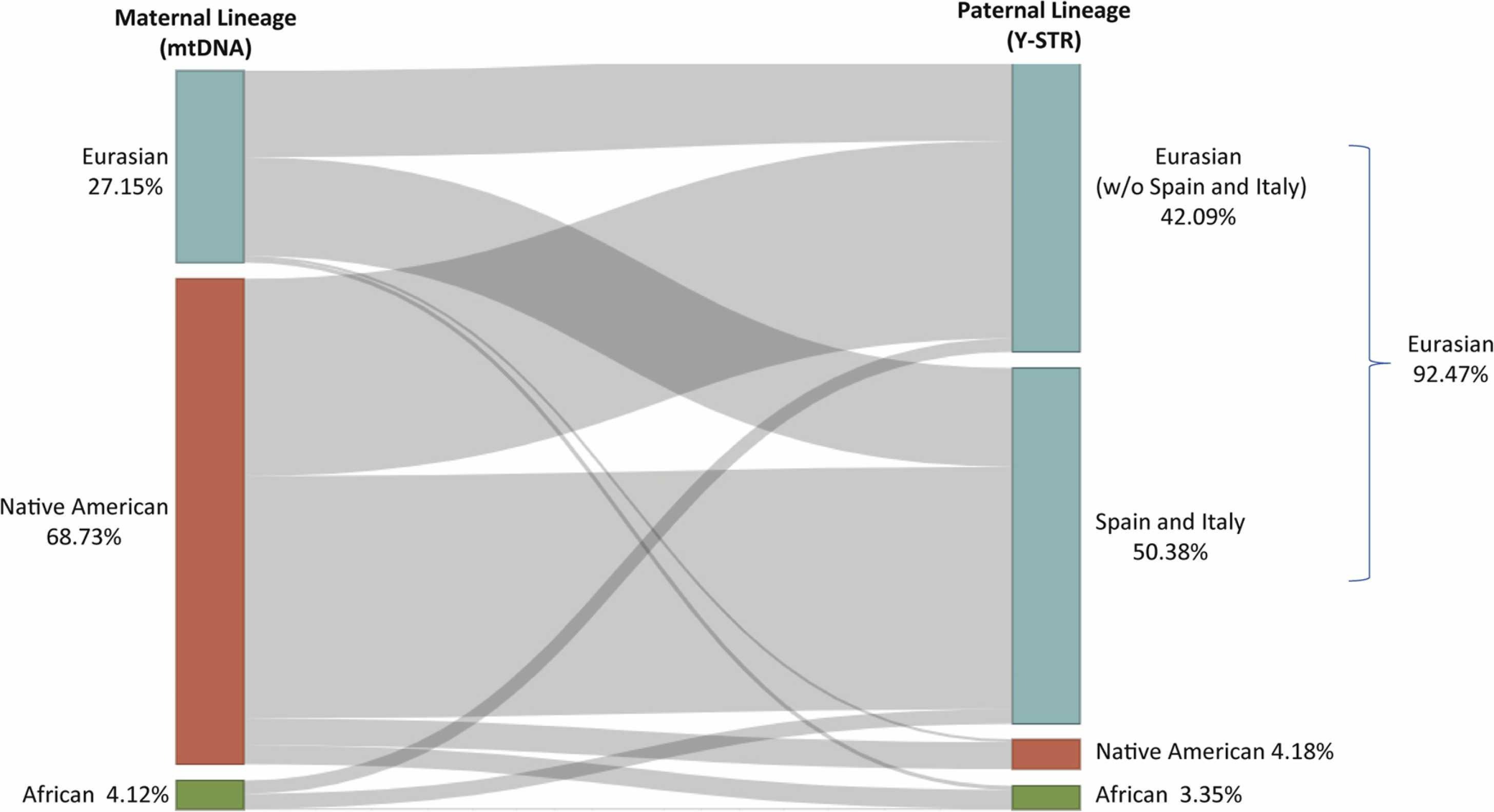
Argentina shows a sex asymmetry that looks surprisingly like Puerto Rico! The African proportion is lower, as you might expect, but otherwise there is not that much difference. Male lineages are overwhelmingly European and female ones majority Amerindian.
Now, one warning.1 The “Eurasian other than Spain and Italy” data are suspect. They use the R1b haplogroup to identify origin, even though R1b is as common in Portugal, France, Belgium, and the Netherlands as it is in Spain and Italy. Worse yet, even in Western Europe, only 57% of the population has it, as opposed to other Eurasian haplogroups. For example, Leticia Abad’s research shows that most of the early Spanish settlers came from Andalucía, where half of the population has haplogroup J. (If you know any Spanish history, you won’t be shocked to learn that haplogroup J is most common in Arabia.) Similarly, later Italian migrants came from northern Italy, where 10% of the population shows haplogroup I. So “other Eurasian” doesn’t rule out Spanish or Italian origins and “Spain and Italy” doesn’t guarantee it.
How can this be?
Argentina is typically thought of as a European settler offshoot, and with good reason. In 1895, 25% of the population was foreign-born, overwhelmingly from Europe and the Levant. By 1914, that figure was up to 30%. Gross immigration between 1857 and 1914 came to 4.6 million people; net immigration ran about 3.0 million. (Pages 201-02 of the 1914 census.) All this with a population of only 7.9 million in 1914! Add in the Argentine-born children of those 3.0 million post-1869 immigrants, and you have a veritable transformation of the population. You might reasonably expect Argentina to have a similar genetic makeup to, say, New Jersey.2

How can Argentine DNA resemble Puerto Rico, given the sheer size of the migratory wave? Well, that wave was not evenly distributed. Rather, as “javiero” points out, it was concentrated in the Pampas and left the north almost entirely untouched.
Differential birthrates diluted the wave’s impact over time by increasing the national weight of the lower-immigration north. Since 1914, the fastest population growth has been in the north. A back-of-the-envelope calculation produces the conclusion that only 24% of the current Argentine population can be traced to the foreign-born population in 1914. Note that this number is an average, because it assumes no intermarriage between the immigrants and the native-born. That’s a ridiculous assumption — the number of Argentines with at least one post-1895 migrant ancestor is going to be much much higher, well above half and probably above ¾ths.)

Now, the 24% number is uncertain. Pushing it down is the fact that almost half of Argentine immigrants in this epoch ultimately returned home. Pushing it up is the fact that there were already a lot of second-generation immigrants by 1914.3
Below is a (very rough!!) estimate of the Argentine population in a no-immigration counterfactual, assuming (probably correctly) that the northern population is almost entirely native-born and that the descendants of immigrants urbanize much faster than the entire population (quite possibly incorrectly).4 If those assumptions are accurate, then the share of Argentina’s cumulative population growth due to post-1869 immigration peaks at 52% in 1947 and declines until 2010, when it starts to rise again as South American immigration picks up steam and Argentine birthrates fall.
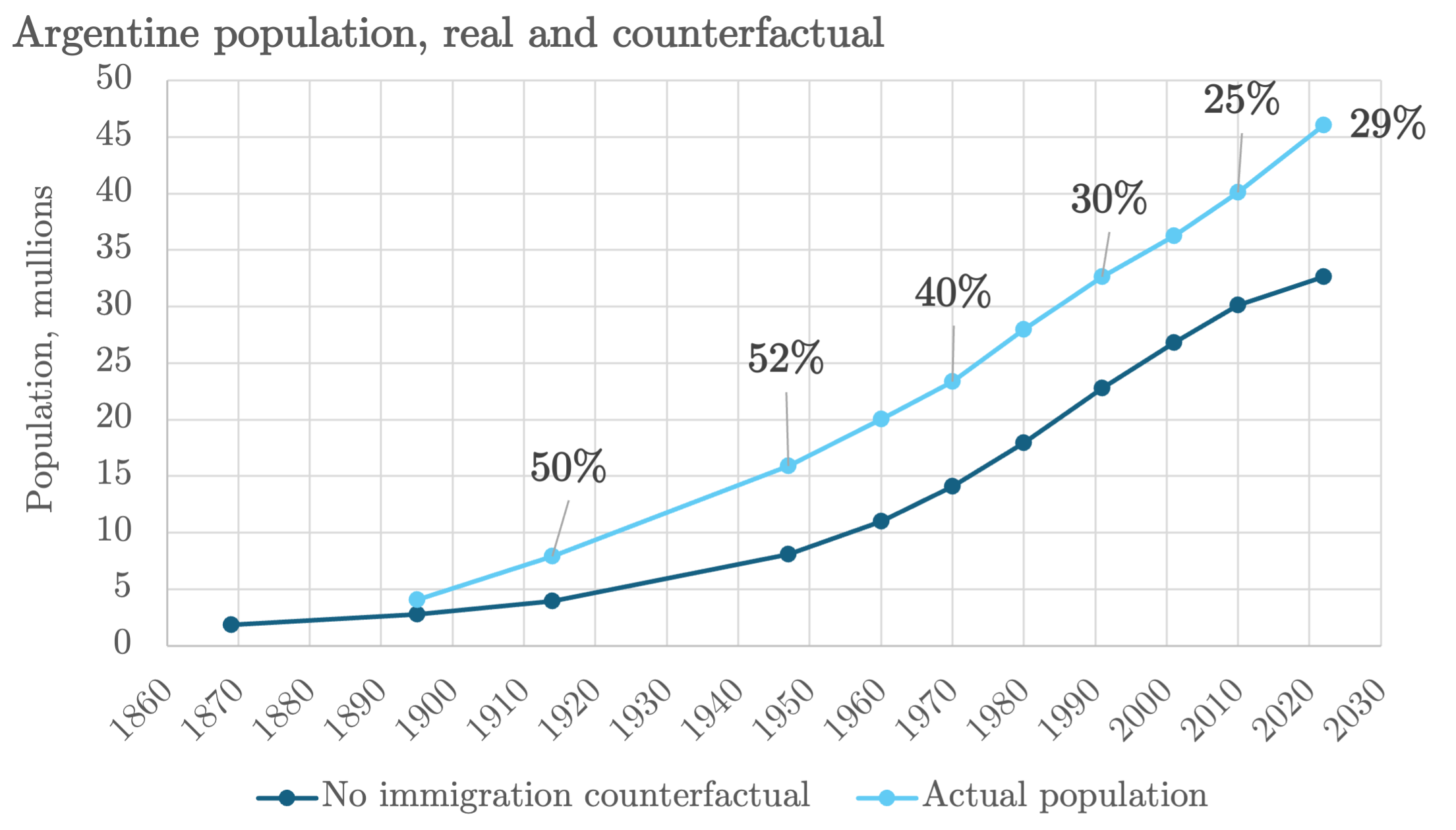
Please don’t forget that far more than 29% of the Argentine population has at least one immigrant grandparent or great-grandparent (let alone great-great grandparent)! These estimates only means that only 29% of Argentina’s cumulative population growth since 1869 was due to immigration.
These estimates help explain why mass European immigration did not erase the older genetic pattern. At some point well before 1860, a mestizo population emerged from Spanish men and indigenous women. (I shudder to think about what probably happened to the indigenous men.) That population was then diluted by the great immigrant wave, but the impact of that wave shrank over time due to differential birthrates between the low-immigration north and the high-immigration central pampas. The same story also better fits the heavy male skew of the 1869-1914 influx and the fact that roughly one-half of all immigrants to Argentina ultimately returned home.

What would a country reshaped by immigration look like?
It would look like the United States.
Much more of U.S. population growth seems to be due to post-1860 immigration than is the case in Argentina. Here’s a back-of-the-envelope exercise from Charles Lehman, using a method not-unlike Javiero’s (or mine), and applying it to the non-black population of the United States:
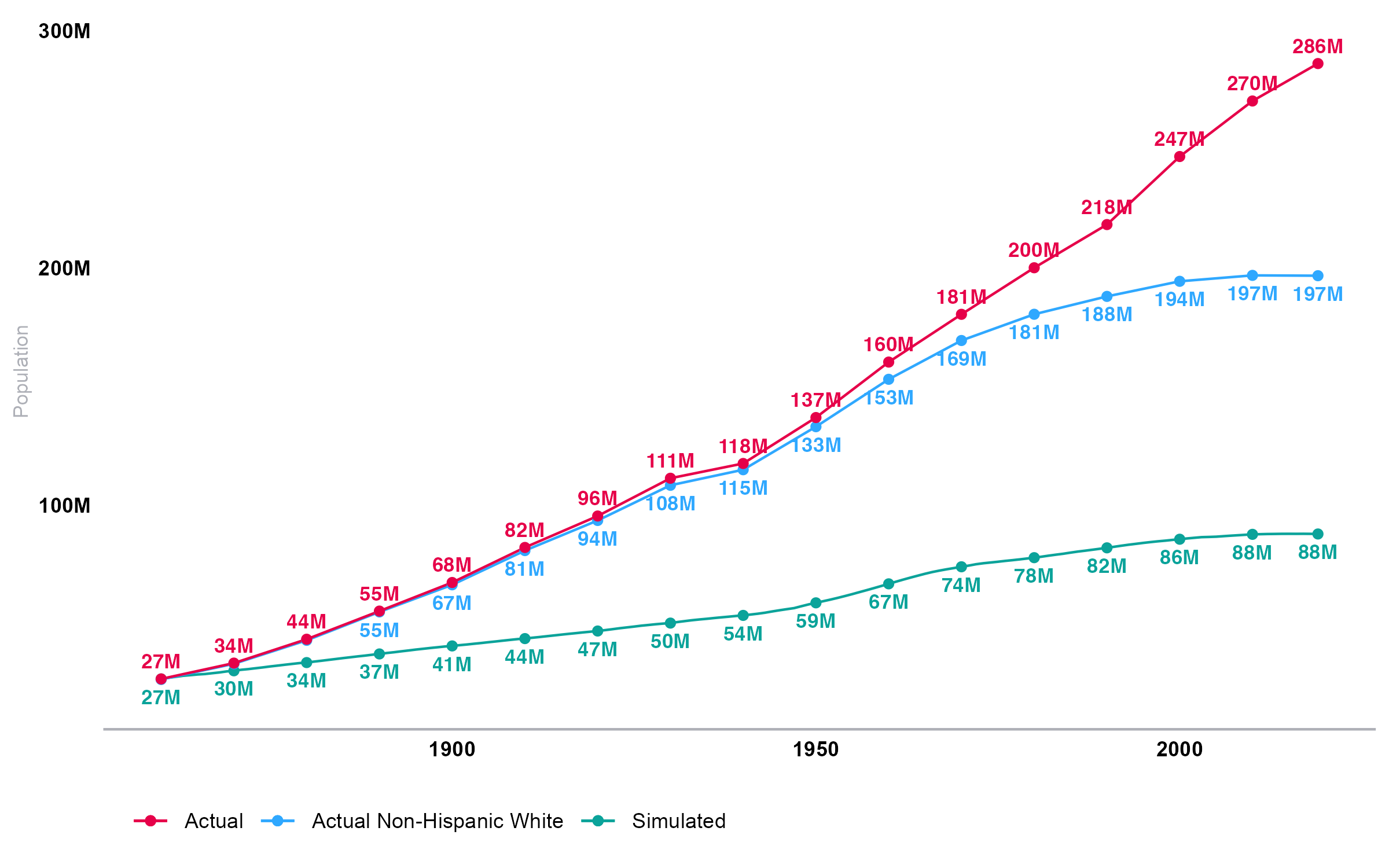
If the above is correct, then Elvis Country really did shrink in North America! Fully 69% of U.S. post-1860 population growth is due to immigration. Now, these estimates leave out the African-American population (they were created to ask a different question than the one posed here) and therefore leave out substantial immigration waves from the West Indies. But including them would only strengthen the conclusion.
To be fully comparable to Argentina, we’d probably want to look at two other numbers. The first is 1970, close to when the foreign-born share of the population bottomed out: immigration’s cumulative contribution to American growth was 59% in that year, against 40% in Argentina. Similarly, if you just look at the non-Hispanic white population, where immigration followed a rise-and-fall pattern similar to Argentina, immigration’s contribution to the growth of the white population peaked at 57% in 1980 and was still 55% in 2020. That is much more than our estimated 29% for Argentina.
A brief demographic history of Argentina
At the level of maternal and paternal lineages, the colonial period appears to have looked a lot like Puerto Rico. Something (probably bad) happened to the indigenous men, resulting in a mestizo population. After 1869, a massive wave of European immigration landed on top of these mestizos, but it was regionally concentrated. Later northern population growth increased the national weight of mestizo Argentines, and male-skewed immigration and return migration further limited the long-run impact of the European wave.
Argentina is not simply a South American version of the classic nation-of-immigrants model. Nor is it a simple extrapolation of the colonial society. It’s a country where an old mestizo substrate that looks a lot like Puerto Rico survived beneath a later immigrant overlay and re-emerged over the 20th Century, more strongly than the national myth admits.
Or, if you’re more willing to risk cancellation, you could just paraphrase Argentina’s former president: “A lot of Argentines arrived on boats, but a lot of them went back home, and a lot of our grandmothers came from the Indians. The boats, though, they really did come from Europe.”
I considered putting this in a footnote, but it’s too important.
My dearly departed father certainly thought so, when he would joke, “Argentina is what happens if you give our people a country without the WASPs to reign us in.” To him, “us” might have meant the whole Ellis Island 1880-1920 wave of immigration — but probably just Italians and Jews. If you’re ever in Buenos Aires, go eat at Mishiguene.
A 35% figure from a 1949 French book on demography gets thrown around a lot, but its provenance and accurateness is unknown.
Don’t be surprised if you return to this post in the future and find this section in strikethrough with new and completely different estimates in its place.
With Mexico, from all sources I have seen, Valley Of Mexico and Southern Mexico received more European migrants than Center West and Northern Mexico. But why are the latter two more European in genetics? First of all, lower prexisiting Ameridian populations. Second of all, cities were population sinks during the pre modern period, so lots of Europeans that ended up in places like Mexico City did not leave that many descendants. Lastly, Center west and Northern Mexico did not have nearby Ameridian peasant population who costanly move to nearby cities and towns.
> You might reasonably expect Argentina to have a similar genetic makeup to, say, New Jersey
That's the image many people still have, instead of the more realistic "New Jersey stitched together with Coahuila". Assuming stitching includes intermarriage, of course.
Thanks for the shout-out! And I should have made the point that: "the number of Argentines with at least one post-1895 migrant ancestor is going to be much much higher". I'm pretty sure there's a chart of autosomal ancestry for a sample of Argentine individuals somewhere, and that it illustrates this point perfectly.