

People seem to think that the Bolivarian Republic of Venezuela — and now by proxy the United States — is sitting on untold riches. For example, the Kobeissi Letter has 2.3 million followers, and it claimed the country is sitting on “$17.3 TRILLION” of oil:
Even if the US sells this oil for HALF of the market rate, that's still $8.7 TRILLION. In other words, in 12 hours, the US has gained control of oil reserves worth more than the entire GDP of ALL countries in the world, aside from the US and China. That's 4 TIMES larger than the GDP of Japan. Most people do not realize how much the world just changed.
Joel Shulman at Forbes calculated that Venezuela’s reserves are worth $18 trillion at $60 per barrel and $45 trillion at $150. Business Standard reported $18.4 trillion. The President of the United States interrupted a reporter who asked him about Venezuela’s “$17 billion worth of oil reserves,” to say, “You mean, trillion,” to general laughter.

And it’s all wrong. Completely wrong. Fake news. Venezuela’s subsoil resources aren’t worth a fraction of that amount. Hell, they’re not even worth 2 percent of $17 trillion. Say about $300 billion, tops. I’m here to bury all this talk of trillions and calculate the real value of the black gold under Venezuela’s soil.
Oily arithmetic
Let’s say I told you that I was gonna give you 300 one-ounce bars of gold. That’s worth more than one million dollars! But because I’m an asshole, I’m gonna insist that you pay me $10,000 right now up front for the combination to the safe. And because I’m an even bigger asshole, I put the safe in Brazzaville, Congo, so you’re gonna hafta fly there yourself to get them. And because I’m the world’s biggest asshole, I’m only gonna let you take out one bar every month. That would be worth a lot less to you than one million dollars right now in cold hard cash.
Same thing with Venezuela’s oil. You gotta invest in oilfields and transportation up front — that’s the $10,000 vig in the above example. Then you gotta spend money to pump it out — that’s your plane ticket to Brazzaville. And you can only get the stuff out so fast — that’s the one bar per month limit. Venezuela may be sitting on $17 trillion “worth” of oil, but nobody in their right mind will pay the country that much for it. Their actual worth is a function of how fast the oil can be pumped, how much it costs to get it out of the ground, how much it sells for, and the discount rate you apply to cash flows that won’t appear until far in the future.
In January, I used data from Rystad to explore the economics of Venezuelan oil. Rystad estimated that restoring output from roughly 1.1 million barrels per day (bpd) to 3 million by 2040 would require $183 billion of capital spending, including $53 billion to maintain existing production and $130 billion for expansion. So we’ll use those numbers to estimate the amount of capital spending needed to get production back up to 3 million bpd.
But why stop there? In 1998, PDVSA’s CEO announced plans to get production up to 6.4 million bpd by 2007. (Hugo Chávez assumed office the next year.) A few years later, in 2005, PDVSA announced new plans to increase its output to 5.8m bpd by 2012. Regarding the latter plan, the U.S. GAO wrote, “Some industry experts told us that the expansion plan is technically feasible and that Venezuela’s oil revenue in recent years has been sufficient to fund the plan. However, many oil industry officials and experts expressed doubt about the government’s ability to implement the expansion plan in the near term for several reasons.”
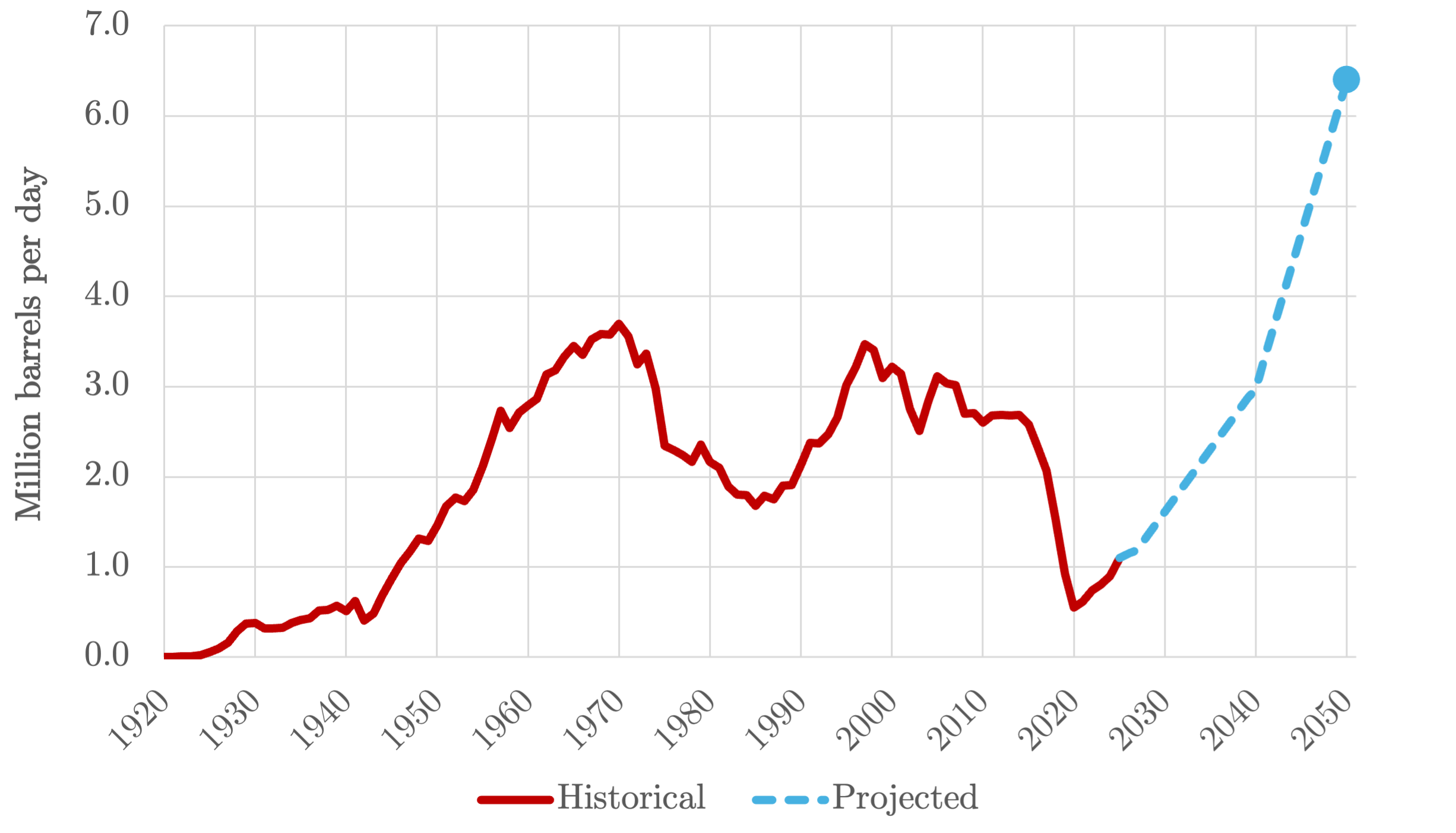
A competent oil company run by a reasonable government should be able to execute that expansion. So the scenario here assumes that production hits 3 million bpd by 2040 (in line with Rystad) and then 6.4m bpd by 2050. It also assumes a real oil price of $70 per barrel and a 12% discount rate.
These assumptions give you a net present value of $227.6 billion for the cash flows through 2050. Of course, projected cash flows after that date are still worth something today — even at 12%, people aren’t that shortsighted — and the current value of those future cash flows is $63.7 billion. Add them up, and you have a total value today of $291.3 billion for Venezuela’s oil production tomorrow.
How much is that per barrel? Well, it depends on how many barrels you think are under the ground. Venezuela says 303 billion barrels. The USGS estimates 513 billion barrels of “technically recoverable heavy oil,” but that’s not the same thing as “3P
reserves: i.e., the sum of proved (1P), probable (2P minus 1P), and possible (3P minus 2P) reserves. If we assume that the ratio between “technically recoverable” oil and 3P reserves is the same in Venezuela as it is in Canada, then the BRV has about 168 billion barrels under the soil. Francisco Monaldi is the expert, however, and he convincingly argues that PDVSA recovers only about 7-8% of the extra-heavy oil in the ground, not the 20% it claims in the official reserve calculations. He reckons that the correct number is about 110 billion.
I trust Francisco. Using his number implies that Venezuela’s oil resources are worth about $2.65 per barrel, or roughly $10,000 per man, woman, and child in the American Bolivarian Republic.
Canadian content
Alternatively, we can value Venezuelan resources by looking at what other buyers have actually paid for similar plays. I found (with some help from a talking computer, I’ll admit) six roughly comparable Canadian transactions from the early 2000s. These were all purchases of undeveloped or lightly developed heavy-oil resources where buyers expected to spend heavily to expand production, which makes them roughly comparable to Venezuela in 2026:
After converting the transaction prices to 2026 U.S. dollars, we get prices per barrel between 88¢ and $1.52. Now, those numbers take into account taxes and royalties paid to the Albertan and Canadian governments. Since we want to know the value of Venezuelan oil reserves to the Venezuelan people, we have to add back the government take. I assumed about 40% as a first approximation, which gives valuations between $1.46 and $2.54 per barrel.1
Our estimate of Venezuelan oil, $2.65 per barrel, is only a little above the Canadian numbers. That doesn’t mean that it’s correct — Venezuela might have more oil than Monaldi believes, or require a higher discount rate to account for risk — but it does give confidence that we’re in the ballpark.
Bottom line
Assuming $70 oil, a 12% real discount rate, and that the country can increase its output, Venezuela’s oil resources are worth about $290 billion. That puts it somewhere between McDonald’s and Jack-in-the-Box in terms of value. It’s maybe 20 days of federal tax revenue. It is about $10,000 per Venezuelan, which is not nothing from their perspective. But even if you take President Trump’s statements that we control the oil at face value, it’s really not a whole lot of money from the perspective of the United States.
Trillions my foot.
This is a fudge factor — oil sands royalties in Alberta run about 1%-9% until all capital costs have been recovered, after which they jump to the greater of the 9% off the top or 40% of net revenue. Provincial and federal income taxes sit on top of that.