

Cuban history is one of colonization. The irony is that every time the island has been decolonized, it suffered. That sad movie is playing out again, as Cuba collapses without its Venezuelan lifeline.
After the Revolution, Cuba became an integral part of the Soviet system. The Revolution was a domestic affair, but Soviet support made it much easier to stamp out markets and capitalism and build something more Catholic than the Pope. In other words, in a world where the Movimiento 26 de Julio takes power but receives no Soviet support, Cuba might have still swung hard to the left, but it would have been simply impossible to dismantle the private sector as thoroughly as it did.
When the Soviet Union collapsed, so did Cuba. But it managed to reform enough to buy time to find a second sponsor: this time the Bolivarian Republic of Venezuela (BRV). Venezuelan aid was never as large as Soviet aid, so Cuba had to continue to develop its tourist sector, but it was enough to forestall more thorough reform. Most shockingly, Venezuelan aid allowed the socialist Republic of Cuba to ignore the collapse of its agricultural sector.
Now, with the last vestiges of Venezuelan support disappearing, and the Americans going after the viability of the tourist sector, Cuba is facing collapse again.
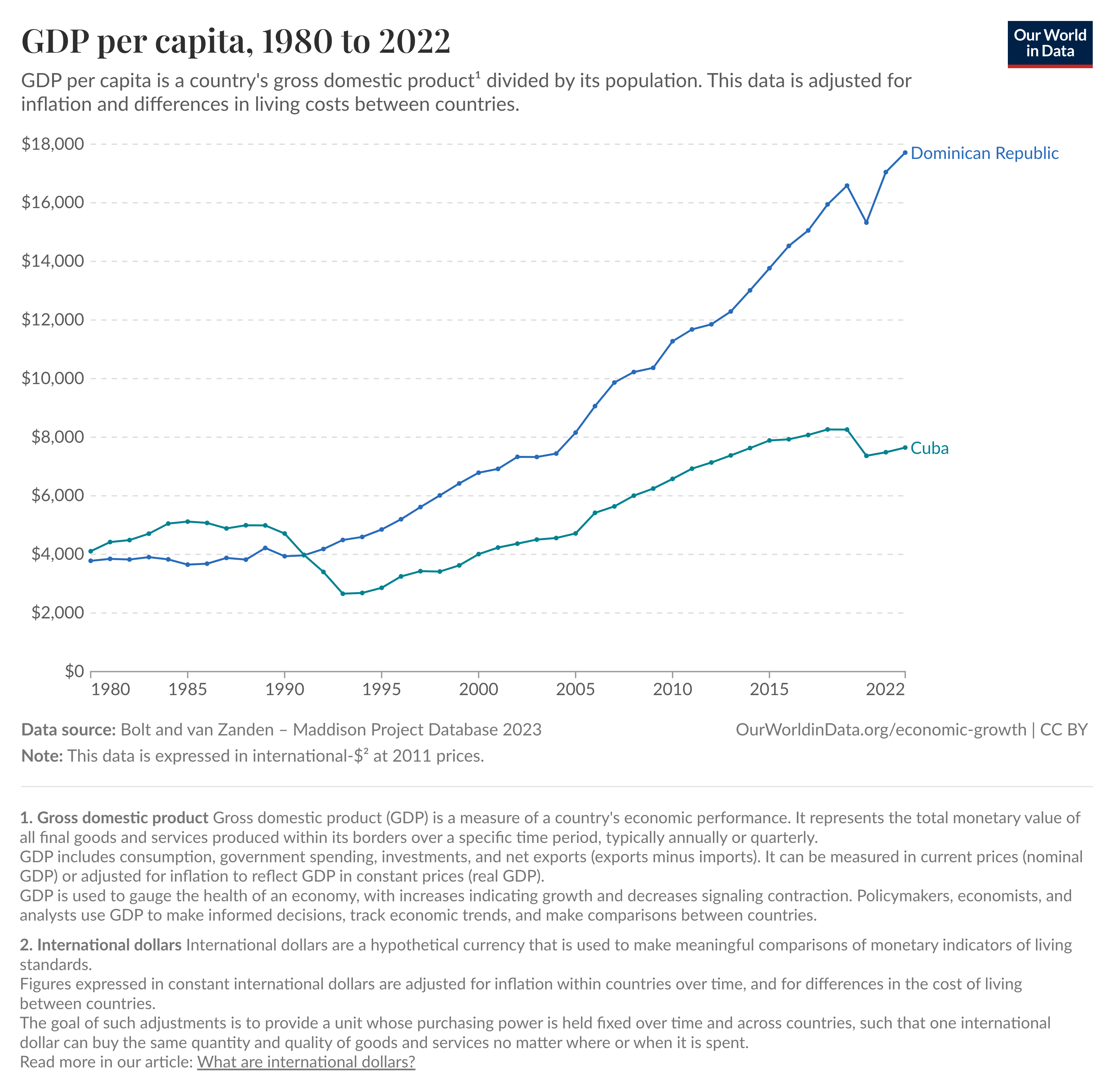
This wouldn’t be the second time the perennial colony of Cuba collapsed because a foreign patron unilaterally decolonized it withdrew its support. It would actually be the third. In the 1930s, the United States wrapped up its semiformal empire on the island and what do you know? The economy collapsed, and hadn’t really recovered by the 1950s.1
In all three cases, the collapse provided an opportunity for reform that was not taken. In Cuba’s case, “decolonization” usually means its foreign patron yanks away the subsidy that has been covering the system’s internal contradictions, and the resulting crash is the moment when reform is possible but repeatedly rejected.
Two threads run through all three cases, more thoroughly each time. First, in all three cases the Cuban tail tried to wag the imperial dog: with slight success in Washington, much more in Moscow, and downright domination in Caracas. Second, in all three cases the Cubans would have preferred a much more formal relationship than the one they actually got, in order to protect themselves from the political winds in the metropole, but in all three cases they ultimately failed.
This series of three posts will move backwards through three empires that dared not speak their name: Venezuela, the Soviet Union, and the United States. Here we’ll briefly review the current crisis and then dive into the Venezuelan connection.
The current crisis
Cuba is on the brink of collapse under an American quasi-blockade. I am choosing my words carefully. The long-standing U.S. embargo was most emphatically not a blockade: Cuba could trade with anyone they wanted, as long as the counterparty was willing to pick a fight with Washington about the Helms-Burton Act. And trade they did! Europeans bought vacations and the Chinese bought cigars and all was … not precisely well, but well enough.
But this time is different.
The United States is putting the screws on all petroleum imports. And even though the U.S. Navy hasn’t (yet) stopped any tankers, everyone knows that the United States has turned into the honey badger of the Western Hemisphere. We don’t need to stop tankers because everyone increasingly believes that we would. Even poor President Sheinbaum of Mexico is going along. Cuba has some domestic oil production, but at some point what’s left of the transportation network is going to seize up.
The Trump administration has declared that any Europeans traveling to Cuba will be denied visa-free access to the United States … and good luck getting a visa.
To be frank, it’s hard to imagine regime collapse. There is no opposition in Cuba and state control remains strong. But power supplies are collapsing and transportation will soon freeze up. With no serious sources of foreign exchange, the country will become dependent on foreign food aid. The thing is, the governments of North Korea and Venezuela both survived science-fictional economic collapses. Moreover, neither of the previous two collapses led to rapid regime change. Unless the U.S. decides to step up its actions, it’s not clear why this time should be different.
Venecuba, a single nation
From the Economist, in 2010:
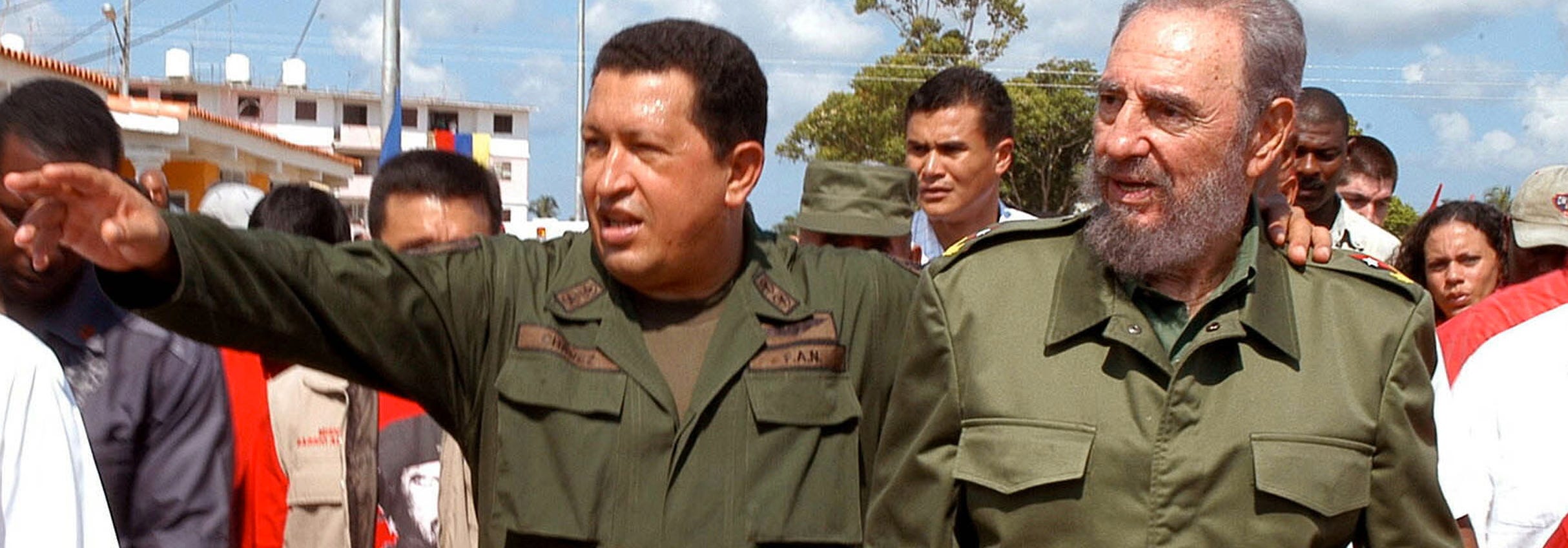
When he was visiting Cuba in 2005 Fidel Castro said publicly to him that their two countries were “a single nation.” “With one flag,” added Mr Chávez, to which Mr Castro replied, “We are Venecubans.”
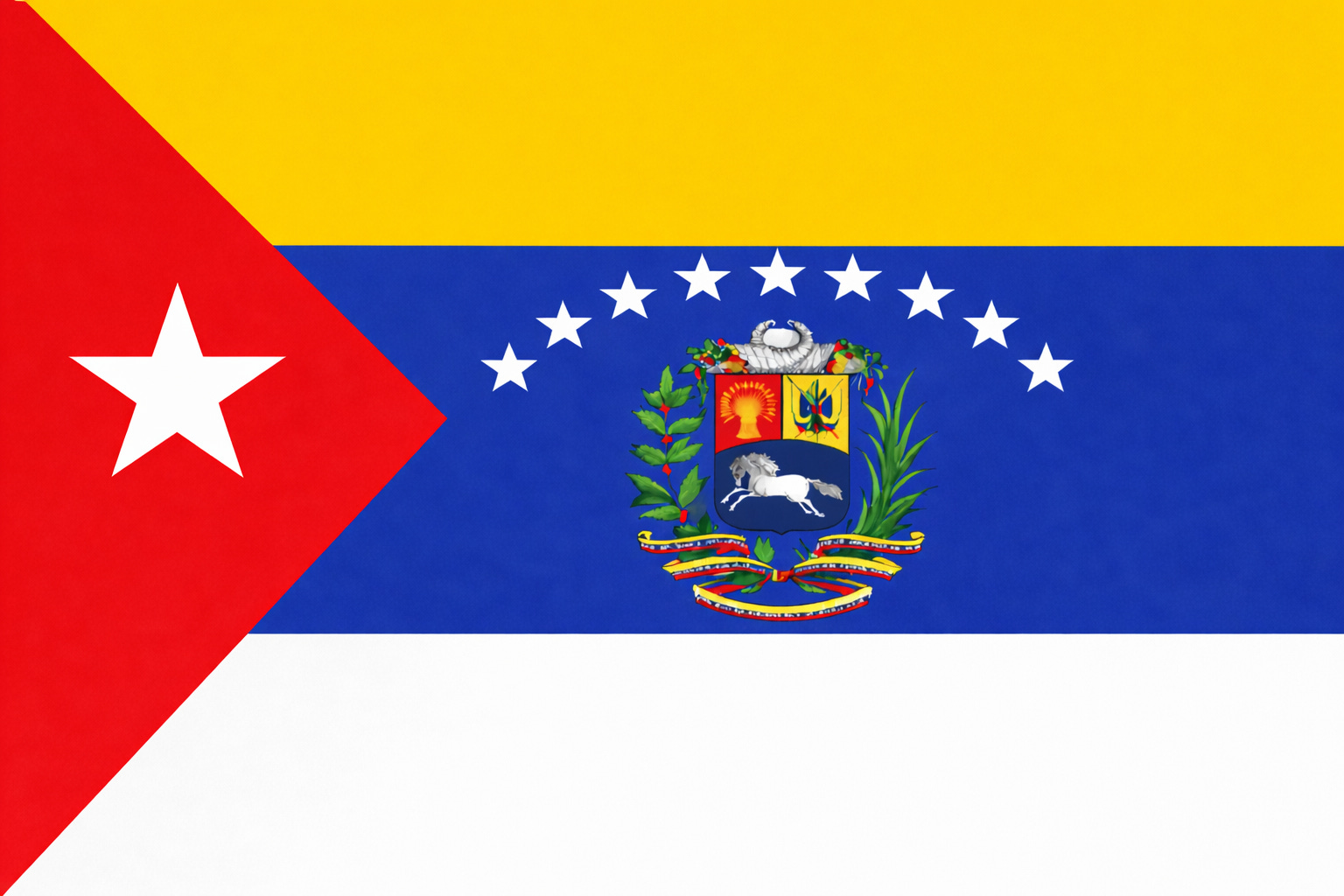
Analysts disagree as to whether Mr Chávez or Mr Castro intended to formally unite the countries. We do know that Chávez floated the idea of a “Bolivarian Confederation” between the two at various times and in 2007 he went to the voters and asked them to change this (very boring and legalistic) article of the Constitution:
Article 153: The Republic shall promote and encourage Latin American and Caribbean integration … the Republic may transfer to supranational organizations, through treaties, the exercise of the necessary authorities … Provisions adopted within the framework of integration agreements shall be regarded as an integral part of the legal order in force, and shall be applicable directly and with priority over internal legislation.
to this turgid but nonetheless much less boring paragraph:
Article 153: The Republic shall promote the integration, Confederation, and union of Latin America and the Caribbean with the aim of configuring a great regional political, economic, and social power bloc. In order to obtain this objective, the State will favor the construction of new models of integration and union across our continent, to permit the creation of a geopolitical space within which the peoples and governments of our America shall construct a single Greater National project, which Simón Bolívar called “A Nation of Republics.”2
The prose is terrible, but terrible in a recognizably leftist manner. Substantively, the change in wording would have altered little …but approval of the new version would show popular support! A Nation of Republics! He might as well have run up a flag reading: us and Cuba, man, how about it?
Well, the public said “no.” Three years later, in 2010, a poll showed that 85% of Venezuelans didn’t want their country to become “more like Cuba.”
So that didn’t happen.3
But what did happen was a massive informal integra … no, it was more like a Cuban takeover. The island of Cuba got oil. Mainland Venezuela got good doctors, very good secret policemen, and plenty of Cuban bureaucrats. Those bureaucrats wound up effectively running the security services, the presidential guard, the economic planning bureaucracy, and much of the military.
Formally, the core of the system was a trade. Cuba sent over advisors and medical personnel. The Venezuelans paid not the individual Cuban expats, but the Cuban government, mostly in the form of crude oil. The Cuban refinery at Cienfuegos refined that oil … and sent much of it back to Venezuela for foreign exchange. Of course, Havana overcharged for its part of the trade, and Caracas happily went along.
Cuba did very well out of Venecuba, even if it failed to fully formalize the relationship, which might have offered some protection against Venezuelan political winds (if not necessarily the 160th Special Operations Aviation Regiment). Venezuela overpaid for the doctors; Cuba underpaid for its oil. There is a way to come up with a rough idea of the subsidy. On the doctors’ side, we can subtract the amount taken by the Cuban government from the salaries and support received by the doctors. On the oil side, Cuba paid for its oil on credit, which it never paid back. So add those two numbers, and you’ll have a very rough idea of the size of the Venecubano transfer.
Aritmética venecubana
To the numbers! How big was the subsidy?
Cuban GDP
First we need to know Cuban GDP. That’s not easy! For reasons that maybe made sense before the Trump administration, the World Bank and IMF all value Cuba’s GDP at the official exchange rate of one peso per dollar. Except that’s silly — the parallel market rate for the peso averaged 24 per dollar after 2005. That implies that we should just divide Cuba’s official GDP by 24, but that’s silly too: the one-to-one exchange rate really did apply to huge chunks of the economy, like the tourist sector! In 2020, Pavel Vidal did the work and calculated an average exchange rate of 2.38 per dollar. That cut the figures for Cuba’s nominal dollar GDP in half.
Still, 2.38 per dollar seems high: the calculation assumes that the official rate applies to the entire public sector: the “state business system and mixed capital, public institutions, fiscal budget, rationed consumption markets, public services to the population, banks.”4 That seems wrong. Lots of what state companies did involved purely domestic transactions — say, confiscating agricultural production from Cuban farms and transferring it to rationed markets, or paying for investment using workers paid in CUP rather than CUC. In 2021, the Cuban government unified the exchange rates and the resulting average rate crashed from 2.4 per dollar to 26 per dollar.
Did the country’s dollar GDP really fall tenfold that year, or was that just when the Cuban government recognized reality? I mean, sure, you state expenditures and investment spending at the 1:1 exchange rate, but would any foreigner have been willing to pay for the resulting services and equipment at the 1:1 price?
Well, no. Prices soared by a factor of five while the exchange rate collapsed by a factor of ten so maybe nominal GDP dropped “only” by half. That’s well within the experience of other countries experiencing crises on the level of the one that shellacked Cuba in 2020-21, so let’s accept the Vidal numbers and move on.
Venecuban transfers
Now we need to know the scale of the transfers from Venezuela to Cuba.
This is a blog substack, so I’ll keep it quick and dirty. Werlau (2013) estimated that Venezuela paid about $5,000 per month for each Cuban doctor — an extravagant number; you could hire an entry-level family doctor from Spain — but the doctors themselves received only $900 to $1,740 per year for their services. If that’s true, then you could reasonably conclude that the whole program is pure subsidy.5
But that’s probably not correct. First, the Cuban doctors really did provide value. Second, many of those Cuban doctors were basically drafted into the program, so Havana could pay them wages far below market. Some of the rents, therefore, were extracted from them, not from the BRV. We don’t want to include that in the calculation of Venezuela’s transfers to Cuba. So let’s value the doctors at their replacement cost, using the $940 average monthly salary for Venezuelan doctors. If Venezuela was paying roughly $5,000 a month per Cuban doctor, but the replacement cost of a public-sector doctor was only $940, then the gap is a crude lower-bound resource transfer to the Cuban state. Multiply that $4,060/month gap by the total doctor-months Venezuela brought in in 2007-17 and you get a total transfer to the Cuban state of $53 billion in 2007-17 …
… unless you believe that Cuba’s organizational services were worth an 80% margin. Maybe. I could be biased, but I have trouble believing that.
Then let’s get a low estimate for the underpayment for crude oil. I’m going to do something … uh … crude: treat the unpaid oil credit as a transfer. The actual terms are opaque, but there is a 2019 estimate that Cuba owed the Venezuelan government $11.4 billion, which most observers agree the BRV never intended to collect. We can allocate that unpaid-debt stock across 2007-17 in proportion to annual physical oil shipments. This ignores aid flows, price discounts, refinery investments, and refined-products pricing, so it is a lower bound.
In a bit more detail: First, it ignores Venezuelan aid projects, such as the expansion of the Cienfuegos refinery. Second, it ignores the fact that Cuba refined a lot of Venezuelan oil and sent it back to Venezuela, in essence capturing the crack spread for itself. I am not adding pricing/refining margins here, only unpaid credit. Third, it leaves out the fact that half of all Venezuelan petroleum exports consisted of refined products, which were sold at less than market prices (or Cuban refining costs). Finally, who knows if that $11.4 billion debt figure is comprehensive? I know many U.S. Army finance officers who would love to poke around inside the BRV’s accounting — MOS 36A, it’s a good career — but sadly those records are still in Delcy Rodríguez’s hands.
That said, it does give us a rough lower-bound estimate of the size of the transfers:
These numbers are enormous. They’re on the order of the net subsidy that Alabama receives from the rest of the United States (roughly 15% of Alabama’s GDP), only the rest of the U.S. receives considerable benefits from its spending in Alabama: the 20th Special Forces Group, Army aviation at Fort Rucker, the rocket research in Huntsville, keeping the interstates open across the state, the emotional benefit from helping fellow Americans, etcetera. It is unclear at best what the average Venezuelan got from their government’s massive support for Cuba.
Venecuba is (was?) a thing
The BRV government, on the other hand, got a lot of value out of its support for Cuba. It tamed its own military, created a police state, took control of the economy (albeit incompetently), and developed new surveillance systems. In addition, the BRV benefitted from the mystique surrounding Fidel Castro and his Revolution. Consider:
During the 2002 coup, Chávez was suicidal, but Fidel Castro talked him down and convinced him to neither kill himself nor resign. The Chavista defense minister at the time later stated that the call with Castro was “the determining factor. His advice allowed us to see better through the darkness. It helped us a great deal.”
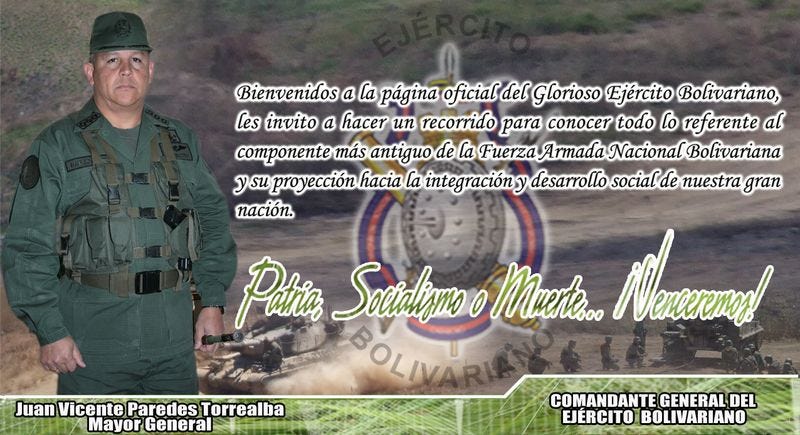
Venezuela renamed its armed forces the Bolivarian National Armed Forces (FANB) and redesigned the uniforms along Cuban lines. Cuban ideology permeated the whole organization:

If you don’t know the origins of “Homeland, Socialism, or Death … we will win!” well, now you do. It comes directly from the slightly shorter Cuban version from 1960: “Homeland or Death, we will win!” It says something that it was the Venezuelans what added the “socialism.”
Thousands of Cuban trainers arrived, who were “housed in military installations and given lodging, food, and transportation.” But it didn’t stop there …
In 2008, Venezuela allowed foreigners to serve in the military. This was clearly aimed at Cuba. At first, Cuba limited its involvement to placing officers in the FANB planning apparatus, but according to Venezuelan military sources who talked to a pair of American academics, Cuban personnel eventually took direct command of logistics, support, and transportation. Only the President stood above the Cubans in the chain of command. (Honestly, given the Venezuelan military’s disastrous attempt to mobilize against Colombia in 2008, this was certainly helpful.)
Cuban officers monitored and reported on military morale, both for officers and the enlisted ranks. Cubans (reportedly wearing either civilian clothes or distinctive black uniforms) in Military Counterintelligence Directorate (DGCIM), were stationed inside FANB facilities where they would “compile dossiers on perceived troublemakers and report any signs of disloyalty, according to more than 20 former Venezuelan military and intelligence officials.”
Cuba developed Venezuela’s “Homeland Card” system, which has proven to be an incredibly useful instrument of machine politics and political repression.
“Cuban officers control Venezuela’s public notaries and civil registries. Cubans oversee the computer systems of the presidency, ministries, social programmes, police and security services as well as the national oil company,” reported Moisés Naím in the Financial Times.
Finally, the two governments signed agreements which, in the words of the U.S. embassy in Caracas, allowed “cooperation in investigating political crimes and offenses which are considered illegal in only one of the two countries.” It also allowed Cuban officials to “act directly in Venezuela, without judicial supervision, to investigate people and property for trials in Cuba.” Later agreements in 2010 and 2018 extended the ability of Cuban police to “to carry out intelligence and police tasks in Venezuela.”
And, as mentioned before, it was Cuban soldiers around the Venezuelan president whom U.S. soldiers killed during the Maduro raid.
Now Vene and Cuba have separated
Venecuba was falling apart well before the U.S. Army invaded Venezuelan airspace. The mainland’s economic mismanagement meant that it could provide less and less economic support for the island. The “Greater National” projects mostly came to naught, the Cienfuego refinery expansion aside. Cuba was forced into wrenching economic adjustments after 2018, with particularly painful adjustments in 2021 and 2024. And now the last of the Venezuelan links is cut off.
The future is precarious. I admit, I am skeptical that the Cuban regime will fall unless the U.S. does something more than blockade the oil. Please note the italics if you want to mark me to market: I will be wrong if the U.S. leaves policy where it is right now in February 2026 and the Cuban socialist state falls nonetheless. If the U.S. intensifies its actions and then the regime in Havana collapses, well, that’s entirely consistent with my prediction. (It’s also what I kind of suspect will happen, but my crystal ball is cracked where the Trump administration is concerned.) “Stepping things up” could mean anything from generalizing the current blockade into an actual naval interdiction of commerce, actively aiding (or even creating) opposition organizations on the island, or sending in the Marines. But as it stands now, I think that the socialist Republic of Cuba will survive.
Why do I think that the regime can weather the loss of Venezuela, even in the context of an American blockade?
Well, Cuba has been here twice before. Both times the regime survived, to the surprise of many. The next two posts in this series will explore those episodes.
This is from the chapter, “Escaping by Accident” in The Empire Trap, the book I wrote on America’s informal economic imperialism back in 2013. The mechanism is that during the Depression U.S. creditors and U.S.-owned sugar interests wanted opposite things; as a result, Washington stopped enforcing the old Platt-era deal and restricted Cuba’s access to the U.S. market. After that, everything fell apart.
The Spanish for “Greater National” is “Grannacional,” which doesn’t mean “supranational.” Grannacional is no more standard Spanish than “Greatnational” is standard English. Rather, Hugo Chávez invented the term for his project to create a “Greater South American Nation,” as stated in Article 100 of the proposed constitutional reform.
The new version of Article 153 had a second, boring paragraph: “The Republic may sign treaties and international conventions based on the broadest political, social, economic and cultural cooperation, Greater National productive complementarity, solidarity, and fair trade.” Capitalization is taken from the original text.
They partially formalized the relationship through a loose alliance called ALBA — the Alianza Bolivariana para los Pueblos de Nuestra América — which grew to include Bolivia, Ecuador, Nicaragua, Honduras (sort of) and a scattering of Caribbean islands. Nonetheless, ALBA never developed any institutional heft.
Vidal, Pavel. (2020): “Where the Cuban Economy Stands in Latin America: A New Measurement of Gross Domestic Product.” Cuban Studies, 49 (1), 97-118.
Werlau, M. C. (2013). “Cuba’s Health-Care Diplomacy.” World Affairs, 175(6), 57-68.
> In the 1930s, the United States wrapped up its semiformal empire on the island and what do you know? The economy collapsed, and hadn’t really recovered by the 1950s
Another effect of the 1930s depression in Cuba was the loss of recent Spanish immigrants, who left the island en masse (most were recent arrivals, attracted by the WWI sugar boom and the 1920s). Also mirrors the departure of Spaniards after the first decolonization.
I think your prediction of regime survival is spot on, sadly.
The example of North Korea is instructive. A regime that has truly achieved a monopoly on the use of force can let its population starve and still survive.
Re: Cuban medical aid, when my grandfather was visiting Cuba in the early 2000s, a Cuban citizen told him sardonically, "Yes, Cuban doctors are great but you have to live in Venezuela to see one."