

The European Union is basically a national government with a legislative and judicial branch, but no executive.
I know, that sounds like a bold claim. It just happens to be true, with (as usual) a few exceptions. Now, it’s a claim about functions, not form. And it says nothing about whether Europe has a national consciousness, enjoys formal sovereignty, or possesses democratic legitimacy. The claim rests only on the answer to three simple questions:
Who can make binding general rules?
Who can say what those rules mean and decide if they’ve been broken?
Who commands the men with guns that carry out the rules?
In the classic framework, legislative authority means the power to create binding general rules. Judicial authority means the power to interpret those rules and decide whether private parties or public officials have broken them. And the executive power means the ability to enforce those rules, ultimately by resort to violence. European institutions have the first two authorities. Moreover, as I’m going to try to convince you, they have about as much of those two authorities as in any federal state. What they don’t have (with, to repeat, a few exceptions that we’ll get into) is anyone capable of directly carrying them out.
That will sound wrong to many of you, of course! When I ran my formulation through a computer, it told me that I was wrong because the treaties assign “executive” and “implementing” functions to E.U. institutions. But few of those “executive” institutions really carry out executive functions. It’s a bullshit use of the term, to be blunt.
In the United States, armed FDA agents can break down your warehouse door if you violate federal law. Federal uniformed officials perform customs checks and track down illegal entrants. The EPA investigates and fines; Washington doesn’t order Alabama agents to investigate and fine you. And, of course, there’s the military.

The European Union isn’t like that at all. What the E.U. calls “executive functions” aren’t really executive functions, because Brussels doesn’t directly enforce the law in any real sense.1 No European officials are standing around collecting customs duties, and if you have some illegally labeled sausages in a warehouse, it’s not armed agents from the European Food Safety Authority that show up.
This post has four parts. First, we document the missing executive machinery. Second, we show that the legislature and courts have about as much authority as they do in other federal states. Third, for completeness, we discuss the few areas where European officials can act directly on private entities. Finally, we address the constitutional objections: the E.U. can only exercise specific conferred powers, national courts hear most European cases, member states can unilaterally secede, parliament can’t initiate legislation, and treaty amendment is very hard — none of which really distinguish the Union from other federations.
Where’s the executive?
In the United States, some FDA agents carry firearms, arrest people, and execute search warrants. Federal customs officers inspect goods and detain people. Federal environmental officials investigate violations. The federal government collects its own taxes, runs its own prisons, prosecutes criminals directly, and commands armed forces. Even the postal service has an armed branch. The states also do (most) of these things, but Washington has its own large coercive machine.

Other federations organize the details differently but all of them have the machinery to directly coerce their residents. Canadian provinces have rather more power than American states, but the country still has a federal tax agency, border service, police force, prison system, and military.2 German states enforce much of federal law on behalf of Berlin, but the country still has a federal custom service and federal police force.
Not so the European Union. Article 291 of the Treaty on the Functioning of the European Union begins thus: “Member States shall adopt all measures of national law necessary to implement legally binding Union acts.” In other words, the E.U. writes “union acts” but doesn’t carry them out. Rather, Brussels instructs national governments to write European law into their own legal codes and enforce it using their own bureaucracy. The next paragraph lets the Commission adopt “implementing acts” when uniform conditions are needed, but that only lets Brussels control the exact wording of the national laws that it directs its member states to write. It usually does not give Brussels a corps of officials that can apply it directly to you.
And so, E.U. customs legislation is implemented by national customs administrations. The Union sets the rates and gets the revenues, but national agents collect the duties and remit them to Brussels. Other European revenue is based on contributions levied by the Union or formulas based on national tax collections, but it is once again national governments that collect the revenues and pass it upwards. Similarly, E.U. countries enforce the rules that Brussels sets over food and medicine. In fact, the European Medicines Agency has a whole page detailing “What we don’t do.” Brussels sets environmental rules but national governments implement them.3
When national governments fail to enforce the rules, the Commission normally proceeds by suing the government at the European Court. It does not send a European inspector around to fine the factory.
But you can see the legislature from your porch
Don’t confuse the lack of a central executive with a lack of central lawmaking! The E.U. can make rules that bind governments and private parties and it can do so over the objections of some of its subordinate governments. Under the “ordinary legislative procedure,” the Commission proposes legislation and the European Parliament and Council jointly adopt it. Article 294 sets out the process of readings, amendments, reconciliation, and final passage. The Parliament usually operates on a majority of all members (not just a majority of all members present), whereas the Council works on qualified-majority voting for most things. In other words, a government can say no and still have the European rule legally applied to them and their citizens.
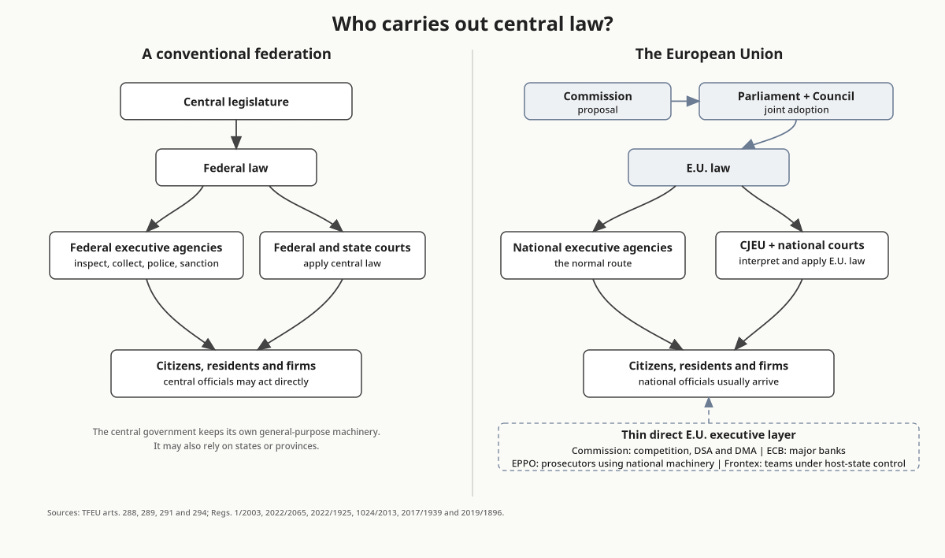
European legislation comes in two flavors. Under Article 288, regulations are directly binding in their entirety and directly applicable in every member state. Directives, on the other hand, order national governments to achieve a certain result, leaving the methods up to them. The distinction matters to lawyers but not to the normal people bound by them — Europe makes the rules.
A skeptical reader will shout here: “But the Commission proposes the rules! Parliament can’t initiate legislation! How can you compare the E.U. to a national government when Parliament can’t suggest any new rules!”
To which I say, “Government ain’t Real Time” or “You have no idea what you’re talking about.” Or, if I’m feeling charitable, “Don’t be such a damn lawyer.” True, Parliament cannot normally introduce a bill in the same manner as the U.S. House of Representatives. But the Commission is an E.U. institution! The distinction between the Parliament and the Commission matters a lot to the Union’s democratic character, but it matters not a whit to its legislative power. And the Council, made of ministers from the respective elected state governments, can order the Commission to propose a law or explain why it won’t. A weird tripartite legislature with a convoluted process is still a legislature and no single national government can fully control its agenda.
Another argument is that the European legislature can’t impose taxes. Again, “You have no idea what you’re talking about.” Article 311 explicitly allows the Council to impose taxes! Yes, it’s hard — you need a unanimous vote and approval by the Parliament – but it could be done. What the E.U. can’t do is assess, audit, collect, seize, and prosecute tax evasion. Why can’t it? Not because its constitutional documents won’t let it. It can’t because it has no executive. The Commission can do all sorts of things, but sending an armed agent around to arrest you if you don’t pay your taxes isn’t one of them.
In other words, the European legislature is powerful and interesting! Go read Ruben Cober’s Essential Europe or Politico.eu if you don’t believe me. It just can’t send around men with guns to enforce its laws — which doesn’t make the laws meaningless, just enforced by national officials ultimately paid by and beholden to national governments rather than employees of the European Union.
The courts count
The European Court of Justice is essentially a federal supreme court.4 In Van Gend en Loos v. Administratie der Belastingen it held that European law could create rights that individuals could invoke in national courts. In Costa v. ENEL — Europe’s Marbury v. Madison — it held that national law could not override European law. Under Article 267, national courts can refer questions of E.U. law to the European Court. And Articles 258 through 260 give the Commission the power to ask the Court to rule that a member state has failed to comply and impose financial penalties.
Now, it’s true that national judges hear most cases under European, but state and provincial courts in many federations apply federal laws all the time. Nothing in the definition of a federation requires the central government to provide every trial judge. It doesn’t even require a system of federal courts below the supreme judicial authority — heck, federations can have multiple supreme judicial authorities or even (like Australia before 1986) use the supreme judicial authority of another country. The important question is whether federal law governs and whether the supreme federal court(s) can settle their meanings. In the E.U., both things are true.
In short, it’s got a legislature and a judiciary with powers that rival any national federation.
The incorrect constitutional objections
Now, Article 5 limits the Union to competences granted by the treaties. But the United States Congress also has enumerated powers! And America isn’t alone: most federal constitutions divide subjects between levels of government. So that’s just normal federalism.
Now, you can make a case that foreign and security policy is a relevant subject-matter exception. But you’d be wrong. It is true that Article 24 says “the adoption of legislative acts shall be excluded” from foreign policy making, demands unanimity on the Council, and limits the jurisdiction of the Court of Justice. So what? The U.S. constitution gives the President almost unlimited authority over foreign policy. Congress can’t, say, order the President to annex Greenland or invade Cuba. Congress can impose economic sanctions (but only unilaterally if it can override a Presidential veto) but so can the E.U. legislature under Article 215. The E.U. constitution limits the ability of the legislature to direct foreign policy but who the hell cares because there’s no real European executive for the legislature to direct.5
The final objection is that the E.U. cannot be compared with a national federation because its powers come from treaties among states. Under Article 48, amending those treaties normally requires every member state to agree. And the (in)famous Article 50 lets a member state withdraw.
But this just makes the European Union look like Canada. Its amendment formula requires Parliament plus seven provinces containing at least half the national population, but some changes require unanimous provincial consent. Others require Parliament and give every directly affected province a veto. A federation with subnational vetoes over amendments is still a federation.
And some federations have constitutional routes toward secession! Canada’s Supreme Court held that a province cannot leave unilaterally under existing law. It also held that a clear majority on a clear question would create a duty to negotiate separation. A legal exit does not by itself destroy a federation. Ethiopia goes further, at least on paper. Article 39 of its constitution gives every nation, nationality, and people an unconditional right to secession. The Federal Democratic Republic of Ethiopia is still a federation, but not because the federal government is in practice likely to turn its guns on any state that tries to exercise Article 39.
Federations have different origins. Some were created by a single constituent assembly. Others emerged from agreements among pre-existing states or colonies. What matters for the present claim is what the institutions can do after those powers have been conferred. E.U. institutions can make binding law without unanimity and provide a central court that can interpret that law. But the governments of European states execute most of it.
But let’s get into the exceptions, because the Union dances up to a real executive in a couple of different places.
The executive exceptions
The E.U. does have a few direct executive powers, mostly put into the hands of the Commission, although they usually stop at the point where physical coercion begins. But they’re there, if only partial, and we ought to credit them.
Competition
Competition policy is the clearest case. Under Regulation 1/2003, Commission officials may enter business premises, inspect and copy records, seal rooms or files, and question employees. The Commission can order an inspection, fine companies for obstruction, and impose antitrust fines reaching 10 percent of worldwide turnover.
Now, Commission agents can’t break down the door by themselves. If a company resists, national authorities provide the coercion under national law. Nor does the Commission arrest executives or prosecute them for crimes the way the U.S. Department of Justice (DOJ) can. Still, Commission employees really do barge into private premises unannounced and conduct investigations. So let’s not be too pedantic: this is direct (if weak) executive authority over firms.
Digital platforms
The Digital Services Act gives the Commission powers over very large online platforms and search engines. Under Article 69, its officials may inspect premises, examine records and algorithms, seal premises, and question personnel. National authorities assist when coercion is required. The Commission can also impose fines of up to 6 percent of worldwide annual turnover. The Commission fined the company formerly known as Twitter €120 million in December 2025, Temu €200 million in May 2026, and AliExpress €550 million in July 2026.
The Digital Markets Act creates another enclave of European executive power. The Commission can demand information, inspect premises, issue binding orders, and fine designated gatekeepers up to 10 percent of worldwide turnover, or 20 percent for repeated violations. It fined Apple €500 million, Meta €200 million in April 2025, and Google €890 million in July 2026.
Banking
The European Central Bank directly supervises the largest banks in the euro area under the Single Supervisory Mechanism Regulation. It may demand information, conduct on-site inspections, issue supervisory decisions, and impose monetary penalties. It has used that power, including a €6.94 million penalty against Belfius in 2025. So there is that, although I can’t resist pointing out the SCOTUS has been entirely incoherent on the topic of whether the Federal Reserve is an executive agency or not. Some American justices would say that you can have a powerful central bank outside the real executive, even if that doesn’t quite make logical sense.
Prosecution
The European Public Prosecutor’s Office comes close to a true federal prosecutor. Regulation 2017/1939 authorizes it to investigate, prosecute, and bring to judgment crimes affecting the Union’s financial interests. At the end of 2025, it reported 3,602 active investigations.
I said comes close. But no cigar. The Public Prosecutor’s Office runs through national systems. “European Delegated Prosecutors” work in the member states and generally use national criminal procedure. They prosecute in national courts and searches, seizures, arrests, and detention depend on national police forces. The Department of Justice, this is not, but let’s be generous and say that it dances up to real executive power.
The European Anti-Fraud Office also comes close without getting the cigar. It can conduct administrative investigations involving E.U. institutions, E.U. money, and serious misconduct by E.U. staff. It can inspect economic operators under the rules governing E.U. funds and prepare recommendations. But it cannot prosecute or impose criminal penalties. It’s an investigative arm, but not a full enforcement service. Close, but not quite the cigar. Give it a cigarette.
Borders
Here you do have a real exception … mostly. Well, partially. The European Border and Coast Guard (aka, “Frontex,” a terrible name for a public agency) has an armed and uniformed standing corps that can perform identity checks, patrol borders, assist returns, and use force under specified conditions.

But it’s not the Border Patrol. Frontex teams operate with the agreement of the host state and follow the host state’s law and operational plan. In practice (so far, at least) they generally exercise coercive powers in the presence of national officers. Frontex is therefore a genuine E.U. executive body, but not quite an autonomous equivalent of U.S. Customs and Border Protection.
So the Union has only a weak, partial, functionally siloed executive. But still, it’s a tiny little bit of an executive. Not enough to get me to change the opening sentence of this post, but like I said, it’s there. And who knows? Maybe it will grow.

Plus, the new European field uniforms are pretty snazzy, I have to admit.
A confederation, if you can keep it
The European Union is not a new form of government that defeats existing political vocabulary. It has strong central legislative and judicial power within conferred fields. But it has practically no central capacity to police, prosecute, or compel. National governments remain the Union’s executive arm.
That makes the E.U. a boring old confederation, to use the term in its strict political science sense. That is to say, the European Union is a federation with an unusually weak central executive and unusually powerful constituent governments.6 You could legitimately compare it to the Holy Roman Empire or the German Confederation that succeeded it, although you shouldn’t push that too far.
Or, to repeat, it’s just a national government with a legislature and judiciary, but no serious executive.
I’d kind of hoped that nobody else has ever characterized the E.U. this way before, but predictably, I’m wrong. I’m just the most direct! Robert Schütze called the E.U. a “legislative giant on clay feet.” Tanja Börzel emphasized that policy execution rests mainly with the member states. Daniel Kelemen and Kathleen McNamara described a “legal colossus” with a small administrative apparatus and almost no coercive capacity. And the grand elder of European Union studies, Andrew Moravcsik, pointed out in 2005 that “The E.U., to a first approximation, does not tax, spend, implement or coerce.” [Italics mine.]
If you need an easy analytical framework to understand the European Union, don’t get bogged down in the international relations literature or legal niceties. Think of it as a national government with legislative and judicial branches, but almost no executive. What, if anything, that says about the Union’s future direction is left as an exercise for the reader, as is the equally interesting question of why pretty much nowhere else on Earth has been able to form a serious confederation since WW2.7
Unless I get some bright idea for an answer first.
Again, to repeat, with a few exceptions that we’ll get into below.
With the glaring exception of criminal law.
This can seem complicated, because the E.U. can issue two types of law: regulations and directives. Directives order state governments to write laws and do things. If the government fails to write the mandated law into its own code (or carry out the goals sent down from Brussels), then the E.U. can sue or otherwise punish the state, but it cannot impose an obligation on private parties to follow the directive.
Along with something called the European Court of Human Rights, which is technically not part of the European Union. But even that doesn’t make the E.U. unusual: France has three different high courts: one for ordinary civil and criminal law, one for administrative law, and one for constitutional review. More unusual is the fact that the ECHR’s jurisprudence applies to countries outside the E.U., such as Great Britain.
No, the “high representative” doesn’t count. To paraphrase Joseph Stalin, how many divisions does she command?
“Confederation” has no real colloquial definition, sadly. Switzerland describes itself as a federal state while calling itself the Swiss Confederation. Ditto, Argentina’s constitution establishes a “federal government” but preserves “Argentine Confederation” as an official name. The constitution of the “Confederate” States of America explicitly said that it created a “permanent federal government.” But the Articles of Confederation, by contrast, called the states sovereign, described the United States as a “league of friendship,” and left the center without ordinary authority over individuals although Congress could “require” state legislatures to levy requisitions and sort-of act as a supreme court — it was a true confederation but a weak one even in the strict political-science sense.
I’m not betting on the future of the Alliance of Sahel States, although who knows, maybe it’ll work out.
Factually, I don’t know that I’d quarrel with the underlying details in your piece. Beyond this point feedback you didn’t request. I don’t mean it to be as hominem, but you had an optic that lured me into reading then disappointed. I read your piece because I am genuinely interested in the subject, but as I got into it I realized that you were attempting to answer a question that had not been formulated. “By golly the EU is a government and if you say otherwise you are wrong!” is not a well articulated premise. Factually, you conflate the Europe Union with Europe. But who says the EU isn’t a country? I’m sure in the beer halls of Bavaria (or St Louis) this is discussed but you didnt identify any counterparty or school of thought who makes a contrary argument. Alternatively, you never identify any academic test of the factors defining a country.
The answer is not trivial. I agree that it is a confederacy that has become a country best proved by how difficult it was to leave when UK wanted out. But it’s also a dysfunctional agglomeration that doesn’t work and needs to be restructured.
If I was your professor I would give it a B- The big problem with a platform like Substack is that it lacks professors and editors.
I much appreciate the directness and thank you for the mention!