

First, this:
That’s how millions of American kids learned about the Constitution. Congress writes a law, the President vetoes (or not), Congress overrides (or not). You know you’ll be a law someday! Good schools would add that the Supreme Court gets a say in all this and can declare a law unconstitutional. (Or you could have seen this terrible Schoolhouse Rock video some other Saturday morning and somehow remember it.)
The thing is, it was always a little bit more complicated. Congress often passed vague laws — “build railroad tracks properly!” or “don’t cheat customers” which dumped onto the executive branch the responsibility for figuring out just what exactly it was going to do to carry out Congressional intentions. Often that involved giving orders to private businesses, but it tended to be done ad hoc.
It’s not clear how the Founding Fathers intended to deal with the amount of authority this gave the President. The reason it’s not clear is that the Founding Fathers talked out of both sides of their hat. In the Federalist Papers, for example, Alexander Hamilton wrote pretty explicitly that the President couldn’t fire cabinet officials once confirmed. Heck, he implied that confirmed cabinet officials might even stay in office when administrations changed. That meant that executive power would be limited. By 1793, however, Hamilton had changed his tune and now stated that it was obvious that the President had to have the power to fire cabinet officials.
The issue took a long time to be resolved. The First Congress generally acted like presidents had the power to fire their appointees, but the 40th Congress tried to impeach President Andrew Johnson for firing cabinet officials in 1867. SCOTUS didn’t squarely uphold the ability of the President to fire executive branch officials until 1926.
And so it was that the President wound up with the power to carry out Congressional intentions by writing regulations.1
As things got more complicated, though, many Americans became increasingly uncomfortable with the idea that you could just hand over all these implicit powers to the President. Sure, the constitution enjoined the executive to “take care that the laws be faithfully executed” but that didn’t mean that would happen. In theory, Congress could pass a new law whenever a new problem arose, but that would be insanely cumbersome and lead to insanely detailed laws. (There’s a reason that no place on Earth ever tried that.)
So in the good American tradition of limited government, in 1887 — a mere two decades after the Andrew Johnson imbroglio — we invented the idea of the independent commission. Now the President would nominate (and the Senate would approve) commissioners who would serve staggered independent terms. The commissioners, then, would vote to decide what exactly to do whenever they became apprised of a new problem that Congress had authorized them to handle.2
These agencies multiplied and the tasks handed to them grew more complicated. So in 1946, Congress passed the Administrative Procedure Act, which did three things (oversimplifying greatly, of course):
It created a general right to petition agencies. Before that was a fairly ad hoc process; now it was routinized.
It created standard procedures for rulemaking, including “public comment periods.” This abetted new-fangled lobbying, where professional firms would submit professional reports, in addition to the old-fashioned stuff that happened over steaks and cigars.
It created a whole class of pseudo-courts inside the executive branch to adjudicate disputes. Private parties could still sue in regular court, of course, but now these specialized kind-of-courts would take on a lot of the burden before that point.
And thus things stood until 1996, when Congress added the Congressional Review Act. That gave Congress 60 days to look over new regulations and, if it wanted, veto them. As a practical matter, that gave the Speaker of the House a veto over the veto. Of course, if Congress voted to overturn, then the President could veto their veto and let the regulation pass through.
In practice, this basically never happened before 2017. (Yes, a few exceptions, go away, pedant.)
Let’s put this in flowchart form. (And yes, I made these myself. Talking magic computers only helped me create a red outline in the very last slide, although I did use ‘em for fact-checking. Viva la humanidad.) Here’s how regulation worked from 1887 to 1946:
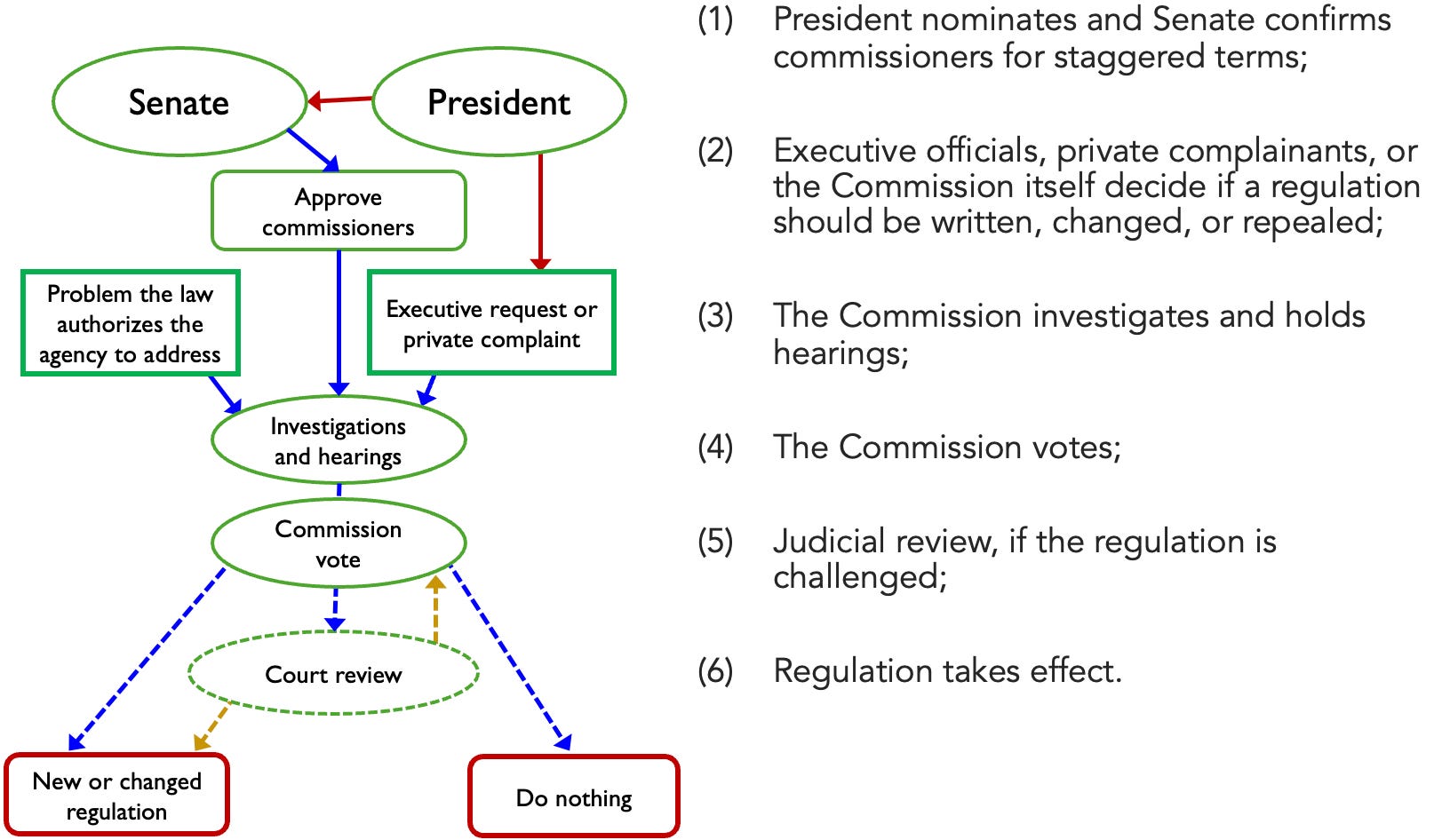
Pretty straightforward. Red arrows are presidential actions. Blue arrows are actions by other parties. Yellow actions are optional decisions by third parties. The President would nominate commissioners, the Senate would approve them. In general, these commissioners would serve staggered terms, so no single-term President could nominate all of them. I guess the thinking was that you won re-election you deserved the prize, but no worries since you’d be out of office after two terms.
The commissioners would then try to solve the problems Congress enjoined them to solve in the law creating the commission. The president could ask the commissioners to do something, as could private actors, in a very ad hoc or commission-by-commission basis. Ditto, commissioners would investigate and hold hearings, but also on a pretty discretionary basis by modern standards. Finally, if you didn’t like it, you could sue, in that great American tradition, and hope that the courts slapped down the commission for overstepping its bounds.
In 1946, Congress decided that this process was too lah-dee-dah. In part that was because there were now a lot more agencies. In part that was because FDR had just won four elections in a row. In part is was because GOP politicians thought regulation-writing was too easy. And so we got the Administrative Procedure Act (APA). The APA laid down, well, procedures for rule-making. It introduced the right to petition agencies to take action as a general right and introduced the idea of the “comment period,” where in theory the public (and in practice skilled lobbyists who know what the commissioners wanted to hear) could make, uh, comments. It also introduced a series of “administrative courts” inside the executive branch, which could handle disputes without gumming up the regular courts.3
And now the system looked like this (a NOPR is a Notice Of Proposed Rulemaking):
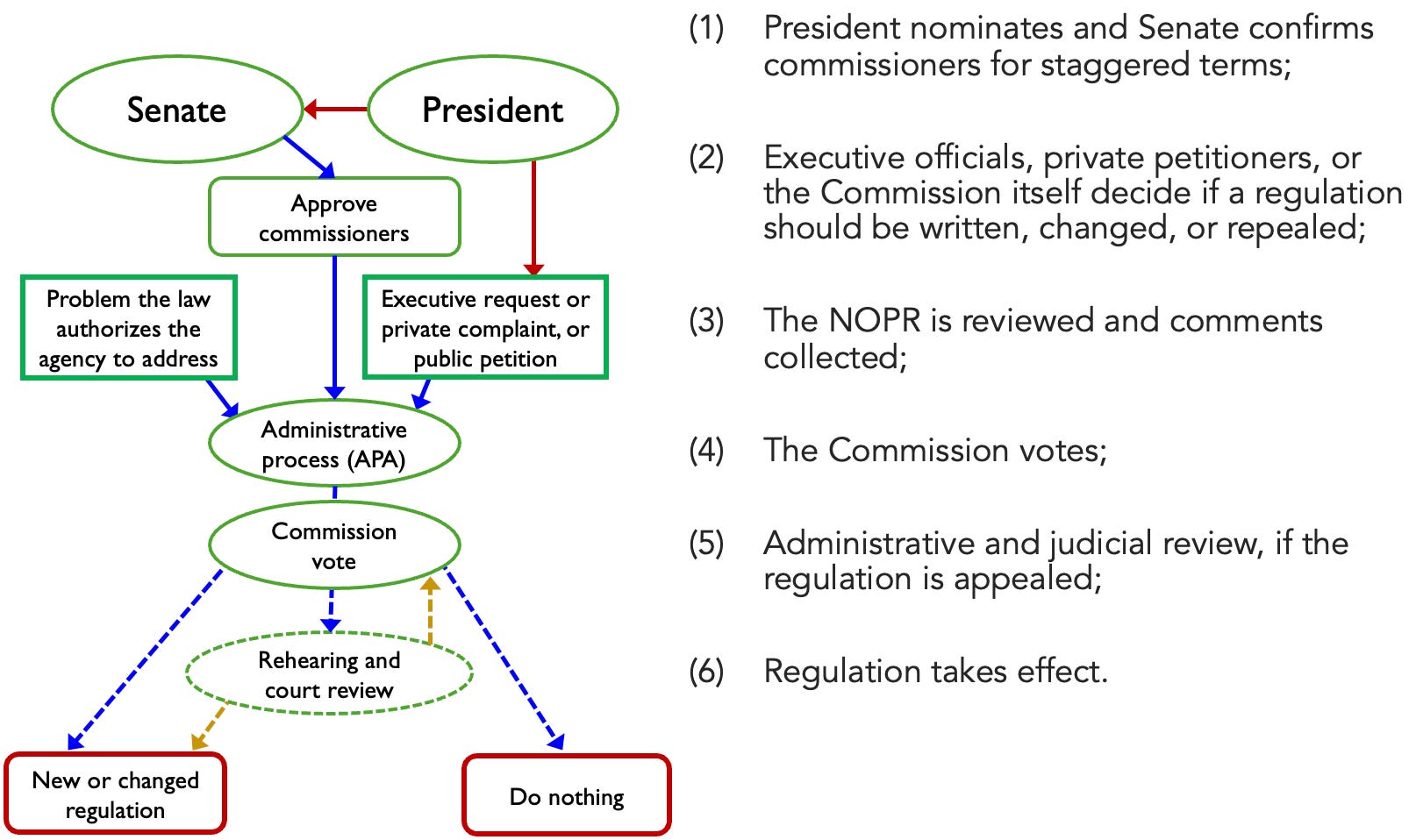
Not a whole lot of change, although APA also applies to agencies under full presidential control, and not just independent commissions.
Now, in theory Congress could always overturn regulations by passing new laws that superceded them. But that wasn’t easy — reopening the law over one tiny regulation meant opening a whole can of worms. You never knew what might come out of Congress once you started that process! And so, in 1996, you got the Congressional Review Act. It gave Congress sixty days to repeal any regulation, with the clock stopped for election season and congressional recesses. Of course, the President could then veto Congress’s veto, which Congress in turn could only overturn with a two-thirds majority. In theory, that added a little bit to the bottom of our flowchart:
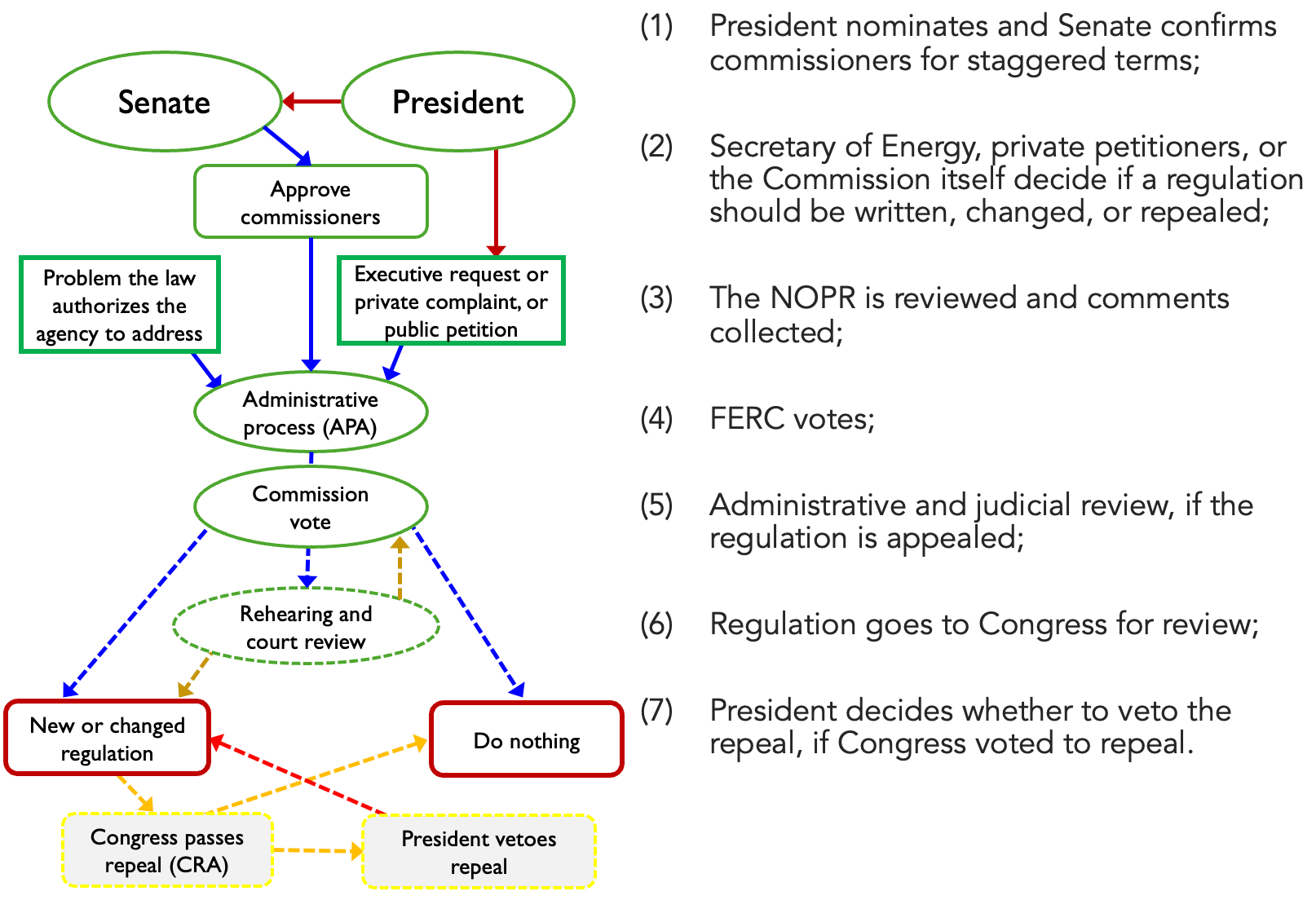
But since Congress only used its new power once before the first Trump administration, it really didn’t matter. Congress and the Clinton administration got to look good to the voters who cared about this sort of thing, without really upsetting any apple carts. Like so many other things, this changed in 2017 and 2025, when the incoming Trump administration got the Republican-controlled Congress to massacre a bunch of new(ish) Obama and Biden era regulations.
Back in the pre-2017 antediluvian age, the baseline Republican position (other than some conservative legal scholars) was that all these checks and balances were great, with one big exception — it should be easier to repeal existing regulations without going through all this rigamarole. But no sane Republican — and not really very many insane ones, either — wanted to hand more power over to Democratic politicians who were simply not to be trusted. Those people believed that it was okay for men to wear shorts in public and had convinced themselves that sandals were comfortable while suits were not, a patently absurd pair of positions.

No damn way you were gonna make it easier for those weirdos to write regulations and boss businesses around.
But then came June 29th, 2026, and the decision in Trump v. Slaughter. I will be very disappointed if Brad DeLong doesn’t show up in comments to yell at me about what I am going to write next. It will be the short version of what I wrote here. (Click the link for a picture of me aged 16 that looks straight out of a bad period movie. But my daughter said my hair was the color of Superman’s back then, so it’s ok.)
Short version: the Supreme Court looked at the first line of Article II of the U.S. constitution, which reads, “The executive power shall be vested in a President of the United States of America.”4 Originalism is no help here: as we pointed out, different founding fathers said different things at different times. So they decided to take it literally. Which is not what I would have done, since the people who wrote it clearly didn’t take it literally, but it’s not crazy.5
But it did make the United States unique among modern developed nations in that this was now our Constitutionally-mandated regulatory procedure:
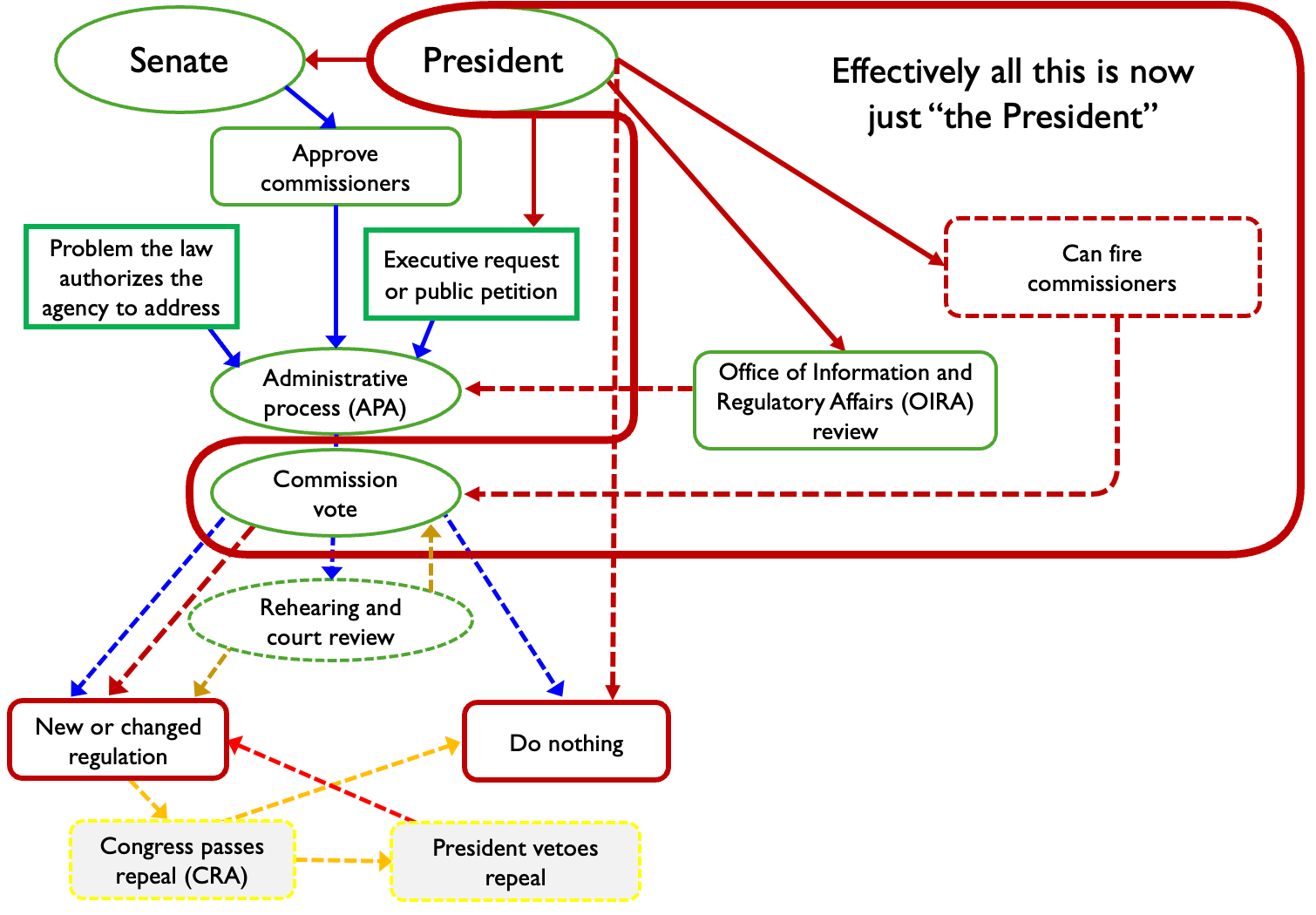
Basically, if the President can fire independent commissioners, then they aren’t independent! Look at all the red arrows. You can take everything within the red blob and basically assign it to POTUS. There are countries that effectively work this way — United Mexican States, we turn our eyes to you — but not very many, and generally for reasons outside the formal constitutional structure.
The Trump administration was pretty confident this was how SCOTUS was going to decide — as was pretty much everyone else looking at the constitutional tea leaves. The decision was the opposite of a surprise. Seeing the writing on the wall, the Trump administration issued Executive Order 14215 in February 2025. That order said that all formerly-independent agencies had to submit proposed regulations to a presidentially-controlled body called the Office of Information and Regulatory Affairs (OIRA, pronounced “oy-ruh”), which got a veto over everything.
But let’s not exaggerate! The APA is still in place. Presidents can now get independent agencies to write whatever regulations they want, but they still have to go through the procedures, which take a lot of time. That includes the repeal of a regulation — the President can’t just erase existing regulations with the wave of a hand, although he will now be better positioned to gum up enforcement. All that’s happened is that we’ve now placed independent commissions like FERC or the FTC or the SEC under the same presidential control as old-fashioned executive agencies like the EPA or OSHA.
This is going to make President Ocasio’s life easier, but not that much easier. Still, I am at a loss as to why Republicans love this decision while Democrats hate it. It’s giving me a Robbie-the-Robot moment.
Seriously, in a sane world wouldn’t Democrats prefer this? And Democratic Socialists should love it! Hell, their platform says, “Replace the President and Supreme Court with an executive and judiciary chosen by and subordinate to Congress.” Trump v. Slaughter is just one step on that road, comrade!
I should also add that Executive Order 14215 is written on a much more logical legal basis that Trump v. Slaughter. SCOTUS incoherently exempted everything the Federal Reserve does. The E.O. logically exempted Fed actions regarding monetary policy. That’s consistent with a coherent theory that argues that monetary policy is a Congressional function under Article 1, Section 8, Clause 5. “[The Congress shall have power] to coin money, regulate the value thereof, and of foreign coin, and fix the standard of weights and measures.” But rather than engage in legal mumbo-jumbo, it went on state that the Federal Reserve powers to regulate banks were not Article I functions and therefore significant banking regulations could be vetoed by the President, acting through OIRA:
This order shall not apply to the Board of Governors of the Federal Reserve System or to the Federal Open Market Committee in its conduct of monetary policy. This order shall apply to the Board of Governors of the Federal Reserve System only in connection with its conduct and authorities directly related to its supervision and regulation of financial institutions.
We’ll see what SCOTUS says when this is inevitably challenged as contrary to Trump v. Slaughter. The logical part of my brain (really, if I wasn’t going to be a Marine logistics officer in a parallel life, what I’d really like to do if I could do it all again, then I should’ve been a lawyer) wants the E.O. to be uphold. At least it makes sense! But the old-school Republican part of that same brain says, no no, please keep elected officials far away from deciding bank regulations, wouldja, please? Consistency, hobgoblins, small minds, and all that.
Anyway, that’s where we are now. Agencies will write or repeal regulations and engage in enforcement actions only when the President wants them to. They’ll still be subject to all the same procedural hurdles as before, so it won’t be like future presidents will be able just whimsically issue even more orders than the current administration has been. But it will give future presidents quite a bit more power over quite a bit more fields.
And it still won’t be much easier to get rid of old red tape. Sigh.
Other countries recognized this from the get-go. When the Argentine Confederation wrote its constitution in 1853, its founders expressly copied the United States, but even they saw fit to make the regulatory power explicit. Article 83: “The President of the Confederation is the supreme head of the Confederation and in charge of the general administration of the country. He issues the instructions and regulations necessary for the execution of the laws of the Confederation, taking care not to alter their spirit through regulatory exceptions.”
These independent agencies include the FRB (banking), CFTC (derivatives), CPSC (product safety), FCC (communications), FDIC (deposit insurance), FERC (energy), FHFA (housing), FMC (shipping), FTC (competition), FMSHRC (mining), NCUA (credit unions), NLRB (labor), NRC (nuclear power), OSHRC (workplace), PRC (postal regulation), SEC (securities), STB (railroads), CFPB (finance), OFR (research), ITC (trade), FCA (farm credit), FEC (elections), FLRA (federal workers), MSPB (civil-service), NMB (railroad workers), and OCC (banks). A few others have gone out of business, like the ICC, CAB, and USSB. (The FPC became FERC and the safety part of the AEC became the NRC.)
Agencies already held trial-like hearings before officials called “hearing examiners.” The APA standardized those proceedings and create a protected system of hearing examiners, renamed “administrative law judges” in 1972.
I always correct silly 18th-century capitalization. I think doing otherwise is malpractice.
The SCOTUS majority also pointed out that the Constitutional Convention could have made like most of the existing state constitutions and divided up the executive, and they noted (as mentioned in the text) that the newly-elected First Congress in 1789 implicitly recognized that the President could fire Senate-confirmed cabinet officials.