

A student asked me yesterday morning, “Is it true that the United States is self-sufficient in energy?”
“Well, North America is, pretty much.”
“Then do we have to care so much what happens in the rest of the world?”
It’s an excellent question. Why do we have to care so much about the rest of the world? Who cares what we break in the Strait of Hormuz? Well, Americans should care because we’re a good and responsible people, but why should anyone care care? Like vote to hand the GOP’s rear-end back to itself levels of care?
One thing this substack does (because its fun) is run with seemingly-impossible or unlikely policies and see if it’s really all that impossible.
Energy populism as an American policy
The Trump administration is often called populist. And by one very useful definition, it clearly is. That definition makes populism into a political strategy: define the electorate as consisting of the core “real” citizenry and outside elements, whether elites, ethnic minorities, political opponents, or some combination of all three. Then convince the core group that your movement represents them against the outsiders. In terms of that sort of populism, you need to go back to the 19th century to see it working as a winning national political strategy before 2016 (unless you really want to be tendentious).
In Latin America, however, populism used to have another definition, albeit often an implicit one: government intervention in markets driven by short-term electoral gains or simplistic (and often wrong) models of the world. In other words, to quote the introduction to this post, they “run with seemingly-impossible or unlikely policies,” generally to bad effect.
The Trump administration certainly engages in that kind of populism — no tax on tips, anyone? Throwing bags of sand in the wheels of renewable energy projects? But generally its straight-up Latin American style economic populism hasn’t been that different than past administrations.
Which in a way is surprising, because a real populist-nationalist administration has an obvious go-to populist move right before the election: ban American oil exports. It’s not the 1970s anymore. Shockingly to those of us of a certain age, North America has become a hydrocarbon island. The United States imports about 4.5 million barrels per day from Canada and Mexico, but infrastructure and refinery constraints mean that Canada can’t redirect its exports at the drop of a hat. Mexico, meanwhile, has become too small to matter much.
Let’s start with the answer to the student’s question. North America is an energy island, pretty much. In natural gas we’re almost completely an energy island. In crude oil it can get a little complicated down in the weeds, but basically we are:
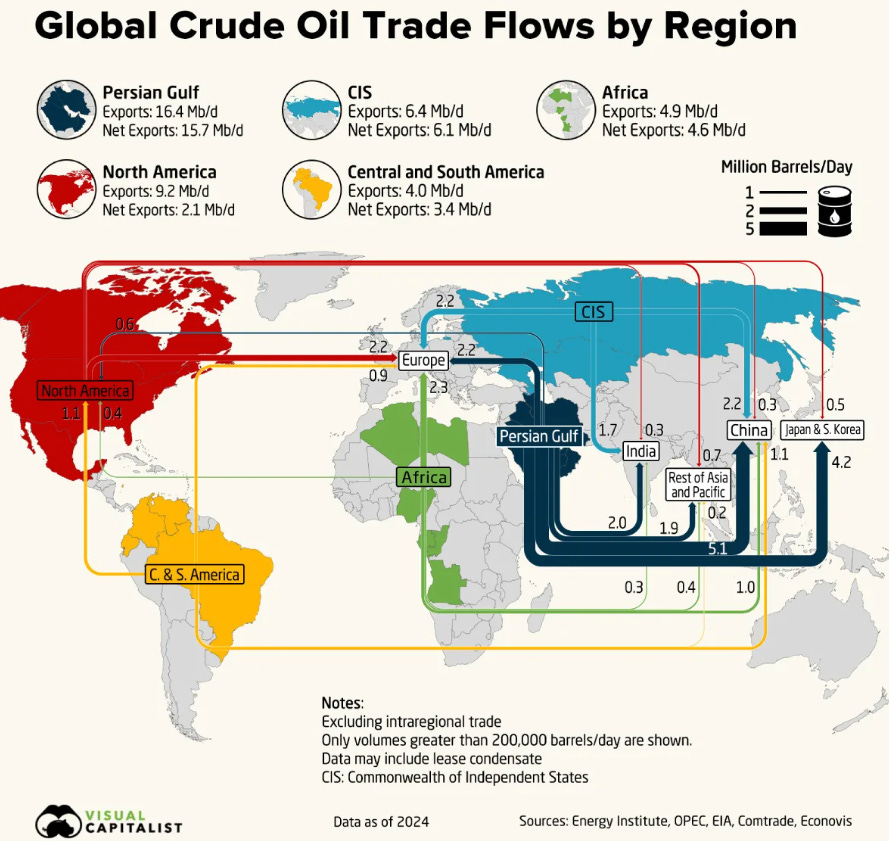
The math isn’t that complicated. In 2025, the U.S. produced 13.7 million bpd of crude and condensates. It imported 6.2 million and exported 4.0 million, for net imports of 2.2 million and total consumption of 15.9 million. Or:
13.7 production + 6.2 imports − 4.0 exports ≈ 15.9 consumption.
The day after the ban exports will fall to zero. Somehow the market now needs to find a home for 4 million barrels per day. Either production will need to fall, or imports will need to fall, or consumption will need to rise. (Or some combination of all three.) Economics isn’t plumbing, however. None of that will happen by itself. All of it requires prices to crash. Falling American prices will tell domestic producers to produce less, foreign producers to sell less to America, and consumers to use more.
A good populist-nationalist president would also have to cut or cap petroleum product exports (i.e., gasoline or diesel or jet fuel or whatever) to prevent a spike in re-exports. That would cause gasoline prices to fall along with crude oil prices. And just by looking at the numbers, you can tell that prices will likely have to fall by a lot in order to clear the market. (As this article says in the title, “Demand for gasoline is more price-inelastic than commonly thought.”)
Awesome sauce for the election! Let’s do it!
The legal basis
There are things that the American president cannot do without Congress. There are also things that the American president cannot do on paper, but will almost certainly get forgiveness for later (at varying levels of “forgiveness”). And then there are things that the American president can just go do.
The Energy Policy Act of 2015 took away the President’s unrestricted right to ban hydrocarbon exports outside North America. But it left enough holes to drive a supertanker through. First, Section 6212a says:
The President may impose export licensing requirements or other restrictions on the export of crude oil from the United States for a period of not more than 1 year, if
(A) the President declares a national emergency and formally notices the declaration of a national emergency in the Federal Register.
Any requirement or restriction imposed pursuant to subparagraph (A) of paragraph (1) may be renewed for 1 or more additional periods of not more than 1 year each.
There’s more, but the only other thing you really need to know is that the law expressly allows exports to be banned if “the Secretary of Commerce, in consultation with the Secretary of Energy, finds and reports to the President that the export of crude oil pursuant to this Act has caused sustained material oil supply shortages or sustained oil prices significantly above world market levels that are directly attributable to the export of crude oil produced in the United States.” In other words, even if SCOTUS moved rapidly, there wouldn’t be a repeat of the recent tariff decision. The law is clear.1
Congress, sigh, continues to outsource its job to POTUS. But that’s good for a nationalist populist.
Those pesky neighbors
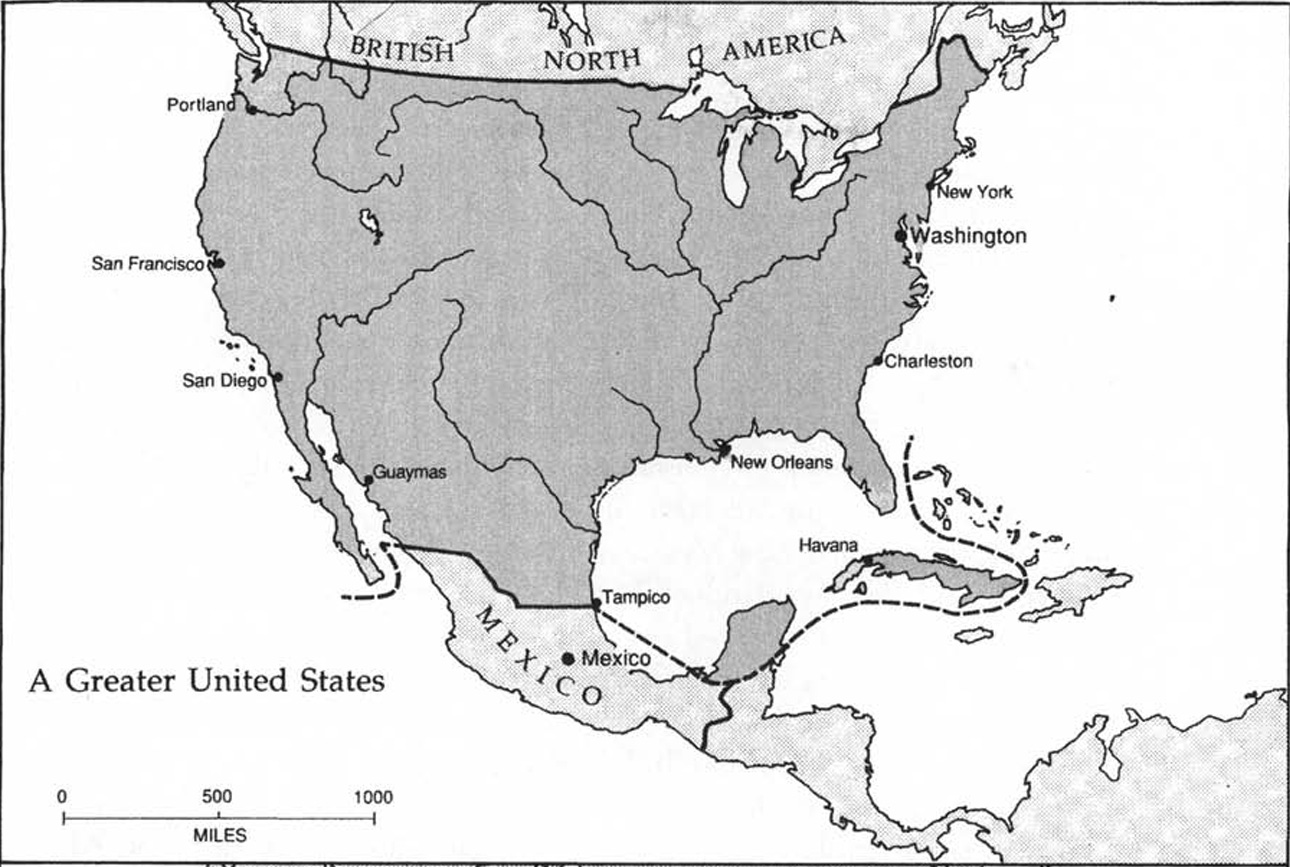
There probably isn’t a parallel universe — alternate history done right is another specialty of this substack, go tell your friends — in which the United States controls the Cantarell offshore fields in the Gulf of America Mexico America Mexico Gulf. And there’s probably not a parallel universe in which the United States controls Alberta, either.2 Sorry about that, fellows, Canada really isn’t a historical accident. (Unlike Uruguay. But I digress.)
Does geography create a problem for our hypothetical populist? No, no it does not. Canada is limited by its pipeline capacity. Quebec and New Brunswick still import crude because there’s not enough pipeline capacity from Alberta to feed the demand that currently exists. In the other direction, the Trans Mountain pipeline has only about 0.13 million bpd of spare capacity. Canada currently exports about 3.9 million bpd to the United States and that flow isn’t going anywhere else anytime soon.
Mexico has a little more flexibility, but it’s no longer big enough to matter, exporting only 0.6 million bpd to the United States. Moreover, that oil largely returns to Mexico in the form of refined products. So Mexico probably won’t divert oil to more lucrative markets and wouldn’t matter much even if it did.
Would an interruption in imports screw with refineries? Well, what interruption in imports? This populist order bans exports of crude (and caps or slightly cuts exports of refined products). It doesn’t affect. imports. If the refineries need imported oil to optimize their output mix, then they can still import oil. But with oil prices crashing, many will use a suboptimal mix with more cheap domestic crude because lower input costs will make up for higher process costs. And inasmuch as those imports come from Canada or Mexico or, likely, Venezuela, their prices will fall as well, although by less than in the United States.
So why not?
Every so often, the ban idea does raise its head. That happened in 2022. Senators Tammy Baldwin, Tammy Duckworth, Jack Reed, and Jeanne Shaheen urged President Biden to restrict crude exports. That same year, Biden administration seriously considered capping refined product exports. More recently, Representative Ro Khanna (D-California) introduced a bill to automatically prohibit gasoline exports whenever the national average gasoline price exceeded $3.12 for seven consecutive days.
Banning crude exports and restricting product exports might cause some disruption in the product market, slowing the price fall, but it wouldn’t be crazy to take a bet against that.
So why hasn’t it gotten more traction?
No, the real reason is that you’d crush the state of Texas. Also New Mexico, Oklahoma, and North Dakota, but mainly Texas. Yes, the Texas economy is much more diverse than it used to be, but the Dallas Federal Reserve estimates upstream oil and gas alone makes up about 7% of the state’s GDP. That rises to 15% — roughly one dollar in seven earned in the state — when you include midstream, refining, petrochemicals, machinery, and related manufacturing.

An export ban would hammer this sector. It might not be 1986 all over again — but it could also be worse. Oil probably won’t hit $31 — WTI’s inflation-adjusted 1986 low — but modern unconventional producers are leveraged up the wazoo. Bankruptcies will multiply and unemployment will spike. When high-paying oil jobs go away, so do other jobs; in Texas, the Dallas Fed estimates that each oilfield job supports three to four others.
When oil production hiccuped during the 2020 covid pandemic, “mining” employment dropped by about a quarter. A conservative assumption is that every oilfield layoff will cause one other job loss, so if our populist president prompts similarly-sized production drop, then one out of fifty jobs in the state will just evaporate.
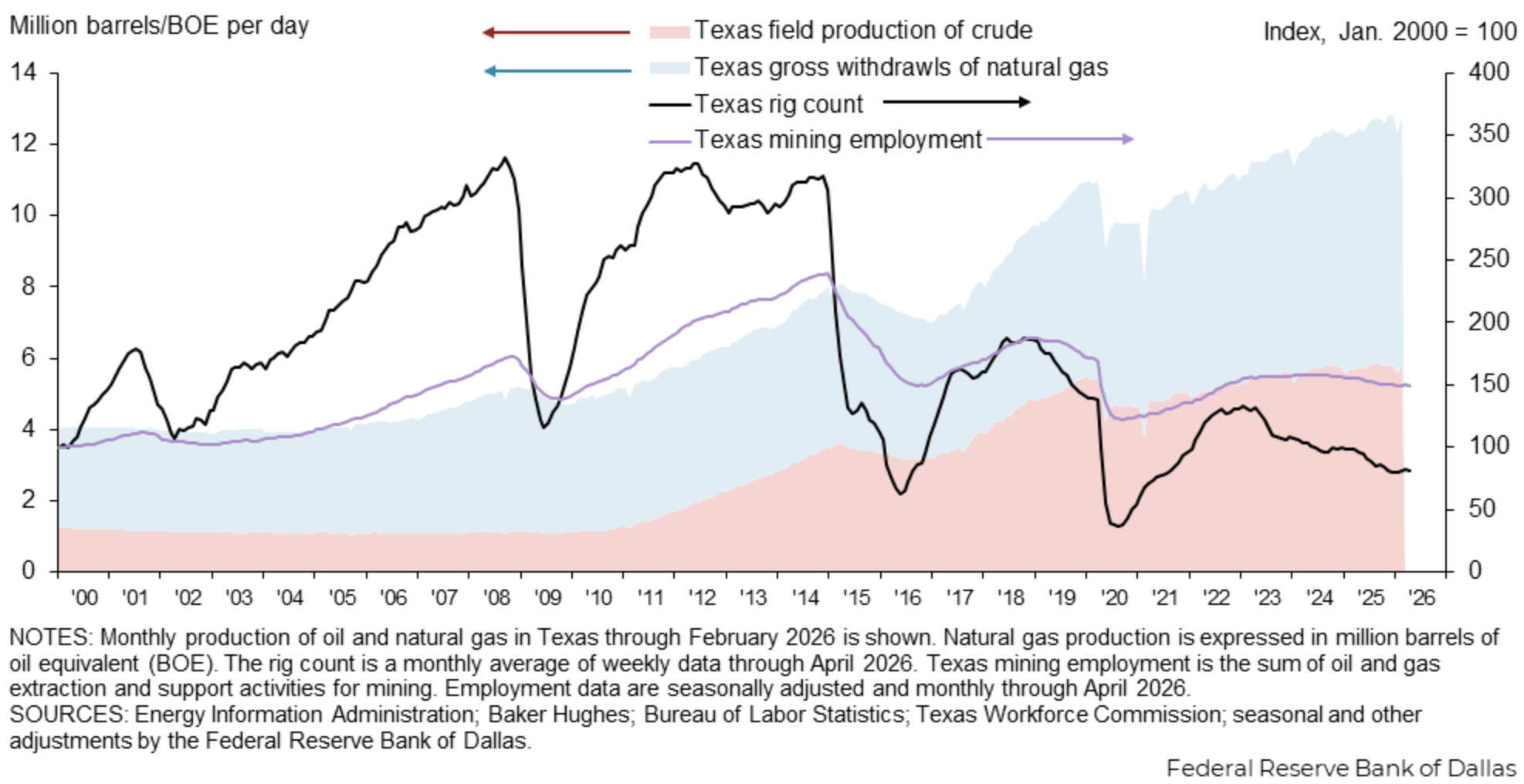
And the impact will rock on. In the United States, private landowners own the subsoil rights, so when prices and production drop so will those lease and royalty payments. Each royalty dollar generates another 49¢ in local income when the landowners spend their windfalls. Direct taxes on oil and gas provide 9% of state tax revenue, not counting indirect tax revenues. The University of Texas system earns $2 billion a year in oil and gas royalties. All of that — spending by royalty recipients, state tax revenues, and investment returns — will fall.
Be careful what you wish for
Texans won’t like a federal government that deliberately hits them in the head with a hammer. Any party that does that will lose Texan votes for a generation. Maybe when the state was deep red, you could imagine a populist president (of either party) taking the risk. But with the place on the verge of turning purple, it would take a brave president indeed to gamble on losing the state for decades.
In other words, growing Democratic support in Texas makes oil populism less likely.
But there’s a longer-term risk from petrol populism. Right now, Texas nationalism is a sideshow. But Alberta separatism was also once a sideshow: a 1969 poll found only 5% of the province were even interested in discussing secession.
And then came Pierre Trudeau. In 1980, the new prime minister implemented the anodyne-sounding National Energy Program. It wasn’t the export ban we’ve been discussing, but it was pretty bad for the oil patch. It capped Canadian oil prices at 85% of American oil prices. And then it imposed a gross revenue tax of 8%. The upshot was to raise the federal share of petroleum production income from 10% to 24%. The provincial share fell a little bit, from 45% to 43%, but private industry’s share got hammered, collapsing from 45% to 33%.
The NEP didn’t cause the 1982 recession — that was made in America — but it worsened things in Alberta. Unemployment jumped much more than elsewhere, the economy shrank much more than elsewhere, and provincial migration turned negative.
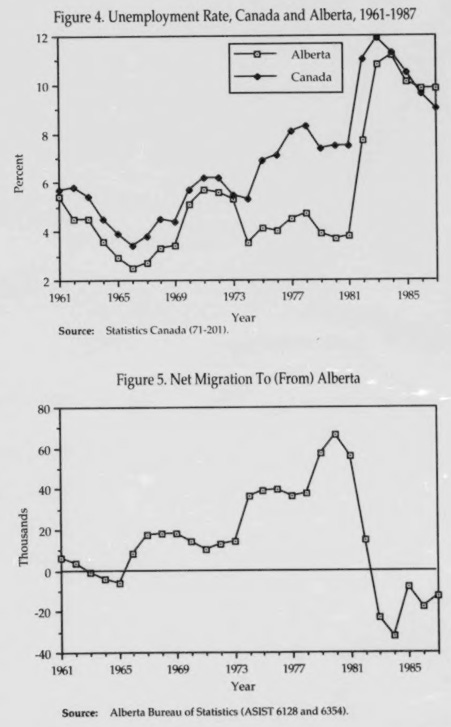
In 1960, Alberta separatism would have appeared to the average Canadian as a crank or fringe notion. Sure, the province had a distinct political culture, but nobody really talked about independence. There’s a whole 1962 book on the province’s weird politics that makes no mention of it. You can’t find it in the newspapers. It’s just not a serious idea.
That all changed when Trudeau announced the NEP in 1980. (See pages 130-34.) By the end of the year, you had three separatist organizations in operation. Support for separation was only 5% right after the Liberals won the February 1980 federal election, but after the NEP was announced it jumps to 13.6%, 23%, or 11%, depending on the question. A party calling itself the Western Canada Concept managed to win a by-election to the Alberta legislature and grabbed 11.8% of the vote in the November general. The WCC didn’t last, but grievance did — thus, this year the sudden surge in separatist sentiment.
Now don’t get me wrong, the idea was still fringy, and Alberta is not about to declare independence or become a U.S. state.3
But hammering Texas would not only be a good way to drive the state into the arms of the other party, it could ignite the slumbering giant of Texas separatism. Underlying secessionist sentiment is much higher in Texas today than it was in Alberta in 1980. For example, Texan support for secession jumped from 15% to 20% after President Obama won the 2012 election, and grew to 26% by August 2016. (Sadly, Public Policy Polling appears to have stopped asking the question after 2016.)
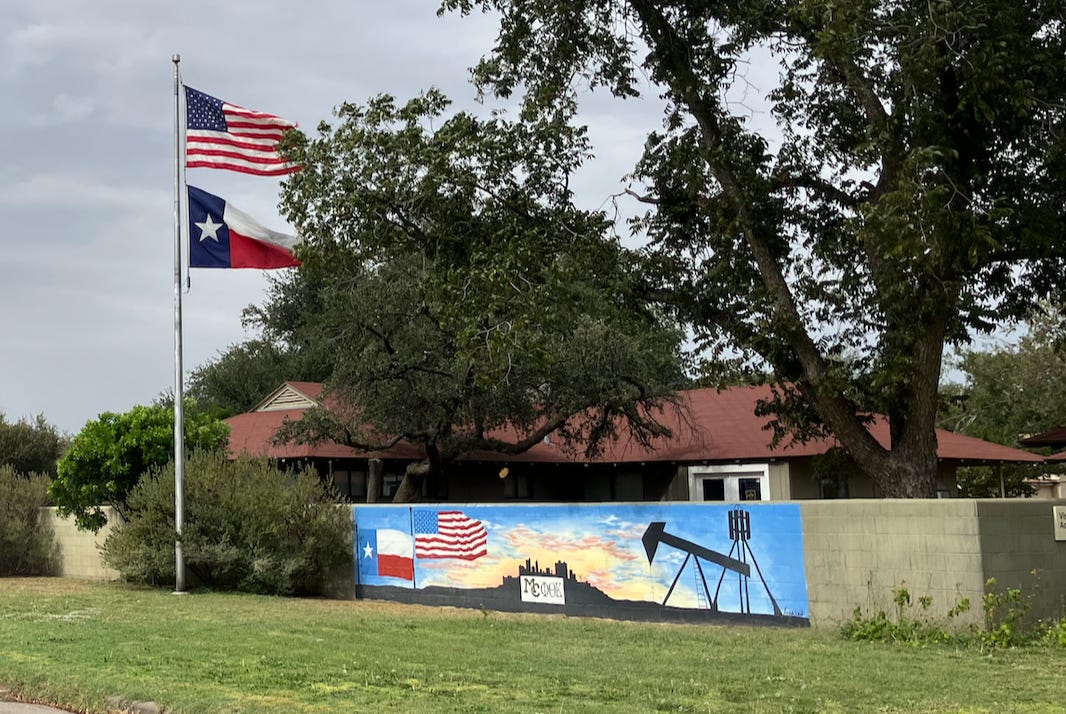
Most Texans who tell pollsters they support secession are probably just expressing partisan anger — that’s certainly true for most of the existing polls on “do you want your state to secede,” which is why I don’t cite them. Partisan anger explains the rise in secessionist sentiment in Texas over the course of the Obama administration. But that is precisely the point! Alberta shows that a fringe regional grievance can become politically consequential very quickly if the federal government deliberately takes a hammer the region’s core industry, particularly one with emotional resonance.
And that is probably the best reason why a present or future administration should refrain from oil populism. The last thing America needs is a secessionist movement that we’d have to take seriously.
The President can also ban exports under the International Emergencies Act (I hate calling it “IEEPA”), the National Emergencies Act, or the energy conservation chapter that allows for renewable one-year crude-export restrictions should the Commerce Secretary or Energy Secretary declare that prices are too high. Even a GOP-controlled Congress under President Obama was unwilling change those laws in order to seriously tie the President’s hands, alas. Of course, even if they had, we later got the Export Control Act of 2018, which lets the President, uh, control exports.
Donald Meinig also published a map of the Lesser United States that he also considered more ex ante probable than the continental boundaries we all know:
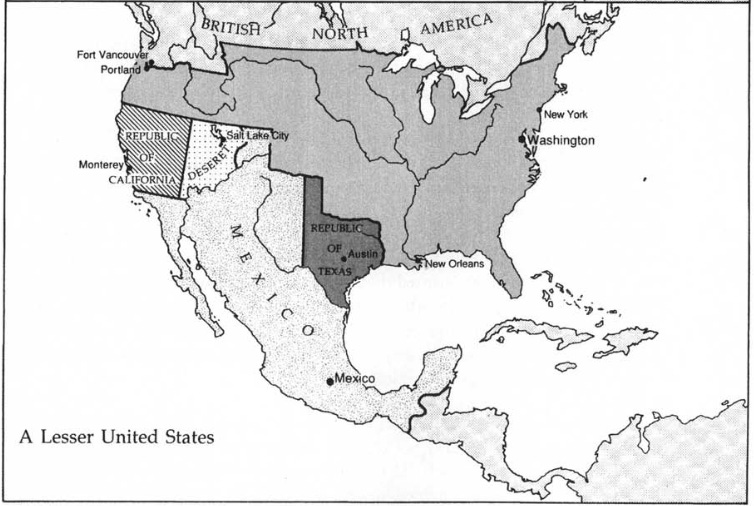
Although the latter would benefit both Alberta and the United States and not by a little, even if the geography would be a bit ridiculous.