

In 1933, the United States overthrew a Cuban government because it insisted on repaying American creditors.
That really happened. President Gerardo Machado was prepared to pay any price, bear any burden, rather than miss Cuba’s debt payments. Even when that price included confiscatory taxes, wage arrears, the complete shutdown of public education, and an unstoppable downward GDP spiral, Machado refused to default. The end result was the extraordinary spectacle of the Roosevelt administration (Franklin, not Theodore) orchestrating the overthrow of a Cuban president because he refused to default on debts to American investors.
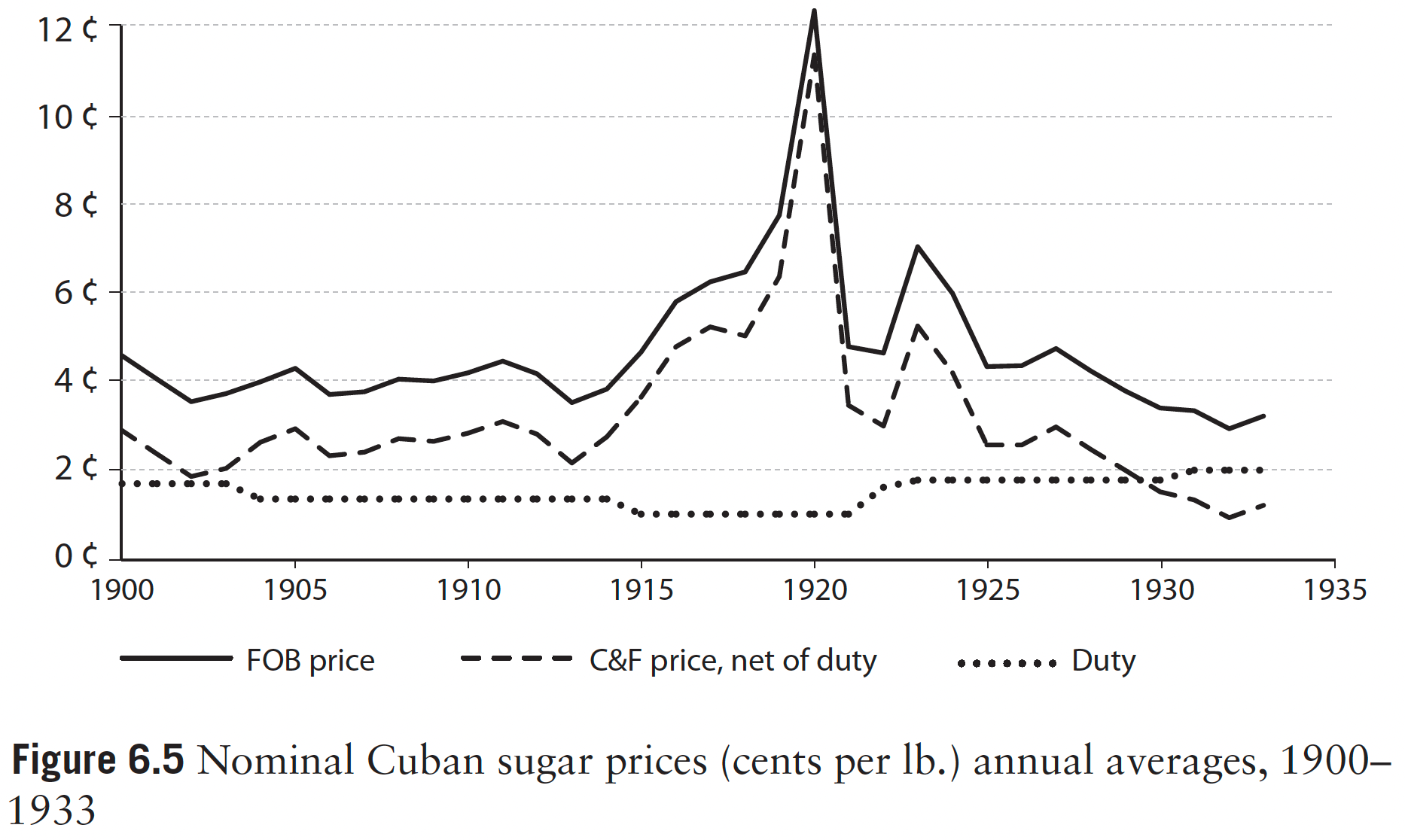
Machado had the bad luck to be elected president in 1924, right before the sugar market collapsed. Elected in November, he didn’t take office until May, as the market went into free fall. A record Cuban sugar harvest combined with London’s decision to exempt imperial sugar from U.K. duties caused prices to collapse. Prices sort of stabilized after that, but the good times were over.
The Machado administration reacted with a kind of proto-Keynesianism. In 1926, it borrowed $10 million (2% of GDP) from Chase to accelerate a public works program. The next year, it ran a fiscal deficit of 3% of GDP. In 1928, it negotiated a $50 million credit line as nominal GDP shrank from $648 million to $584 million.
After securing a constitutional amendment, Machado (a Liberal) won re-election in 1928 as the nominee of all three Cuban political parties — the U.S. embassy believed, perhaps unsurprisingly, that he had used government funds to bribe members of the Conservatives and the Cuban People’s Party in order to secure both the amendment and his uncontested re-election. When Carlos Mendieta tried to challenge Machado under the rubric of the Nationalist Union, the new party was kept off the ballot and harassed by police.
In February ‘29, after the election, the government issued an additional $38 million (7% of GDP) in long-term bonds and negotiated an additional $20 million credit line (4% of GDP) … which it exhausted by August. By the end of the year it had run an eye-watering deficit of 15% of GDP. Under the prevailing interpretation of Cuba’s constitution, the U.S. State Department had to sign off on all of these loans, which it dutifully did, terrified that a failure to do so would cause the Cuban economy to deteriorate faster.
Machado failed to ignite a recovery, as the Great Depression ravaged the country’s export markets.1 The fundamental problem was that Cuba used the U.S. dollar as its currency, which meant that it could not devalue. It therefore had to adjust through deflation. Prices and wages declined, the debt-to-GDP ratio rose, and the gigantic budget deficits made matters worse by making everyone fear higher future taxes.2 The government tried minting silver pesos in 1932, which helped it cover its growing deficits, but not in sufficient quantities to drive the dollar out of circulation.3
Instead of reactivating the economy, growing public debt dragged it down further. Prices were falling. Nominal tax receipts followed. But the burden of public debt rose and the willingness of lenders to finance new debt fell. The government therefore had to raise taxes, lay off workers, and cut salaries to make its debt payments. But that cut the demand for goods and services, which in turn caused prices to fall further, depressing tax revenues even more …
And so a de facto dictatorship entered an economic spiral. Violence rose. In 1930, before the midterm elections, gunfire broke up a student demonstration, killing one and wounding two. The President then “temporarily” suspended constitutional guarantees, and armed his supporters to violently break up Nationalist Union rallies, which in a heavily-armed country managed to kill both police officers and civilians. Massive student demonstrations followed the November “elections.” Machado shut the university and all high schools in December (fiscal exigencies would keep them from reopening). In January he arrested the entire university student directorate and rammed a bill through Congress indefinitely suspending civil liberties.
The Machadato, Part I: The Full Ceaușescu
Machado dismantled the Cuban state and wrecked the economy in order to keep paying its debts. The result was exactly as chaotic as you would expect. Debt service rose from 9% of public spending in 1928 to 13% in ‘30 and 14% in ‘31 before spiking upwards to 20% in 1932.
In January 1930 the government decreed the first wage cut; by September 1931, overall nominal public sector salary levels had declined by half. Even then, the government couldn’t pay its bills. In December 1931, the Machado administration postponed government paychecks for several weeks. Six months later, in June 1932, it again suspended wage payments, save the judiciary, high officials, and the military. The judiciary came under the axe in September ‘32.
And even that didn’t stop the bleeding. In January 1933 cabinet members joined the long list of public servants expected to work for worthless paper IOUs. The New York Times reported that salary arrears reached $14 million that month and the government began paying salaries in scrip. By May 1933, wage arrears alone surpassed $19 million, fully half the central government’s annual budget. The rest of the public schools and all of the courts shut down, agricultural extension programs ceased, and public services were suspended.
Tax hikes were almost as destructive. In 1933, Cuba imposed a 1¢ per pound excise tax on refined sugar at a time when sugar (net of U.S. tariffs) traded at 0.9¢ in New York. Machado essentially confiscated the lion’s share of Cuba’s export earnings. The tax ignited a furious response from sugar growers. The government backed off (informally) on the sugar levy but imposed a dizzying array of domestic taxes, only to see collection collapse even faster than the economy because tax collectors, having been unpaid for months, grabbed the receipts for themselves.
The state’s collapse didn’t go unresisted. Open revolt broke out in August 1931, as Cuban troops fought rebels in Havana, Matanzas, Pinar del Río, and Santa Clara. The organized revolt collapsed within a week, but organized warfare morphed into widespread terrorism. 1931 and 1932 saw a regular litany of bombings and assassinations — including two massive car bombs fortunately discovered by police before they could detonate.4 Machado gave as good as he could take: in addition to the police, Machado pardoned 489 supporters in 1931, 400 for violent offenses. The U.S. ambassador warned Machado that “nearly everyone was opposed to the government except those being paid by it.”
So why did Machado insist on repaying the bankers? Well, part of it was a (misplaced) fear of American intervention, part was pride, and part was fear of losing access to foreign credit, but the strongest motive appears to have been self-interest. From The Empire Trap, page 228:
Cuba’s lenders provided Machado and his supporters with personal incentives to continue the government’s debt payments. Chase Bank granted Machado personal loans worth $130,000 ($2.15 million in 2011 dollars), “with little prospect of immediate payment” in the words of a later Senate investigatory committee. Chase also made loans to enterprises owned by the Cuban president: it gave $45,000 ($745,000 in 2011 dollars) to a construction company and $89,000 ($1.48 million in 2011 dollars) to a shoe factory.
In addition, Chase hired Machado’s son-in-law, José Emilio Obregón, even though, as Chase officials themselves wrote, “As we know, from any business standpoint he is perfectly useless.” Although Obregón was perfectly useless to Chase’s business, he nevertheless received a starting salary of $12,000 (which rapidly rose to $19,000, for a rise from $202,000 to $319,000 in 2011 dollars) and an additional $500,000 commission ($8.5 million in 2011 dollars) for his role in securing the 1928 public works loan.
Cuban families close to Machado were invested in the Cuban public debt. The State Department reported that at least $1.5 million of the Cuban public works bonds ($26.3 million in 2011 dollars) was held by “individuals close to the President,” with an additional $5.5 million ($96.8 million in 2011 dollars) belonging to the Compañía Cubana de Contratistas, “in which those chiefly interested are Augustus Alvárez and Rodolfo Arrelano, both of them intimately connected with the President.”
Machado’s system meant that Machado and his cronies had a vested interest in continuing to pay the debt. That was great for American bankers, at least as long as Machado could keep himself in power. For the Cuban people, under Depression conditions, not so much.
The Machadato, Part II: The American coup
There’s a long history of paranoid people seeing an American hand in all sorts of foreign events. Sometimes they’re even true. In the 1960s, American oil companies really did try to overthrow Sukarno. In the 1970s, ITT really did try to overthrow Allende. (There is something very strange in having the phone company try to overthrow a government, but when you think about it, it has a certain perverse sense.)
In Cuba, however, the U.S. got rid of Machado because he refused to default on the debt. Back in Washington, the Great Depression destroyed whatever political influence the bankers possessed. Abroad, meanwhile, American officials were urging client states to stop servicing unsustainable debts — nobody wanted to see countries fall into chaos under the burden of interest. Nor did they want to see taxes on American enterprises raised to confiscatory levels in order to repay debts to American banks. And Machado, in Cuba, was simultaneously dismantling the state he ruled and taxing away the foreign earnings of American enterprises, even as his country slid into civil war.
But Machado was stubborn. Or greedy. Or crazy. Or all three — American officials who met with him during this period reported strong whiffs of “crazy” from the man. He studiously ignored every hint emanating from the American embassy in Havana.
The problem for Washington was that it couldn’t openly order Machado to stop making payments. It couldn’t even simply pressure U.S. banks to unilaterally offer a debt restructuring. President Hoover’s last ambassador, Harry Guggenheim, succinctly summed up the dilemma: “Any effort by our government to induce the bankers to relieve the financial strain on the Machado administration will be generally condemned as United States support of the unpopular Machado administration.” In other words, the Hoover Administration wanted to get Machado to stop wrecking his country, but they didn’t want to be seen saving him from himself.
Guggenheim’s FDR-appointed successor, Sumner Welles, was less risk-averse and tried more directly to get Machado to default. The problem, Welles reported, was that Machado was delusional. “He feels that the strongest support which he has in his present position is the support given him by the American banking groups and he has further the conviction, which nothing will shake, that any default of obligations by his administration will make more likely the possibility of American intervention.”
The thing is that failing to default made American intervention inevitable. Machado could have forestalled that by defaulting, but didn’t, even when FDR’s own ambassador told him to.
And so the U.S. got rid of Machado. We didn’t have to invade. A wave of strikes provided the pretext. On July 25th, Havana’s bus drivers went on strike to protest a municipal tax hike. Cab drivers followed on August 1st. Their strike wasn’t just a walkout: the strikers littered Havana’s boulevards with broken glass and nails to make them impassable. Long-distance truck drivers and bus drivers in other cities walked out on August 2nd; the longshoremen followed on August 3rd.5 The next day the strike went national: government employees walked out, stores closed, and Welles worried that “there will be a state of near starvation within the next 24 hours.” Three days later, on August 7th, the general strike turned violent when the police fired on demonstrators.
Welles immediately went to President Machado, and bluntly told him Cuba would fall into anarchy that unless he appointed somebody else to run the government and resigned. Machado told Welles that he would “prefer armed intervention to the acceptance of any such proposal.” In Welles’s words, Machado “was in a state of mental disturbance bordering on hysteria.”
FDR quietly called the Cuban foreign minister in Washington down to the Oval Office on August 9th. He gently told the ambassador that Machado should step down “to prove to the world his high purpose in this crisis” and perform “a noble act” suitable for “a great man, a great leader, and a great patriot.” FDR even offered to provide unspecified political cover so that Machado would not lose “face.” He also somewhat ominously added that he felt a “duty to do what we could so that there should be no starvation and chaos among the Cuban people.”
When Machado refused FDR’s direct order, the gig was up. With disorder and food shortages spreading, Ambassador Welles held meetings with the leaders of Cuba’s three major parties and the military to organize a new government. Welles was less than impressed with most of the opposition’s leaders, with one exception: Hortensia Lamar, the leader of the campaign for women’s suffrage.6 Welles told her on August 12th that Machado would be resigning soon and Lamar announced it to an enthusiastic crowd from the balcony of the U.S. embassy.
The next day, Machado stepped down. Carlos Manuel de Céspedes took over as provisional president. Machado left by plane for the Bahamas with “five revolvers, seven bags of gold, and five friends in pyjamas.”7
He would die in 1939 in … where else? … Miami.
The U.S. proceeded to implement a plan for orchestrating a Cuban default. Bureaucratic conflicts between State and Treasury led to a rather less smooth rollout than Ambassador Welles hoped, but it nonetheless worked. With his typical creativity, FDR even found a clever way to aid the new government without the need to go to Congress: have the Reconstruction Finance Corporation make a $4 million loan to a mining company, which it would pay in silver that the Treasury would immediately mint into coins with a face value of $14 million that would then be shipped to Cuba — that’s the equivalent of $7.7 billion in 2024 as a share of the federal budget, and almost 4% of Cuba’s GDP.
After the Machadato: Not quite over
As the Americans were hammering out their plan to start repaying salaries, one Sergeant Fulgencio Batista led a mutiny of non-commissioned officers. The proximate cause of the mutiny was a [false] rumor that the government intended to cut enlisted pay from $22 a month to $13. Radical student leaders quickly converged on the mutineers’ headquarters. The mutineers agreed to support the students, and declared a new government on September 4th under a five-man executive commission headed by one Ramón Grau. Five days later, Grau assumed the Presidency. Recalcitrant Cuban officers held out in the National Hotel in Havana, when Grau’s soldiers stormed the building and captured or killed the holdouts.
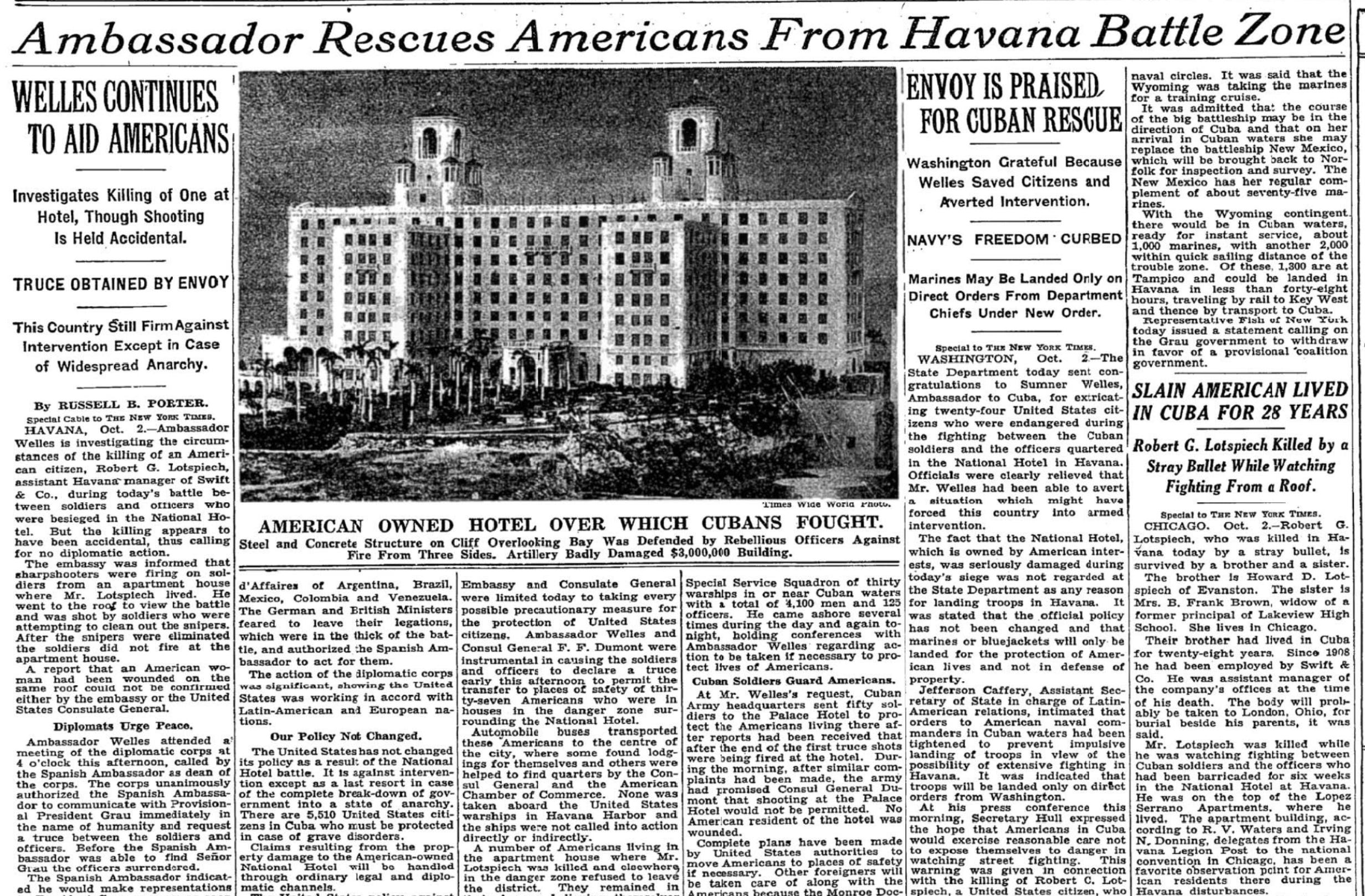
Ambassador Welles wasn’t thrilled by the new regime, and not only because he was between leases and living in the National Hotel when the Cubans stormed it. No, the problem was that Grau was a terrible combination of left-wing and ineffective. Bombings and terrorism surged, assassinations proliferated, and anti-Grau troops from Camp Columbia “flying stolen fighter planes, swooped low over the city of Havana, spraying 50-caliber machine gun bullets into the streets, across the roof tops, and into the streets again.”
More importantly, the disorder threatened American investments. Workers occupied American-owned sugar plantations, including two sugar mills, and the Grau government directly interfered in the management of the American-owned Cuban electric and phone companies. Other plantations went up in flames. Police protection had already evaporated under Machado; Grau made it worse. Welles reported that the Grau government was under “ultra-radical control,” and “Communistic elements are having an unfortunate influence.” Standard Oil asked for U.S. Marines to protect its operations. Bethlehem Steel and United Fruit quickly followed.
FDR heard their requests: he ordered 29 naval vessels to Cuba and Key West. He also ordered the Marine Corps to put its air squadrons on alert, with pilots at Quantico, Virginia, ordered to be packed and ready to fly to Cuba “on a moment’s notice.” The Marines also activated five battalions in Quantico and Port Everglades in Fort Lauderdale, Florida, and prepared for deployment.
American covert action managed to head off the need to invade. Jefferson Caffery, acting as FDR’s personal representative, brokered a deal between the aforementioned Carlos Mendieta and Fulgencio Batista to organize a coup against Grau. On January 15th, 1934, the Cuban army swung into action and quickly ousted the chaos-prone left-wing government. Mendieta assumed the presidency, ceased debt payments, got American money, and started paying back salaries.
A New Deal for Cuba?
The … uh … new deal between the U.S. and Cuba was a strange one. As Alan Dye and Richard Sicotte have argued, it relieved the immediate crisis at the cost of long-term growth.
The U.S. gave up its legal right to intervene, but nobody thought that meant anything. The Olney declaration was still alive and well: “Today the United States is practically sovereign on this continent and its fiat is law upon the subjects to which it confines its interposition.” The U.S. hadn’t needed legal justification to create Panama, occupy Hispaniola and Nicaragua, or install its officials inside the governments of places as far afield as Peru and Bolivia. It was a nice gesture, but purely symbolic, as Messrs. Noriega and Maduro would discover many decades later.
The substantive change was that FDR renegotiated Cuba’s trade status with Congress to channel more benefits to the island while protecting mainland sugar producers. FDR convinced Congress to cut the sugar duty in half, from 2¢ to 0.9¢ — but with a quid pro quo that capped Cuba’s share of the American market to its 1931-33 average. (See figure below.) Moreover, access had to be renewed every three years, which discouraged investment.
So Cuba would enjoy high sugar prices, but American producers could rest secure that no matter how efficient the Cuban industry became — and there was ample scope for innovative productivity gains — it would never cut into their existing market.
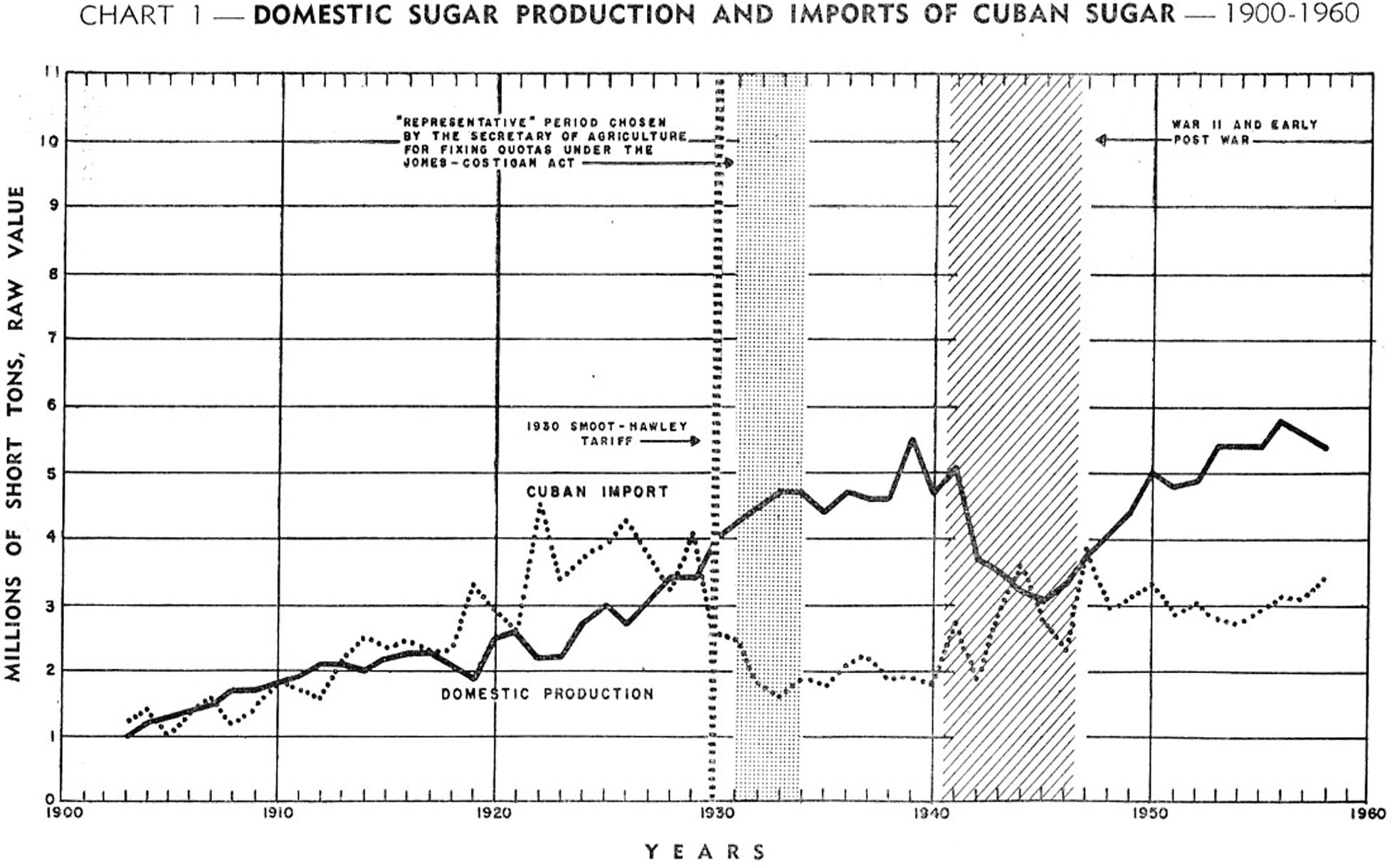
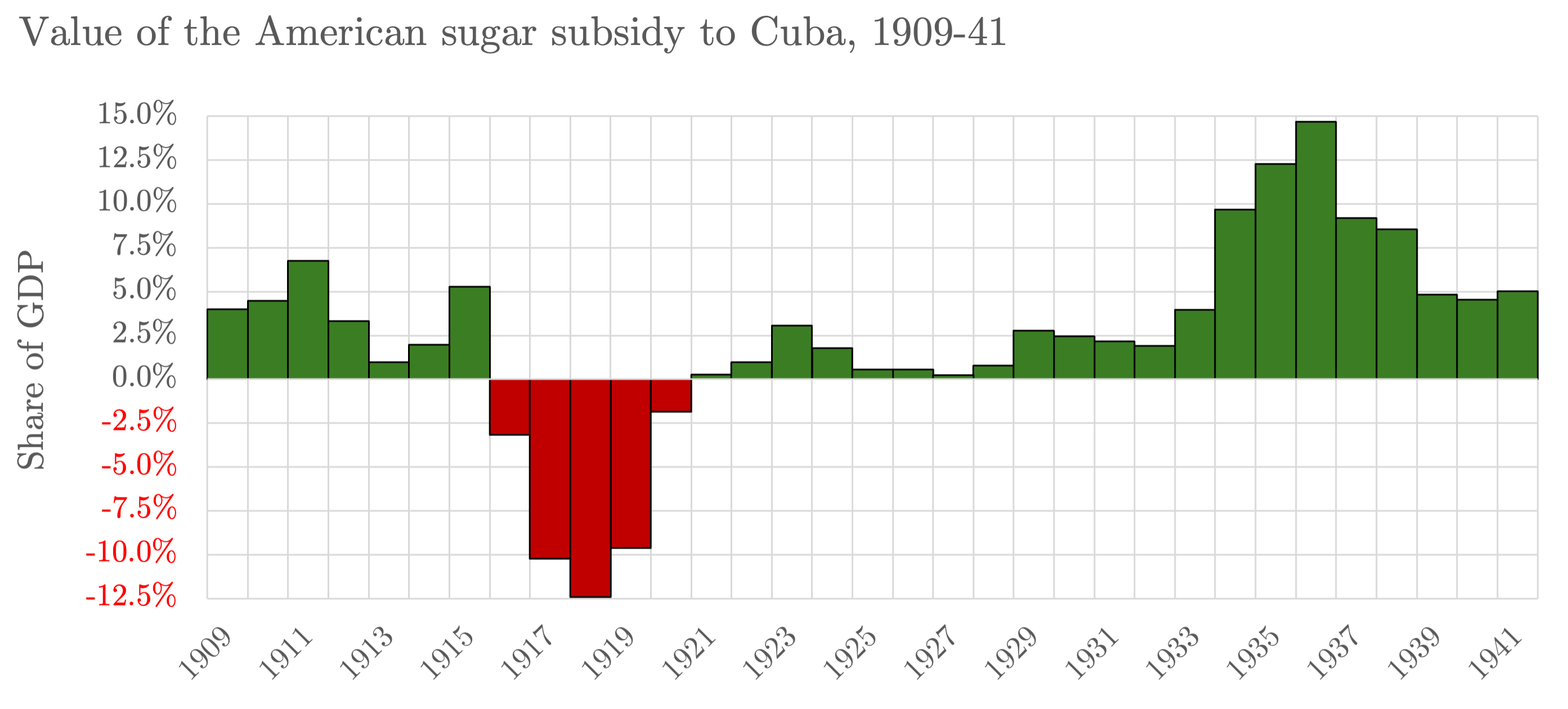
The resulting arrangement stabilized Cuba and generated rents, but it also capped the island’s main source of growth. With its share of the U.S. market quota-limited and foreign markets increasingly inaccessible or unattractive, sugar production stagnated. In an alternate universe, that stagnation might have produced dynamic new industries (or a precocious mass migration to the United States) but we don’t live in that universe. In this one, the combination of American subsidies and hard output caps seems instead to have generated enough rents to keep Cuban elites attached to protecting their existing lines of business.
In the words of Mary Speck:
Reorganization of the [sugar] industry would have been economically painful, and, for a country still reeling from Machado’s overthrow, politically disastrous. Cuban producers demanded internal quotas to protect themselves from internal competition. Decree 522, promulgated in 1936, followed a year later by the Law of Sugar Coordination, set up an elaborate regulatory system designed to guarantee the survival of the island’s smaller mills, along with independent sugar planters or colonos. Small mills were guaranteed minimum basic quotas, while larger mills were limited to their average production in 1934 and 1935. Sugar planters or colonos in turn won quotas to preserve their share of the cane sold to mills, and also secured restrictions on the amount of “administration cane” large mill owners could grow on their own property. Colonos also won the so-called “right of permanent occupancy,” which meant that as long they met their cane quota and paid their rent, they could never be evicted. And just to be sure no mill owner or cane grower ever went into bankruptcy, the act extended a moratorium on agricultural loans.
But it did not end with sugar.
Risk-free capitalism in Cuba after ‘34
After 1934, Cuban governments increasingly extended the sugar sector’s logic of protection to the rest of the economy. Back to Mary Speck:
U.S. trade policies not only limited the growth of Cuban sugar exports, they discouraged the growth of other export industries, as well. High tariffs on finished tobacco products … encouraged U.S. cigar makers in Havana to shut down their factories and re-open them in New Jersey. 30 Would-be exporters of winter vegetables and citrus fruits also faced tariff barriers supported by strong domestic lobbies. It did not matter that many of these small farmers were U.S. citizens, lured to the island shortly after independence by land developers … Well-organized fruit growers in Florida and California made sure that tariffs were high enough to discourage foreign imports, including those raised by their compatriots in Cuba.
The economic polices that emerged beginning in the 1930s were geared, not toward growth, but toward protecting Cuban jobs and Cuban businesses. In the words of the World Bank, Cuban economic policies focused on “preserving the status quo and on regulating the division of a fixed national production, rather than on innovation to enlarge the total product.”
Mills were discouraged from economizing by reducing the length of the harvest or improving the productivity of labor. Labor legislation made it difficult to dismiss workers for any reason, including “tecnificación.” Sugar unions also protested against rising “intensivismo” in sugar factories. … Growers had little incentive to improve the quality of their cane because their payments were based, not on the yield of their individual crops, but on the average yield of the entire cane crop processed at their local mill. In order to equalize payments to colonos with poor land, the percentage payment declined as yield increased. There was little reward for raising yield by planting better varieties of cane, cutting cane only when mature, or delivering it promptly to the mill.
The attempt to create risk-free capitalism was not limited to the sugar sector. Quotas were extended to two other important products, tobacco and coffee. Nor were imports allowed to bring unbridled competition to the island’s domestic market. Most industries were organized in manufacturers’ associations that secured tax advantages, subsidies, and protective tariff barriers against finished products while lobbying for low tariffs on imported inputs. The result was a complex system of taxes and tariffs, riddled with exemptions.
Manufacturers did not hesitate to join forces with labor when threatened with technologies that might raise productivity and thus displace workers by putting inefficient enterprises out of business. Attempts to mechanize cigar production beginning as early as the 1920s were repeatedly thwarted by a powerful alliance of small manufacturers and skilled workers. Candy manufacturers who invested in modern machines during the 1940s had to run them at the lowest possible speed so as not to put their rivals out of business and displace workers. Textile factories faced potent opposition from their competitors and their workers as they tried to raise productivity in the 1940s and 50s.
In short, other sectors demanded the same security that the U.S. quota system gave to sugar, which soon enveloped Cuba in an ever-tightening web of regulations. Cuba remained a relatively prosperous country, but growth never returned to its pre-Machado trend. Hell, it didn’t fully recover from the Depression until 1950:
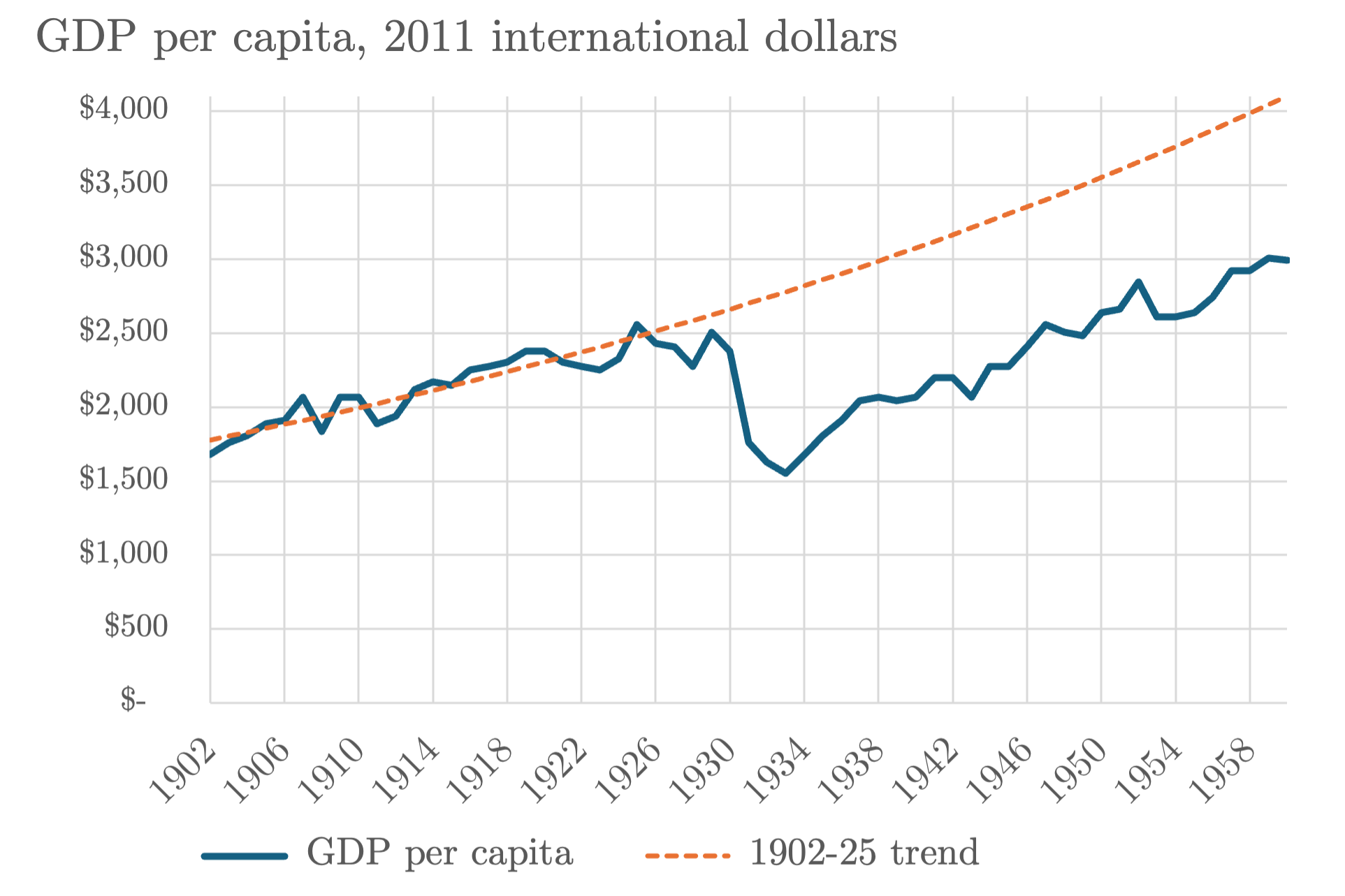
Needless to say, none of this would have happened had Cuba become an American territory in 1898, let alone a state.8
The irony is hard to miss. Washington helped remove a government because it would not stop paying American creditors. It then imposed a settlement that channeled rents to Cuba and avoided a painful restructuring of the economy. The settlement spared the island a complete implosion, but locked Cuba into a political economy in which too many interests lived off rent-seeking and too few were able to gamble on creative destruction. The opposite of dollar diplomacy, it turns out, was not economic freedom. It was a system where American dollars prevented collapse but froze the economy.
At least until 1959.
The Smoot-Hawley tariff wasn’t good for Cuba, but it only raised the duty from 1.76¢ to 2.0¢. That wasn’t enough to cause the economy to collapse the way it did.
An excellent case can be made that Cuba should have delinked with the dollar and devalued. The problem, however, wasn’t just ideology, it was that Cuba quite literally did not have a currency, other than some coinage. Silver pesos were minted in small quantities until 1932 and paper pesos weren’t introduced until 1934. In the words of a 1950 observer: “The outstanding characteristic of the dollar in Cuba was precisely that it could be neither stretched nor bent.” By 1934, however, the U.S. had begun to reflate and the pressure to devalue had abated.
Silver pesos traded at a small discount to the dollar. Rather than expose themselves to the risk that the silver peso might decline further, Cuba’s mostly American-owned banks established separate peso accounts. Moreover, the Cuban government refused to allow private actors to pay more than 20% (raised to 35% in 1932) of their tax bill in pesos, insisting on dollars. See Henry Wallich, Monetary Problems of an Export Economy (Cambridge, MA: 1950), p. 83.
In April 1932 a police raid uncovered “an infernal machine which was in reality an automobile made into a monster bomb.” Gunmen killed the head of the security services in July and the president of the Senate in September — terrorists then attempted to bomb the Senate leader’s funeral with 300 pounds of dynamite dispersed into 23 separate charges. A gardener fortunately discovered the bombs.
See Philip Dur and Christopher Gilcrease, “US diplomacy and the downfall of a Cuban dictator: Machado in 1933,” Journal of Latin American Studies; Cambridge Vol. 34, (May 2002).
Nowadays historians face a silly temptation to increase the importance of female actors beyond their actual contribution. That said, Hortensia Lamar deserves all the credit she gets and then some.
Apparently the wings of the plane were riddled by bullet holes from Cuban troops who tried to stop him until the U.S. ambassador asked them to let him go. See Dur and Gilcrease (2002), p. 278.
Well, maybe not needless to say, but fairly obviously. I’ll lay out the argument in more depth if anyone asks in comments.
> The economic polices that emerged beginning in the 1930s were geared, not toward growth, but toward protecting Cuban jobs and Cuban businesses. In the words of the World Bank, Cuban economic policies focused on “preserving the status quo and on regulating the division of a fixed national production, rather than on innovation to enlarge the total product.”
That sounds awfully similar to communism.
> Needless to say, none of this would have happened had Cuba become an American territory in 1898, let alone a state.
I guess the obvious argument is: look at Puerto Rico (and the possible mass migration you mentioned above). But I wonder if you were thinking of something else.