

The first two entries in the series explored Cuba’s relation with Venezuela and the Soviet Union. Both countries economically supported Cuba’s economic model and thereby its regime. Both times Cuba suffered when that support went away.
But there is a third episode in Cuban history: Cuba under American domination, between 1898 and 1934. The United States takes control of Cuba, declines to annex it, reserves the right to intervene, and finally overthrows the government on its way out because said government insists on repaying its debts to American creditors.
It’s a weird story. This is part I.
The annexation that wasn’t
So why didn’t the United States annex Cuba in 1898?
Well, there are three general hypotheses:
Anti-imperial ideology. In some readings, this is actually a form of racism; we weren’t anti-imperial so much as we didn’t want more non-white people in the polity.1
Cuban resistance.
Sugar.
The correct answer is sugar. There is something to the other two arguments. But neither was decisive in the face of opposition from sugar interests. Nonetheless, let me briefly take the other two in turn.
Yes, Congress got into the Spanish-American War in order to guarantee Cuban independence. And yes, back in 1870 the Senate declined to ratify the 1869 treaty to bring the Dominican Republic into the Union for purely racial reasons.2 So there are reasons to think that Congress didn’t want to expand southward.
But let’s be serious. The U.S. annexed the Philippines and Puerto Rico as a result of that same the Spanish-American war with no compunctions. And while Congress had declared its support for an independent Cuba, the McKinley Administration was very careful to leave the island’s status vague in the peace treaty.
But what about the Dominican precedent, you ask? The Dominicans had peacefully signed a treaty joining the United States, yet Congress said no. Well, the D.R. project was Ulysses Grant’s brainchild and came out of nowhere for most Americans. It was purely idiosyncratic and quite strange The idea of annexing Cuba, conversely, went back a long way. Moreover, domestic and international conditions in 1898 were very different than they had been in 1869 — and most importantly, while no one could deny that Cuba had a lot of black people, American opinion (elite and popular) did not consider the island to be black; racial differences did not forestall Puerto Rico’s annexation.
As for Cuban opposition, well, there was no serious violence under U.S. occupation. (This may have been related to the fact that the U.S. paid former Cuban rebel fighters the equivalent of $3,034 per person in 2024 dollars if they turned over their equipment — about 25% more than the country’s per capita GDP at the time.) Many Cuban elites were opposed to American annexation, but that’s not the same thing as stating that they would pledge their lives, fortunes, and sacred honor to prevent it.
That said, as with the debate over Castro’s intentions, it doesn’t matter. Congress was not going to accept a Cuban territory even had it been populated entirely by light-skinned northern Italians. Why not? Simply put: the domestic sugar industry. (Shrinking cane in Florida and Louisiana; booming beet in California, Michigan, Colorado, Utah, and Nebraska.) The industry’s output was trivial — a near invisible 0.3% of GDP in 1900 — but its influence in Congress was anything but that.
The power of the sugar lobby is obscured in the debates over American intervention and the Treaty of Paris, but you can see it clearly when the new Cuban government and Teddy Roosevelt tried to get a free trade treaty with the United States.3 The Cubans opened with a fairly simple proposition: “The proper solution for both countries is virtually free trade.” (Page 94.) Luis de Abad eloquently put it this way before the U.S. Congress (page 142):
The Cuban workingman remarks with surprise, without being able to explain it, that while the Stars and Stripes float on the Morro there is less bread and butter in his home and he is worse off than under the Spanish domination.
Free trade didn’t happen. All the Cubans got was a 20% reduction in the tariff faced by other foreign producers. (That’s one-fifth off the base rate for any product, not a 20-point benefit.) In return, all the Cubans had to do was add an “appendix” to their constitution — and, just to be sure, sign a treaty with the same language — giving Washington the legal right to “intervene”:
The Government of Cuba consents that the United States may exercise the right to intervene for the preservation of Cuban independence, the maintenance of a government adequate for the protection of life, property, and individual liberty, and for discharging the obligations with respect to Cuba imposed by the Treaty of Paris on the United States, now to be assumed and undertaken by the Government of Cuba.
And even then, Congress balked. In 1902, the proposed agreement came under widespread condemnation in the House of Representatives. The Department of Agriculture came out against the President’s own initiative. The New York Times reported colorfully on the scene before the Ways and Means Committee:
It was impossible to determine even approximately the attitude of the committee. It seemed to be beyond question, however, that Mr. Tawney (Rep.) of Minnesota, Mr. Lu (Rep.) of Kansas, Mr. Metcalf (Rep.) of California, and Mr. Robertson (Dem.) of Louisiana were strongly against the Cubans. The questions they asked indicated this, and it also was indicated by the intimate association maintained all through the day between these gentlemen and Mr. Oxnard and his friends of the beet sugar persuasion.
The one thing made absolutely clear was that a great pressure was being brought upon the committee to prevent it, if possible, from yielding anything to Cuba. Mr. Oxnard and his friends completely filled the space in the committee room to the left of the committee table, and every man in the party was alert and active in furnishing information and in offering suggestions to the members of the committee who had espoused their cause.
The Cubans apparently lacked earnest advocates of their proposition.
So it died in Congress. Died dead. Opposition by the sugar interests meant that you couldn’t get a 20% cut in tariff rates through the House, let alone bring Cuba under the American tariff wall.
Now, T.R. was not a man to give up that easy. So in 1903 he resubmitted the agreement, this time as a treaty, allowing him to bypass the House of Representatives. In order to get it through he had to agree to higher tariffs on Cuban refined sugar, because the Havemeyer sugar trust feared that new refineries on the island might undercut it.
If that’s how hard Congressional interests fought the possibility of a tariff cut, how do you think they would react to bringing Cuba fully under the American tariff wall? Badly, that’s right. The Philippines and Puerto Rico got in because they didn’t yet possess extensive sugar industries — and in 1898, the latter wasn’t expected to in the future either. Hawaii only got in because of the combination of a planter elite that enjoyed direct family ties to New England elite Republican families, the presence of a rapidly growing community of American settlers, and some very astute politicking.
In other words, neither domestic anti-imperial sentiment nor Cuban nationalism mattered. ‘Twas old-fashioned industry lobbyists what kept Cuba a country. At least on paper. End result was an “independent” Cuba linked to the American market and subsidized by American sugar consumers, but with a constitutional clause allowing Washington to intervene.
The colony that was
Preferential access to the American market brought Cuba real economic advantages.
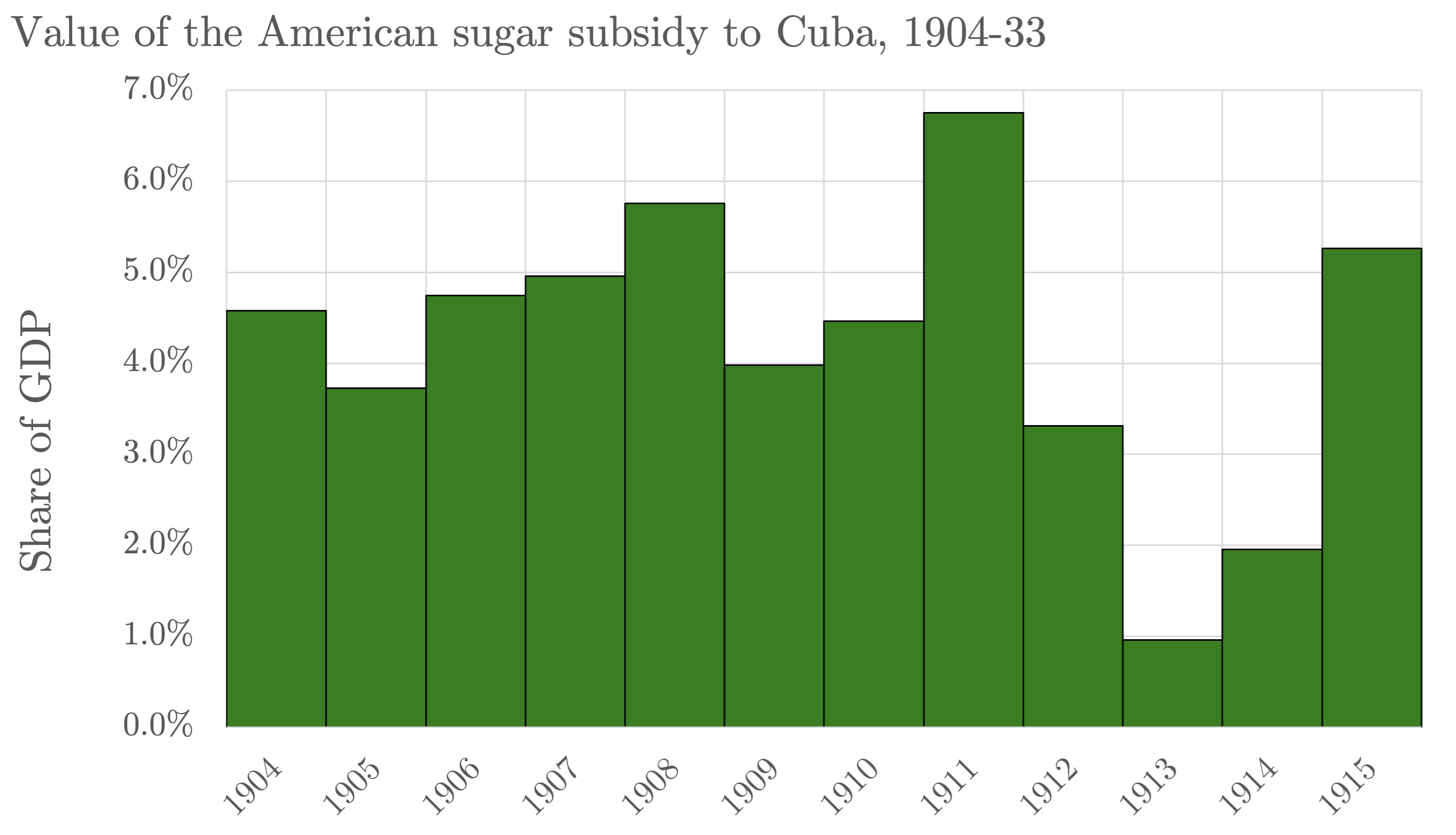
The above figure measures the size of the American subsidy by the difference between the revenue received by Cuban sales to the U.S. minus the revenue they would have received from sales to the U.K. market. It doesn’t hold a candle to later Soviet or Venezuelan subsidies, but it’s nonetheless relatively large. (After 1916, World War 1 sent British sugar prices soaring, making a simple measurement of the implicit subsidy impossible.)
The American protectorate had a second benefit for Cuba: investors regarded Cuban bonds nearly as secure as obligations of the United States. And nothing dissuaded them from this belief. Cuba could face armed revolts, foreign occupation, sugar price gyrations, and changes in American tariff policy without the sharp repricing seen in other Latin American countries. In fact, during the “dance of millions” speculative boom following WW1, yields on Cuban bonds fell below the United States, when the yields for other Latin American countries spiked.
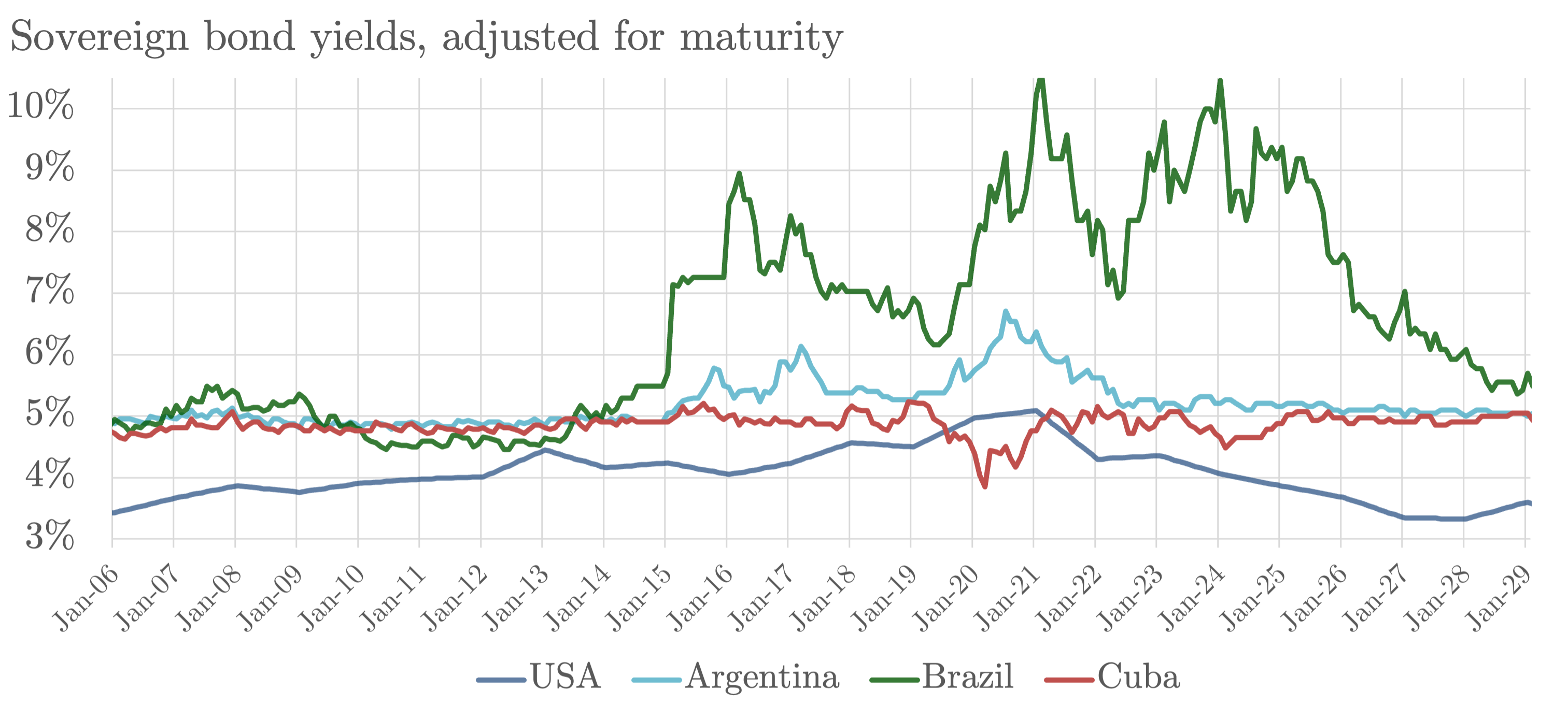
Nonetheless, American tutelage didn’t transform Cuba. The export sector remained dominated by sugar. Manufacturing remained desultory, at best. Tourism was slow to expand. Cuba could borrow money at lower rates than other Latin American nations, but the U.S. State Department had the power to restrict all borrowing, and so Cuba did not invest as much in public infrastructure as it might have had it been fully independent. (Of course, it also possibly avoided worse debt crises — but as you’ll see in Part IIIb, it ran into a pretty awful one anyway.)
The Second Occupation
American control didn’t remain a distant threat. In 1906, the fraudulent re-election of President Tómas Estrada triggered riots, which grew into armed revolt. When the U.S. consul cabled Roosevelt, “Government forces are unable to quell rebellion,” Roosevelt’s personal reaction was to say to a friend, “I am so angry with that infernal little Cuban republic that I would like to wipe its people off the face of the earth.” Roosevelt, however, used more temperate language in a cable to the consul: “Perhaps you do not yourself appreciate the reluctance with which this country would intervene.”
Upon hearing of Roosevelt’s reluctance to step in, President Estrada threatened to resign, “and therefore the prevailing state of anarchy will continue.” Unwilling to invade, but also unwilling to sit idly by, Roosevelt dispatched Secretary of War Taft to Havana, with orders to take all necessary measures. (To be fair, he also dispatched nine warships carrying 6,000 soldiers to Cuban harbors.) Taft landed in Havana on September 19, 1906.
Taft rapidly realized that the government had essentially lost control of everything save a few scattered urban centers. On September 29, ten days after arrival, he commandeered an office in Havana, printed up on his own accord letterhead reading, “Office of the Governor, Republic of Cuba, Under the Provisional Administration of the United States” and declared himself the governor. He then ordered the Marines to land.4 The Americans remained in control of the island until 1909.5
Armed resistance to the occupation was minimal. Marine letters home talk about how good the shopping was in Pinar del Río.6 When insurgents returned from the field on a passenger train, the crowd went into the following call-and-response:
Crowd: “Viva los Liberales!”
Rebels: “Viva Cuba!”
Crowd: “Viva los libertadores!”
Rebels “Viva la Constitución!”
Both: “Viva los americanos! Viva la paz! Viva Taft y Bacon! Viva-a-a-a Mister Roosevelt!”7
The 6,000-man Army of Cuban Pacification saw little action during the occupation.
Taft’s biggest headache came from annexationists among the Cuban elite and American expats. First, they spread rumors of revolt in an attempt “to show the Americans that they must remain in Cuba.” Second, they invited in a junket of Republican congressmen and tried to convince them of the wisdom of permanent association. Third, Juan Masó Parra.
The Masó Parra Conspiracy
Ah, Juan Masó. This guy was the son of a Spanish immigrant. He was also the cousin of Bartolomé Masó Márquez, President of the Cuban “Republic in Arms” during the independence war.
Masó joined the fight against Spain, but on January 19, 1898, he took his entire battalion of 107 men and defected to Madrid’s side. For obvious reasons, this made him rather disliked in Cuba, and he returned the favor by writing an entire book called Masó Parra contra Cuba. His own father reported that nothing would make Juan happier than a chance to fight Cubans again. The guy became a political extortionist, collecting commissions from both the Colombian and Venezuelan governments to not raise hell within their borders. He apparently did very well out of unrest in the Dominican Republic.
On June 22, 1907, Masó crosses the border into Haiti and walks into the Cuban consulate in Port-of-Prince, where he declares that he will return to Cuba. For reasons known to nobody, he gets a visa, even though he was on a Cuban no-entry list. In Cuba, Masó starts meeting with anyone who might even vaguely be interested in violence. And who would that turn out to be? Well, as Masó himself unwittingly told an American intelligence agent, his financiers were Cuban elites trying to bring on annexation. According to U.S. intelligence reports, a group of Cuban elites, Spanish expats, and German investors wanted to finance a “Negro revolt” which would end “the chance of Negro control” because it would terrify the Americans into making Cuba a U.S. territory.8 So the plan seemed to be to get a revolutionary army to attack American interests in order to make Washington think that they’d have to stay permanently? I’m not sure that it made sense, but that was the idea.
Anyway, the U.S. governor who replaced Taft, Charles Magoon, sent the Havana police to arrest the plot’s leaders on September 26, 1907.9
And that was sort of the end of that, although I have to point out two ridiculous ironies about the plot. First, the Military Intelligence Division — America’s proto-CIA — reported that the Spanish conspirators wanted the U.S. to take over Cuba because they, uh, wanted to prevent “[a government] like the United States which plays to the common people and makes [business] interests secondary to politics.”10 Second, the Cubans who’d helped reveal the plot were reviled by Cuban nationalists.11 So some of the conspirators wanted to annex Cuba to the United States in order to prevent Cuba from getting a government like the United States, whereas nationalists opposed to any American interference on the island yelled “traitor!” at the Cubans who helped expose a plot intended to annex Cuba to the United States.
OK, history is full of dumber things.
Although maybe the dumbest is that Masó received a pardon from the Americans only to try to overthrow the government again in May 1909, a mere three months after the Americans turned the keys back over to the Cubans.
Intimations of the end
During the occupation many people (American and Cuban) proposed that the U.S. and Cuba should form a customs and postal union. (The Platt Amendment was widely considered to commit Washington to defending the island from external threats.) Even when the proposals included a sugar carveout they floundered on Congressional opposition — sugar interests wanted to retain the option to raise rates in the future, which a formal customs union would rule out.
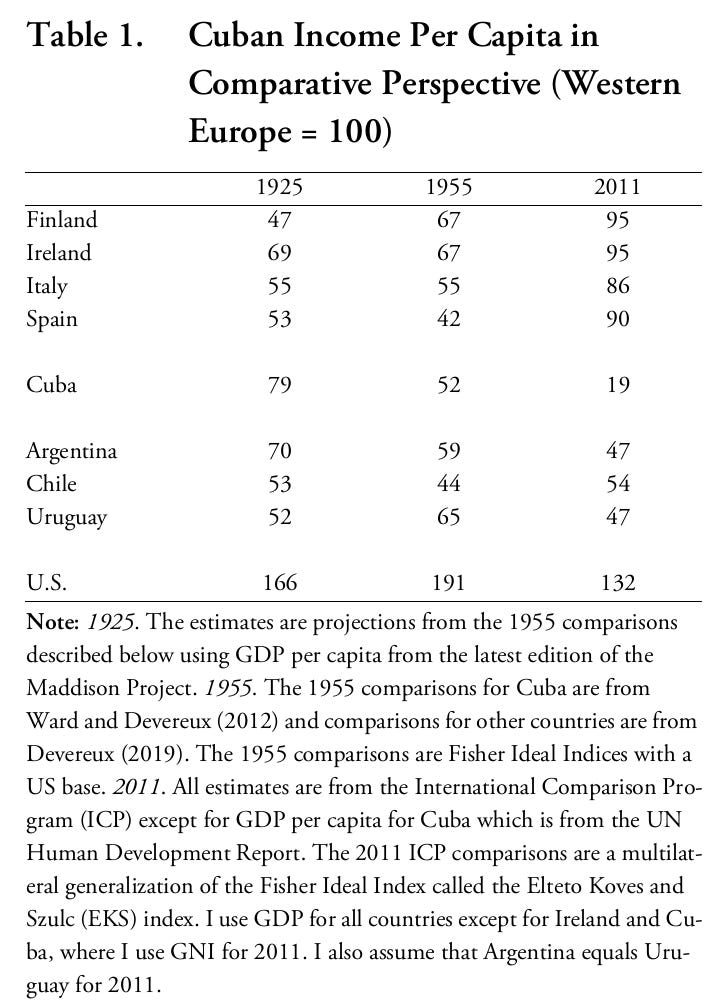
In part, American support for a customs union reflected the attraction of the Cuban market. Cuba was not a poor country per se — agricultural wages on the island were higher than in much of the United States; some kinds of semi-skilled labor could earn as much in Havana as they could in Brooklyn. Overall GDP per capita was higher than in the South (except Texas).
The problem was the concentration on sugar. Governor Magoon put it well in his annual report from 1908:
The industrial situation in Cuba is the same as it would be in a manufacturing community in the United States, where, each year, the mills were run to their full capacity, night and day, for six months and then closed down for six months.
The seasonality introduced all sorts of terrible uncertainty into the Cuban economy. And that was in addition to the general problem of an export-oriented economy centered on a single product, which is that it lived and died on gyrations in the sugar price. But even when sugar demand was high, the country never quite figured out what to do during the months outside the harvest. In another world, Cuba would have become a U.S. territory. Other industries would have flourished, and Cuban workers would have moved to the mainland, replaced by Spanish, Haitian, and Jamaican migrant workers who could go home when the harvest ended. (The latter part happened anyway, I should add, as the planters searched for cheaper labor.)
But none of that happened. Cuba remained dependent on sugar. And then, in 1934, Congress cut the growth opportunities of the sugar economy off at the knees. But that’s the subject for the next post.
Don’t blame me. My paternal great-grandparents arrived in 1896 and my grandfather hadn’t been born yet.
The vote to admit the Dominican Republic as a full territory slated for statehood was 28-28, far short of the two-thirds needed. That lead to recriminations that President Grant should have brought the treaty forward as a joint resolution, much as McKinley did for Hawaii in ‘98. (Remember, the Vice-president breaks Senate ties.) You can find the text of the treaty on page 83.
The U.S. enjoyed free trade with Cuba between 1890 and 1894, under the provisions of the McKinley tariff act. In 1894, the Wilson-Gorman Tariff Act withdrew that access.
Taft worried whether the intervention was constitutional without Congressional authorization. The War Department’s Judge Advocate General, George Davis, assured him that it was. The logic was that since the Cuban constitution authorized us to intervene, then landing Marines was not an act of war. Teddy Roosevelt responded to a letter from Taft about the issue by saying that while he appreciated the opinion, he wouldn’t dream of waiting for Congress if intervention was necessary. (Roosevelt to Taft, September 17, 1906, Roosevelt Papers.)
See Lars Schoultz, That Infernal Little Cuban Republic (Chapel Hill: UNC Press, 2009), pp. 25-28.
Upshur to Dr. J. N. Upshur, October 24, 1906, Upshur Papers.
William Inglis, “The Last Act of Cuba’s Tragi-Comedy of Insurrection,” Harper’s Weekly, (October 27, 1906), p. 1526.
Maj. F. MacIntyre to Magoon, September 26, 1907, File 017-23, Records of the Provisional Government of Cuba, Record Group 199, National Archives.
Memo, Manuel Landa, Secretary of Justice, to Col. E. H. Crowder, October 1, 1907, File 199, Records of the Provisional Government of Cuba, Record Group 199, National Archives.
MID to Chief of Staff, Army of Cuban Pacification, February 1, 1908, File 203, Records of the Provisional Government of Cuba, Record Group 199, National Archives.
MID to Chief of Staff, Army of Cuban Pacification, December 27, 1907, File 017-40, Records of the Provisional Government of Cuba, Record Group 199, National Archives.