

It is July 17, 2026, five days before the 82nd anniversary of the close of the famous Bretton Woods conference that established the world’s monetary system. China’s annual payment on its enormous bancor balance declined for the 12th consecutive year, dropping below $30 billion. President Brenda King isn’t happy about that, and she’s downright furious that the other countries on the board of the International Clearing Union refuse to distribute the trillion-plus dollars sitting in its reserve fund. Many Latin Americans resent that the United States can run giant current account deficits without overdrawing its bancor account and some European observers — at least ones from countries not named Germany — rue that the usual rules don’t apply within the eurozone. None of this seems remarkable, because for eight decades countries have settled their bills through the ICU.
Except, of course, we do not live in that parallel universe. During twenty-two days in July 1944, the delegates at Bretton Woods considered two substantially different operating systems for the world economy. The American vision of Harry Dexter White beat out John Maynard Keynes’s alternative. (There’s an irony in the fact that Harry Dexter White was passing information to Soviet agents.1) We got the IMF instead of the ICU … and things, well, things just haven’t been the same.
The Invisible Band of Economic Historians did yeoman work recently calling our attention to the ICU proposal, but it didn’t really explain how the damned thing would have worked or why it would have mattered. That’s not because they don’t understand it; they clearly do! But they assume that people will understand the implications of Keynes’s system. I’m old enough to know that’s not true, and so here I am, with the guide to the International Clearing Union for dummies.
The rest of this post will run as follows. First, we’ll briefly discuss what the ICU was intended to prevent. Then we’ll walk through what international transactions looked like in 1938 — or, indeed, look like today. Third, we’ll go into how they would have worked differently in a world with the ICU in place. After that, we’ll get into the political and macroeconomic implications of Keynes’s system, which leads cleanly into a discussion of why the United States opposed the thing. Finally, we’ll discuss whether it at all possibly could have happened — spoiler, yes — and whether it would have prevented modern imbalances or whether the United States would have eventually destroyed it.
The problem of unbalanced payments
People worry about China’s trade surplus and the way the country piles up foreign currency reserves rather than buying imports or investing more overseas. (Actually, people also worry about the latter, but Keynes’s system would not have directly addressed that.) The reasons they do so are too many to count. It represents beggar-thy-neighbor policies, where China’s government encourages firms to export but prevents them from using the resulting revenues to import. It is a side effect of China keeping its currency cheaper than it would be otherwise. It allows China to monopolize key inputs, allowing it to choke off American wartime production. It deindustrializes Western countries. It incentivizes people elsewhere to borrow too much. It even lowers Chinese living standards. It’s bad! All of it!
But lest you think these worries are only directed against the Great Chinese Bogeyman (tm), the same criticisms were levied against Germany during the euro crisis. Germany held down wages, suppressed domestic consumption, and relied on everyone else to buy what Germans produced. German banks then recycled the resulting surpluses into cheap loans to Irish and southern European banks, which those banks in turn lent out to people, companies, and governments.2 When the crisis came, Germany demanded that the deficit countries cut spending without expanding its own demand, forcing the entire burden of adjustment onto them and depressing the eurozone as a whole. Its surplus was bad for Ireland and Southern Europe, bad for the world economy, and bad for ordinary Germans who consumed less than they otherwise could have. It was bad! All of it!
John Maynard Keynes lived through similar problems during the Great Depression, although in that case the evidence is that France was the main culprit, hoarding its export revenues in the form of gold reserves. He had seen the chaos and suffering the Depression caused — not least World War 2 — and he wanted to prevent it from happening again. So he tried to design a system that would allow countries the flexibility to manage their domestic economies while disincentivizing the policies that had exacerbated the Great Depression — or that seven decades later would turn the Great Recession into an existential crisis for the European Union and which now cause the rest of the world to fear and resent China.
And so, in the tabula rasa year of 1944, with the world ready to accept fairly radical new forms of international governance, he proposed that the new United Nations include an organization that would have made difficult those kinds of imbalances.
But how would it have worked?
Well, before we look at things from 35,000 feet, let’s see how things look on the ground. Imagine that you’re an American firm who wants to make a payment to somebody in Canada back in 1938, when the two currencies had the same value and there were no capital controls limiting transactions between them. We’ll walk through how it worked back then, and then we’ll walk through the ways in which Keynes’s proposal would have changed how those transactions would have been made. Then we’ll zoom out and show how it would have supposedly prevented the kinds of imbalances that turned France, then Germany, and now China into economic pariahs … and consider just how radical the whole damn ICU proposal really was.
Oh, Canada, how do we go pay thee? ♪ ♫ 🎶
Let’s imagine that the year is 1938. You’re an American, and you want to pay $100 to a Canadian for maple syrup. What do you do?3
Well, one possibility is that you go mail the Canuck a $100 bill. Alternatively, given that the Canadian seller probably wants to get paid in Canadian dollars you go find somebody willing to sell you a piece of paper with Sir John Macdonald’s face on it in exchange for a piece of paper with Ben Franklin’s face on it, and then you mail the portrait of Sir John Macdonald to the Canadian.
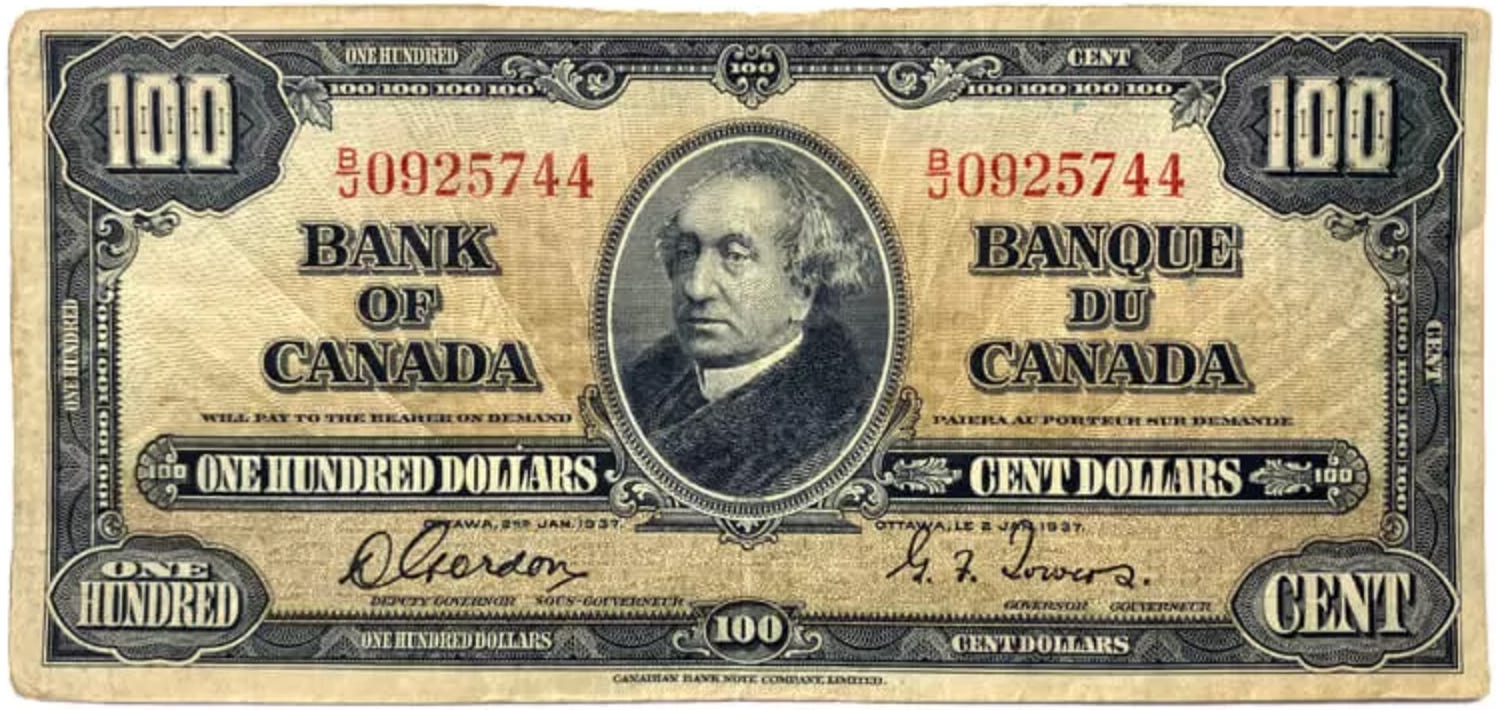
But both of those are a PITA, not least because they involve mailing cash, or even worse, physically traveling to Canada. So you’d rather transfer the money from your bank to your Canadian partner’s bank, just as you’d write a check to somebody in the United States. Thing is, Canadian banks issue deposits denominated in Canadian dollars, not American ones. So since this whole thing is now happening with bank deposits rather than little pieces of paper, how does the accounting work?
Let’s start in a “normal” year, like 1938. (Or 2026.) For simplicity, we’ll assume that there are no fees and the exchange rate between American and Canadian dollars is 1:1. Here’s the American bank’s balance sheet:
And here’s the Canadian one:
Now the $100 gets transferred to the Canadian bank. The American bank debits the sender’s deposit account and credits the Canadian bank’s correspondent deposit account with it by USD 100.
Meanwhile, the Canadian bank gets $100 more in its deposit account at the U.S. bank, but it actually owes that deposit to the Canadian recipient of the payment. So it credits that deposit to the recipient. Its balance sheet changes as follows:
And there you have it! $100, transferred from the American sender to the Canadian recipient. Since that Canadian bank still has that $100 account in the U.S., the U.S. now owes Canada $100 more than it did before. Likewise, Canada as a whole is now owed $100 more by the United States.
But it doesn’t necessarily stop there. The Canadian bank would probably prefer to have its assets in Canadian dollars, not American ones. If it can turn that deposit in an American bank into a deposit at the Bank of Canada, then it will have a liquid asset that is the literal equivalent of cash (which is also issued by the Bank of Canada), only even easier to spend. So the Canadian commercial bank transfers its deposit at the American bank over to the Bank of Canada. (In reality there would be a few intermediate steps here, but we lose nothing from shorthanding it.)
And the Bank of Canada now has a claim on the U.S. bank, which it paid for by creating a deposit account for the Canadian commercial bank.
Finally, since foreign central banks don’t usually hold large deposits in foreign commercial banks (there are exceptions, of course), the Bank of Canada is likely to withdraw that deposit and hand it over to the Federal Reserve. The American bank loses the deposit and has to draw down its reserves at the Fed by an equal amount — remember, from a commercial bank’s point of view, a deposit at the central bank is the same as cash! So think of it as losing its vault cash because the Bank of Canada withdraws the funds:
Which the Bank of Canada then deposits in the U.S. Federal Reserve:
This is what is meant by foreign currency reserves: the Bank of Canada now has the functional equivalent of $100 in cash sitting in its vaults. Of course, the flip side of that is that the Federal Reserve now owes money to the Bank of Canada:
What does this have to do with John Maynard Keynes’s 1944 proposals for a world government International Clearing Union?
The bancor stops here
John Maynard Keynes was worried about the balance of payments. Countries running big current account deficits — i.e., countries whose residents were borrowing from abroad or selling off overseas assets in order to cover their bills — were vulnerable to sudden shifts in investor sentiment.
But Keynes realized that balance of payments needed to balance. Surplus countries — places that received more income from the rest of the world than they spent — had to put those surpluses somewhere, which meant that the rest of the world had to borrow from them.
Think of it this way. Let’s say you make up a country of one, the Republic of You. You decide that you want to spend less and save more. Well, what does that mean? Unless you want to wallpaper your house with little green pieces of paper, you’ve got to put that cash somewhere. Simplest thing is to deposit it in a bank, right? The bank owes you that deposit; you can take it back whenever you want. But that bank is outside the Republic of You. Poof, you’ve just run a current account surplus and the rest of world has just run a current account deficit with you.
Keynes worried about the risks of excessive foreign borrowing, of course. But he was equally worried by the idea that you might want to wallpaper your house with the cash. That would reduce the income of everyone who sells stuff to you without financing any productive investment. While the analogy isn’t perfect, the closest real world equivalent of “wallpapering your house with cash” is “piling up massive foreign exchange reserves at your central bank.”
So how do you disincentivize countries from borrowing too much or spending too little? These countries are made up of millions of separate economic actors. Their governments would have to do something to change their behavior. But that means (at least in non-communist countries) three things: (1) restrict them from freely moving their savings across borders; (2) make it more or less expensive for them to borrow liquid funds; or (3) make foreign imports more or less expersive.
How do you get governments to boss around their private sectors in order to insure that capital flows don’t get too large?
Keynes’ idea was as follows:
Make international transactions in a new currency, called “bancor,” issued by a U.N. agency called the International Clearing Union.4
Restrict central banks from having accounts with each other — uncleared balances are supposed to be at the ICU and be held in bancor. It’s a bank for central banks.
If a central bank owes too many bancor to the ICU, it has to pay interest. If its debt gets even bigger, then the ICU could step in and unilaterally devalue its currency, impose capital controls, or hand over some of the gold in its vaults.
But if a central bank’s bancor credit account at the ICU gets too large, then the ICU will also start charging it interest! In other words, deposits at the ICU would incur interest payments rather than generate interest revenues. That would provide a pretty big incentive for the governments of countries running big current account surpluses to intervene to stop their citizens from saving too much against the rest of the world.
So things are the same up until the point that the Bank of Canada wants to get rid of its account at the U.S. commercial bank. Instead of depositing it at the Federal Reserve, it converts it into bancor and deposits it at the ICU:
Just as above, the American bank had to withdraw its funds from the Federal Reserve, in order to pay the Bank of Canada, but now instead of holding on to the funds the Canadian central bank deposited them into the ICU. That means the Federal Reserve now owes bancor to the ICU rather than U.S. dollars to the Canadian central bank:
In other words, the Bank of Canada now has a deposit at the ICU and the Federal Reserve owes the ICU money. From the ICU’s point of view its balance sheet has changed like this:
The U.S. now owes it $100 more to the ICU than it did before. The rules Keynes wanted would require the Federal Reserve to pay interest — in gold or bancor — should its account at the ICU fall sufficiently into the red.
To repeat point (3) above: If the Federal Reserve’s overdraft account got too much into the red, then the ICU could unilaterally devalue the dollar in order to correct the imbalance. (A dollar devaluation would discourage Americans from buying maple syrup and encourage Canadians to buy newly cheaper beachfront property in Broward County, Florida.) It could also impose capital controls on the United States, or demand that the Federal Reserve hand over some of the gold in its vaults. Or all three.
But remember point (4): if the Canadian deposit account at the ICU gets too large, then the ICU will automatically start charging it interest! In other words, the country piling up foreign reserves would be sanctioned, as well as the country piling up foreign debt. Since the agreement requires the lion’s share of reserves to be held in bancor at the ICU, then this is pretty easy to track and enforce. The money would go into a “reserve fund”
Now, Keynes proposed a maximum rate of only 2 percent, but still, interest is interest. And, of course, an ICU-mandated reduction in the value of the U.S. dollar would be the same thing as an ICU-mandated increase in the value of the Canadian dollar — making maple syrup more expensive and ultimately driving down those Canadian trade surpluses.
Imagine there’s no countries, it isn’t ICU
If we had this system today, China would be paying the ICU somewhere between $30 billion and $50 billion per year in interest.5 Instead of income-producing claims on the rest of the world, China’s massive trade surpluses would produce only interest-bearing deposit accounts owed a Western international organization. That would give the Chinese government a lot of incentives to reduce its trade surpluses. Of course, it still might not respond to those incentives but that would mean enriching the West by a not insubstantial sum every year. Moreover, the ICU could decrease the value of the debtor countries’ currencies against the renminbi — which is the same thing as increasing the value of the renminbi.
And in this world Beijing would have had to have signed up to the ICU if it wanted to enjoy benefits similar to those it got from our world’s WTO. The ICU was envisioned as part of a more extensive system of international organizations that would include something called the International Trade Organization (ITO). In a world which included both the ICU and the ITO, China would have had to sign up to both. Everything would be different and likely better. Chinese living standards would be higher. Western deindustrialization would be lower. It would all be good! All of it!
Social science fiction
Except, well, it feels like the ICU wasn’t likely to happen. And if it had happened, it feels hard to imagine it lasting until today. Because there actually were countries, including one big one called the United States. First, it is difficult to imagine the circumstances under which the U.S. Congress could have been talked into ratifying something like the ICU. Second, if the system started to hurt the United States, then the United States would blow up the system. The ICU could compel most countries to abide by its rules. But what are you gonna do if the United States blows it all up? Stop trading with the United States?
But maybe that’s just a lack of imagination. Feelings only go so far! I don’t care about my own feelings, let alone yours.6 So we need to ask two questions. First, why did the U.S. oppose the ICU in 1944? Second, are there any obvious reasons to think that the system might have exploded later?

At Bretton Woods, the U.S. delegation, led by Harry Dexter White, resolutely opposed Keynes’s proposals and protected what he saw as American interests — “We have been perfectly adamant on that point. We have taken the position of absolutely no,” he said, with regards to Keynes’s plan.7
American objections fell into several categories:
The U.S. was sitting on a lot of gold and wanted it to keep its value. I have not been able to parse why they believed the ICU would cause gold to get cheaper.
Keynes’s plan didn’t give the U.S. sufficient control. His plan gave countries representation on the ICU board based on their share of world trade, defined as imports + exports. (That was also the formula he proposed to set ICU quotas.) His plan would give the U.S. only 14% of the voting rights, against 16% for the U.K. and 35% for the entire “British Empire,” which was still a thing in the eyes of contemporary observers. (Page 9.) The U.S. preferred plans that would give it somewhere between 20% and 50% of the representation and a charter that required a lot of votes to have a four-fifths majority.8
The ICU would automatically extend credit to deficit countries, at least until the hard limits kicked in once overdrafts exceeded one-quarter and one-half of the quota. The U.S. worried that this could cause inflation in the creditor countries. (Page 19.) To see why, go back up to the balance sheets. In the example, Canada is the creditor country, so look at the changes in the Bank of Canada balance sheet:
That liability entry labeled “Canadian bank’s reserve account”? Well, as mentioned earlier, deposits at the Canadian central bank are the same as cash. Which means that the Bank of Canada just effectively printed up the equivalent of a 100-dollar bill. You can see why that could be inflationary.
The U.S. was a creditor country and would have to pay interest on its current account surpluses. That’s good economic policy, but you can see why the U.S. wouldn’t like it. It would start with a quota of about $4 billion using Keynes’s formula. Well, in 1946 we ran a current account surplus of $4.9 billion, which ballooned to $9.3 billion in 1947. This calculation isn’t quite right — the U.S. surplus didn’t all wind up sitting around in the vaults of foreign central banks, but roll with me here — the U.S. would be on the hook for 1% interest on credit balances above 25% of its quota ($1 billion) and 2% on balances above 50% ($2 billion) — meaning that we’d owe the ICU more or less $68 million in ‘46 and $250 million in ‘47.9 As an equivalent share of GDP, that’d be respectively $10 billion and $32 billion today — not a huge amount, but not nothing, and paid to an organization over which the British Empire had an effective veto.
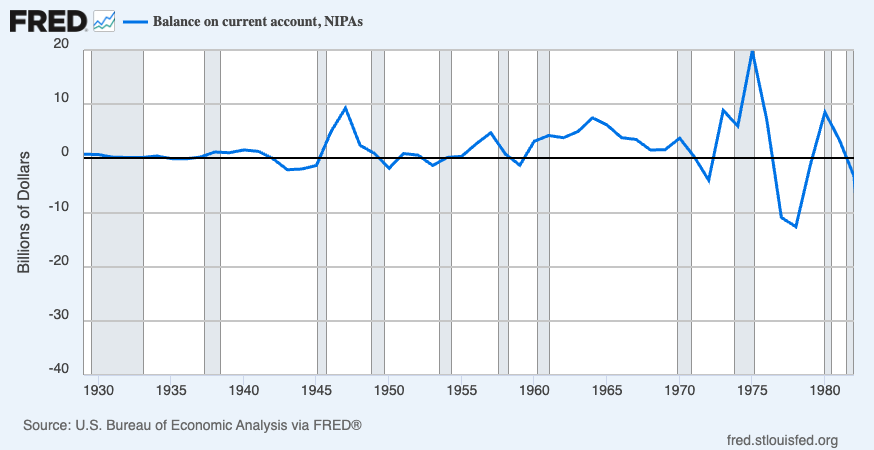
U.S. current account balances — America developed balance-of-payments deficits well before the current account went decisively into the red. Related to (3) — given the immense need for reconstruction in Europe and the expected giant spikes in American export surpluses as we gave away food and coal in exchange for promises of future repayment, the system would need some sort of transitional mechanism. This made it different from the IMF, which could just get up and running.
Many in the U.S. liked the idea of using the dollar as a reserve currency, although White wasn’t particularly explicit about why they wanted the dollar to be a reserve currency. White got that one in there by surreptitiously replacing the phrase “gold” with “gold and U.S. dollars” in the eventual agreement. When some internationalist Congressmen called him out on it, White told them:
What is a “bancor” or “unitas”? There is no such currency. It is because we had to have a name that we used the alternative “U.S. dollar.” And I think that’s a pretty good name.
The ICU would have been an incredibly powerful instrument of economic coercion. Keynes was open about that:
The Clearing Union might become the instrument and the support of international policies in addition to those which it is its primary purpose to promote. This deserves the greatest possible emphasis. The Union might become the pivot of the future economic government of the world.10
He went on to bluntly state that it “would provide an excellent machinery for enforcing a financial blockade.” You can kinda see why this might make people a little nervous.
In real life, the Americans won all the battles of Bretton Woods so we got the IMF instead of the ICU. IMF intervention was discretionary, not automatic. It was capitalized at only two-thirds of the level Keynes thought adequate and unlike the ICU it would not automatically grow along with world trade.
Could it have been otherwise? Perhaps. A president really convinced of Keynes’s vision might have gone along. So might one who had less of a visceral dislike of the British Empire. Ironically, the ICU might have attracted less domestic opposition than the IMF, which was rightfully seen as competing with private credit. The ICU, on the other hand, was more of a central banker’s bank — if it competed with any private sector organizations, it was the British financial complex geared around trade finance. Similarly, the fact that the Keynes plan was based on clear rules rather than political discretion was attractive to American conservatives. As for using bancor rather than dollars as the reserve currency, well, Harry Dexter White may have wanted the dollar to become the reserve currency, but that wasn’t a universal view. American bankers (and Henry Ford) liked it, but the bankers’ domestic political influence was about as low as it was every going to be in 1944. Finagling an effective American veto on the board would have been a sine qua non, but that would not be an incredibly difficult or complex finagle.
What about Congress? Well, Congress generally follows public opinion.
And this was a time when popular support for a world government was at an all-time high. In 1947, a full 56% of Americans said “yes” to the question: “Do you think the United Nations organization should be strengthened to make it a world government with power to control the armed forces of all nations, including the United States?”
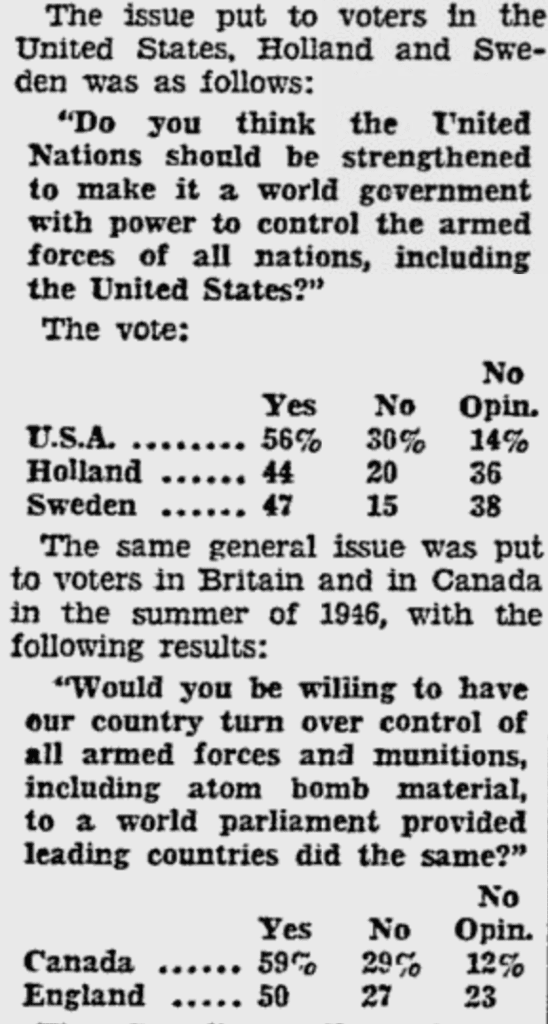
And this wasn’t just one flash-in-the-pan poll. Support for a world government ebbed slowly, as the true nature of the Soviet Union became harder to ignore:
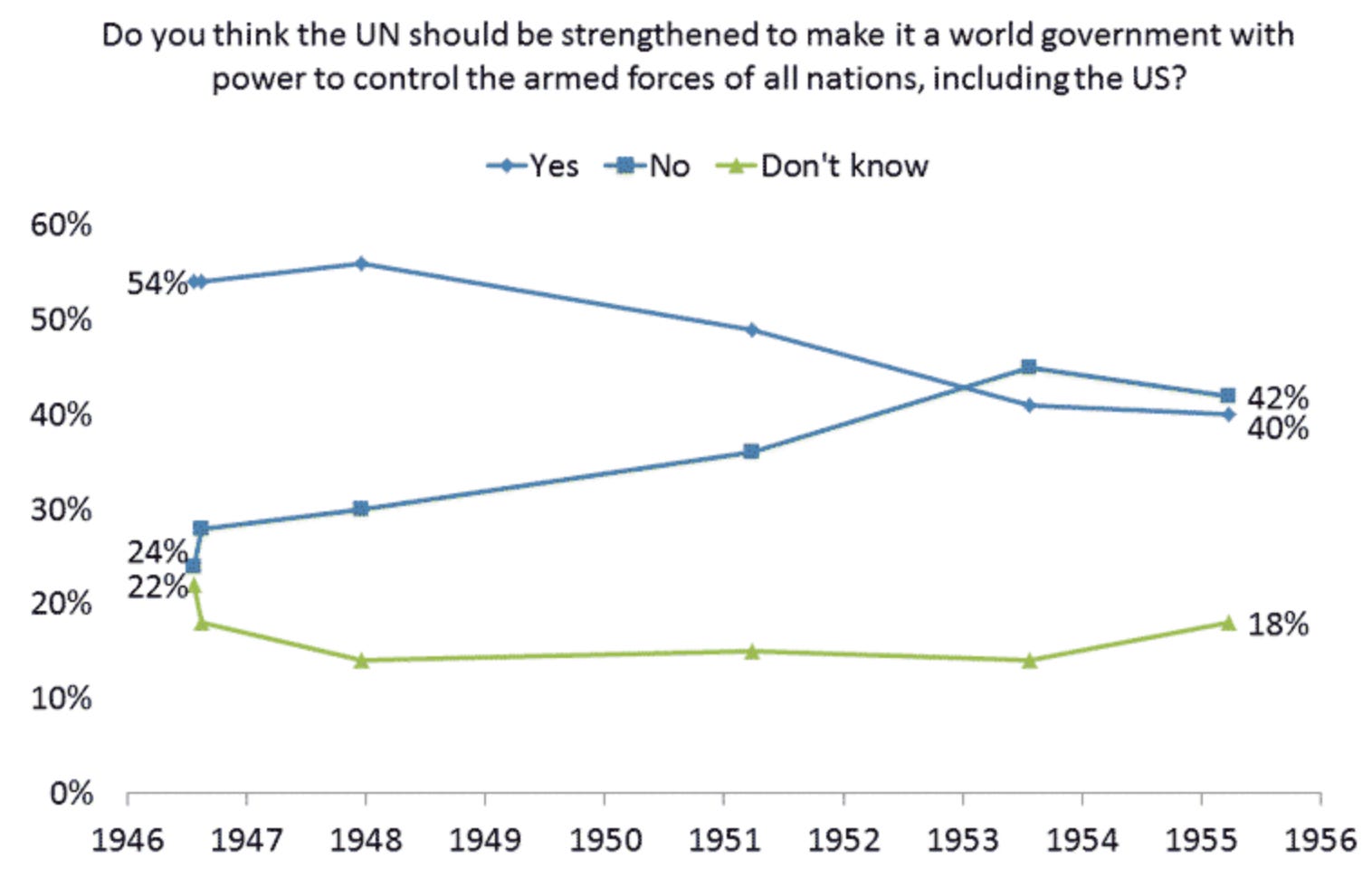
In other words, give us a different American negotiator, a more engaged President, and a more diplomatic John Maynard Keynes and it could have happened. An unlikely alternate history, absolutely, but not an implausible one.
Could it have lasted?
We can’t know. Realistically, however, the United States is the only single country that could have blown up the system. And it isn’t obvious when or why an American government would have wanted to do that.
No Nixon Shock
The United States would likely have accumulated a substantial ICU credit during the immediate postwar dollar-shortage years. Its later 1950s settlement deficits would have drawn that credit down. But even the balance-of-payments deficits of the late 1960s and early 1970s would have been unlikely to push the U.S. overdraft above the 25% level that would have triggered interest payments, let alone the 50% level that would produce ICU intervention.11
The Nixon Administration blew up the Bretton Woods system in 1971, but under circumstances that would have had no parallel under the ICU. In our world, growing American deficits left the central banks of Germany, France, and Japan holding ever-larger dollar balances which the U.S. promised to exchange for gold on demand. But U.S. gold reserves were not increasing. So the promise lost credibility and European central banks began to cash in their dollars for gold. As the U.S. started to run out of gold, President Nixon suspended convertibility in August 1971; by 1973 fixed exchange rates had collapsed.
None of this could happen under the ICU, for the simple reason that the dollar isn’t the reserve currency. Central banks are holding bancor, not dollars. So there is no 1971 convertibility crisis. And the U.S. won’t come close to the boundaries that would trigger ICU intervention. In short, if the ICU is going to collapse, it won’t be at the same time or in the same way as in our history.
Easier Oil Adjustment
What about the 1973 oil shocks, assuming they happen on schedule in this alternate universe? Well, in the U.S. they’re not likely to cause the country to come close to the ICU limits. West Germany might owe interest on a large credit balance, but for fairly obvious reasons (don’t mention the war!) it’s one of the least likely countries to blow up the system. Japan might see trade deficits large enough to temporarily push it far enough into the red to pay interest, but its geopolitical dependence on the United States makes it an equally unlikely candidate to blow up an American-backed system. In the developed world, only Britain and maybe Italy might run into serious trouble, but even with interest charges access to ICU overdrafts would bring far more benefits than any costs. Remember, in our world Britain really did take out an IMF program that was far more costly, because the IMF could and did impose onerous conditions whereas ICU support was designed to be near-automatic.
Meanwhile, the Arab countries would accumulate massive ICU reserve accounts and pay interest on them. For example, the Saudi Arabian Monetary Authority (SAMA) accumulated $5-$10 billion per month at the height of the surge. Kuwait and the UAE saw similar explosions. While Kuwait channeled more funds more quickly into a sovereign wealth fund and the UAE spent a lot to import foreign capital for domestic development, both of which would reduce their reserve accumulation, the pile-up of funds would outrun that.12 Only Iran, which channeled oil money into a military spending spree, might run down its credit balance fast enough to face only a few years of interest payments.
A Better Debt Crisis
If we get something like the Latin American debt crises, then they’re likely to be much easier to contain with the ICU in place. The loans were mostly private-bank claims, not ICU overdrafts. The immediate danger in 1982 was to the solvency of major U.S. and European banks; Mexico’s default threatened institutions whose Latin American exposures were very large relative to their capital. Latin American countries would have automatic access to their quotas to cover part of the sudden stop, while the ICU could coordinate adjustment rather than leaving each debtor to negotiate separately with commercial banks and the IMF. More indirectly, the ICU could pressure creditor governments to support their banks and the debtor countries. (And, well, maybe this is when the Reserve Fund would come in handy.)
In the aftermath of the debt crisis (this may or may not have been causal) the U.S. began to run massive and perennial current account deficits, but they were financed with private capital inflows attracted by high interest rates and the perceived safety of U.S. assets and would not have caused overdrafts at the ICU. This was a different animal than the sort of central-bank driven accumulation of assets that we saw after the turn of the century.
How the ICU would have dealt with Argentina is a fun question that could take up thousands of words. But it couldn’t be worse for anybody than the IMF.

The Inflation Threat
This is a genuine structural problem. Suppose the United States, Britain, and Italy repeatedly have higher inflation than Germany, Switzerland, or Japan while exchange rates remain fixed. American, British, and Italian tradable goods become progressively less competitive, producing larger external deficits and pressure on their ICU positions. (Albeit not very seriously for the Americans, considering that the system would give them a huge ICU quota.) The low-inflation countries face the converse pressure: intervention to prevent appreciation expands their money supplies and imports inflation.
The ICU would nonetheless have some advantages over the actual Bretton Woods system in the face of this problem:
No gold runs force sudden suspensions of convertibility;
Exchange-rate misalignments appear transparently in ICU balances;
Debtors receive temporary finance rather than immediately deflate;
Creditor countries can appreciate without threatening the value of bancor;
The ICU encourages both debtor and creditor adjustment rather than putting the entire burden on deficit countries.
Keynes explicitly contemplated exchange-rate changes and other adjustment measures at the balance thresholds.
But none of that solves the underlying politics of differential inflation. Governments generally disliked devaluation — although the Nixon administration was a big exception to this — exporters in surplus countries resisted appreciation, and central banks had different tolerances for inflation. Between 1970 and 1985, the ICU would probably have required a succession of realignments: dollar, sterling, lira, and maybe French-franc devaluations against the mark, Swiss franc, and yen.
That is potentially destabilizing, but not necessarily fatal. It more resembles the strains inside the European Monetary System than the collapse of Bretton Woods: recurrent crises and realignments, but continued operation. The system blows up only if major governments insist simultaneously on fixed nominal parities and divergent inflation rates. In that case, the ICU can finance the discrepancy temporarily but cannot make it disappear. Nonetheless, the system would probably survive repeated realignments. And if governments resisted them, then the ICU could move towards adjustable bands, crawling parities, or even floating exchange rates.
A Better World that Wasn’t
Well, we didn’t get the ICU. Instead we got the IMF. The IMF competed more directly with the private sector, making conservatives unhappy. It acted discretionally and imposed all sorts of weird rules, making conservatives and … uh … not-conservatives unhappy. It made American power more obvious, while in fact reducing American power, since an American-controlled ICU would have made a far more powerful coercive tool than the IMF ever did.13 And it did nothing to stop creditor countries from building up these massive reserve balances that suck demand out of the world economy and deindustrialize Western nations.
A world where the People’s Republic of China is cutting a $30 billion+ check to a Washington-based and American-controlled institution is one where our current geopolitical strains are going to be rather reduced.14 Even if Beijing won’t like it, in that world China will have no alternative but to reduce its balance-of-payments surplus. And if it does so to avoid the charge, then the system will be working exactly as intended.
The ICU system did have an inflationary bias for creditor countries, but it’s not like the IMF system did much to contain price pressures when they started to explode in the 1970s. Inflation started in the U.S. of A. and spread elsewhere. In other words, differential inflation would pose the most serious threat to the ICU system just as it did to Bretton Woods, but it would come from outside the system. The ICU and its system of managed exchange rates would, however, be much more likely to survive America’s inflationary party than the real Bretton Woods exchange rate system.
And I’ll admit it, I like fixed exchange rates if the costs are low enough. They just make business easier, you know. Uncertainty is bad, as any conservative will tell you!
Plus, to return to an earlier point, automatic systems generally beat discretionary ones. If you’re gonna have a big interventionist international economic organization, then you can at least try to give it clear automatic rules with enough built-in discretion to avoid idiotic outcomes. The ICU met that balance; the IMF does not.
The only “downside” is that the dollar wouldn’t be the major reserve currency. Instead we’d have the bancor. If you want evidence that the dollar is stronger because of its role as a reserve currency, then you need only point to the market panic that ensued in 2009 when Timothy Geithner briefly averred that he might maybe possibly be open to the idea that an international currency could replace the dollar as a reserve asset — the greenback instantaneously lost five cents against the euro. But would that be bad for America? A stronger dollar only smacks around our manufacturing and agricultural industries, while lower interest rates only encourage us to borrow too much. Doesn’t seem like that great a benefit.
But we didn’t get there, because an obnoxious Englishman couldn’t convince a Soviet agent dupe at an obscure hotel in New Hampshire exactly 82 years ago. It probably didn’t help that Keynes’s young wife was a famous dancer who liked to practice ballet at midnight and stayed in a room right over U.S. Treasury Secretary Hans Morgenthau. He didn’t appreciate the banging. (Go buy The Battle of Bretton Woods for even more salacious detail.)
Maybe the ICU would have become the start of an “economic government of the world,” but I doubt it. So on balance, well, it seems that the world would have been better off had Keynes, not White, won the Battle of Bretton Woods.
White was in regular contact with Soviet agents. His wife even complained to the Russians about their lack of financial support. White’s handler didn’t think that he would take regular payments, but “gifts” intended to help out with his daughter’s education might be welcome. White apparently responded favorably; his daughter’s annual expenses of $2,000 would be $38,000 at today’s prices. See the document reproduced on page 375 of Venona: Soviet Espionage and the American Response, 1939-57 available in PDF form at the link on the CIA website. Considering that it was 1944 and the war was still on, it is entirely plausible that White didn’t think of his actions as treasonous or unpatriotic, although the whole “secretly take money from a foreign government” thing is kinda squicky even had the foreign government involved been the Netherlands and not Soviet Russia.
I have no problem pointing out that Germany’s little twin brother, Austria, was also part of the problem. I am a bit more reluctant to admit that so were the Netherlands.
Spoiler: it works pretty much the same way in 2026. The big difference is that under flexible exchange rates central banks can choose whether they want to accumulate reserves because they can choose to let the currency fall should demand for it prove insufficient.
Legally, the International Monetary Fund (IMF) is part of the United Nations, although only pedants think of it that way because neither the General Assembly nor the Security Council nor the Secretary-General have any direct control over it.
There is a little guesswork involved, but its account at the ICU would be roughly in line with the foreign currency reserves of the People’s Bank of China.
My Star Trek loving daughter abandoned the Discovery spin-off because, “They spend too much time talking about feelings.”
See page 171 at the link. The irony of Mr. White resolutely protecting America could cure anemia, considering that we know that Mr. White freely passed along information to Soviet agents. But see footnote #1; he wasn’t a Communist and he probably didn’t see what he was doing as against U.S. interests.
An alternative calculation estimated that the British plan gave the U.K. 21% of the votes, the “British Dominions” another 22.5%, and the U.S. only 17.5%; whereas the American plan would have given the USA a whopping 45.5% of the votes, followed by 11.8% for Britain and 9.2% for the Dominions. See “The British and American Proposals for an International Monetary System,” Bulletin of International News, Vol. 20, No. 10 (May 15, 1943), p. 437.
Those surpluses evaporated quite rapidly and were gone by 1950, but observers in 1944 had reasons to believe that the U.S. would run big postwar surpluses for a very long time. (Also, I’m working at only two significant digits for guesstimates.)
I know, that sounds weird in 2026. Heck, it would have sounded weird by 1956 and ridiculous by 1965. But it was a reasonable expectation in 1944.
I stress-tested this assumption using data on U.S. reserve balances or, alternatively, the current account minus the financial account net of changes in reserve assets. The maximum plausible U.S. overdraft peaks around 9% of its quota in 1969.
Remember, Keynes’s plan was designed to discourage big reserve build-ups. If a country channeled its export revenues into either import purchases or “productive” overseas investments, then it would not accumulate reserve balances at the ICU.
There is no way to have a world with the ICU unless Keynes’s voting formula is rejiggered to give the U.S. an effective veto.
Keynes may have wanted the ICU to split its headquarters between London and New York, but there was no way that was going to happen. The organization would have to be in Washington, D.C., to get any American president and Congress to accept it.