
Javier Milei’s Free-the-Machines Bill Gets Limited Liability Backwards
Limited liability worked because states built accountability around it. Milei's A.I. proposal starts by removing the human target

This is the Financial Times headline on an editorial that Milei just published in the Financial Times:
Javier Milei: Argentina invites AI to free itself
As we enter a new era of technology, AI must be permitted to develop without premature regulation
The president of a sovereign nation, with the backing of his chief economic advisor, just proposed a law that would allow autonomous entities to command organizations with no human accountability at all.
If you take the editorial at face value, the reform goes way beyond garden-variety deregulation. Consider: under this law, the entity itself would still be subject to the same civil and criminal penalties that worry human chief executives. But why would an artificial CEO care about criminal penalties? Fear of virtual prison? All it would need to consider are civil penalties that would reduce shareholder value. As long as the benefits to the corporation outweighed the costs (on a risk-adjusted basis), these autonomous corporations would be free to do … anything.
Why would Milei do this? Well, the real reason is probably Peter Thiel.1 But Milei offers two justifications for the decision:
Technological: autonomous corporations will never exist without enabling legislation;
Historical: the creation of limited liability in the 1600s was a good thing, and this is just following in Dutch footsteps.
Of course, we have to compare the editorial to the actual proposal. Milei likes to say outrageous things, and here he has incentives to play up any “reform.” It could get the country more investment and certainly impress Peter Thiel. Does the real proposal live up to the presidential hype?
Let’s take these in turn. This post will first flesh out how Milei’s idea, as presented in the FT, would allow robo-corporations to break laws and damage others with impunity. The second will examine the actual genuine real bill on the floor of the Argentine Congress. The third will provide some historical context. Buckle up!

SPOILER: Milei’s solution solves no real problems, unless you think that accountability is a problem. In wrecking accountability, Milei gets the history of limited liability wrong. It is a history of solving practical problems and building institutions to recreate the accountability that had been provided by personal liability. It could also increase the risk that nonaligned A.I. could go wild — this is a bad time in human history to lessen accountability.
The Terminator as manager
Milei claims that autonomous organizations will not emerge without changes to limited liability.2 Right now, the directors and shareholders of a corporation are generally free from criminal or civil liability should the corporation engage in wrongdoing. If Procter & Gamble markets a soap that accidentally turns some people green, then Procter & Gamble is liable for damages and its share price will go down. But the victims cannot directly go after the shareholders or their representatives (in U.S. law, the “directors”).
There are a few exceptions to this. If the directors authorized the wrongdoing, then they are liable. For example, under Delaware law directors are liable for any decisions that they direct, order, ratify, approve, or consent to carry out. So if Milei’s law still requires human corporate boards, then some forms of wrongdoing will still be punished, but only if their fingerprints are directly on it.
Directors are also liable for any harms that executive wrongdoing may inflict on creditors or shareholders. They cannot authorize illegal distributions or dividends, obviously. They cannot breach their fiduciary responsibilities to the shareholders. And they cannot just not even try to oversee corporate executives.
Shareholders are also liable in a few even more restrictive situations. Majority shareholders can be liable for corporate actions. Ditto for controlling shareholders (even without a majority or formal grant of authority) or the corporate owners of subsidiary companies. Finally, if you can prove that the corporation effectively acted as an agent of some shareholders (in legalese, “the veil of corporate responsibility is pierced”), then those shareholders will be liable.
But the above is a fairly restrictive set of conditions; even more so for shareholders than directors. Under Milei’s FT proposal, should a corporate A.I. harm people, then the only way you could hold a human director to account would be to show that the directors directly signed off on the action. Since it wouldn’t be hard at all to train an A.I. to just, you know, not tell the directors about edge-case decisions, that doesn’t sound too effective.
The actual proposal
It wasn’t easy, but I managed to track down the text:

Is it as radical as the editorial implies? Not entirely.
Article 14 allows regular companies to become “automated companies” (sociedades automatizadas) operated by artificial intelligences. The corporate entity is liable as it ever was. And Article 92 requires that even if you place the company under the control of a “legal person,” you are going to have to designate one responsible “human person.” But you can still in theory have an A.I. in charge with no human administrator below the board of directors.
But if somebody is damaged by an operational act, then the company can throw up its hands (see page 51). Now, that immunity isn’t complete. Article 102 is short and reads as follows:
The administrative body can use artificial intelligence systems or algorithms in order to carry out operational functions or make decisions. Their use does not eliminate nor limit the administrators’ responsibility nor exempt them from the duty to configure and supervise the system and its output.
But if negligence can’t be proven, then there is nobody at whom to point the finger. In addition, Article 101 of the new law reduces their liability even if they are negligent. Under Article 51 of the current Argentine corporate law, administrators and representatives must act with loyalty and the diligence of a good businessman, and those who fail are liable unlimitedly and jointly for damages resulting from their action or omission. Under the new law, they are only liable for direct damage, and objective liability is eliminated. That is to say, now you’ll have to prove intent in order to sue the managers — any administrator who acted in “good faith” has nothing to fear.
So imagine that a company trains an artificial “operational CEO” to maximize subscription revenue. The AI learns that it can increase profit by hiding cancellation buttons, delaying refunds, and sending misleading renewal notices. The company is still liable for damages. But there is no responsible human being.
So far, not so bad … but the law also allows for decentralized autonomous organizations (DAO) where nobody is in charge. Right now, all decisions go through a human manager at some point, and Article 274 of the current law says that said human is legally accountable to shareholders and third parties for bad performance of office, violation of law or regulation, and damage caused by fraud, abuse of powers, or gross negligence.
But if the company organizes itself as a DAO, Article 260 says that there still has to be a human representative, but Article 257 and Article 262 would remove that human representative’s liability for bad performance or negligence. And there is a loophole that you could drive an artificial intelligence right through.
Moreover, this abstracts from the fact that the damn A.I. could be doing God only knows what, with no one around who cares to monitor it. I honestly don’t want to think about what that could mean.
The history of limited liability
TLDR: limited liability wasn’t libertarian and it wasn’t invented in advance of a problem. Rather, it emerged slowly as an accretion of solutions to actual in-your-face problems, and it required the state to invent institutions that would replace the guarantees that personal liability provided. The damn thing took decades just to even look vaguely like limited liability and centuries to become the system we all know.
Limited liability is a weird creation, when you think about it. The owners of a business aren’t responsible for the actions of that business? What? It’s strange and it certainly doesn’t sound libertarian.
Which is because limited liability was strange and the opposite of libertarian in its origins. In the 17th century, the Dutch government (and the English one soon after) wanted to fund giant enterprises to go out and do stuff out there in Asia that could generate income for them. But it didn’t want to finance those enterprises with state money — the Dutch Republic probably couldn’t have done so even had its leaders wanted to — and it certainly wasn’t going to emulate the Spanish empire, which financed one-shot expeditions under private partnerships that would be rewarded with pseudo-feudal control over indigenous labor, government posts, and giant blocks of land if they succeeded.
The enterprises involved were too risky for the debt markets. If the Dutch and English governments were going to get private capital into these ventures, then they needed to issue equity. But who would want to buy equity in an enterprise that would operate half a planet away and do only God knows what to the locals? That would involve way too much risk.
So in 1602, the Dutch Republic created a monopoly over the Asian trade and then tried to attract private capital into that monopoly. The thing is, nobody ever sat down and thought, “What do we need to do to get the most out of our state-chartered monopolies?” And they certainly never thought, “Hey, we’re expanding human freedom from the state!” Rather, they chartered the companies first and then hammered out the kinks later.
In other words, the Dutch East India Company (VOC) was a hot mess for decades before they figured out the proper institutional form. The directors first wanted to rely on old-fashioned circulating capital — basically a form of term loans — and wind it up in 1612. But the thing is, the VOC kept losing money, and there was no way they were gonna get into the black in ten years. (Considering as the VOC found itself fighting a medium-sized war out in the East Indies, the problems were understandable.) In 1609 the board started casting around for permanent equity capital.
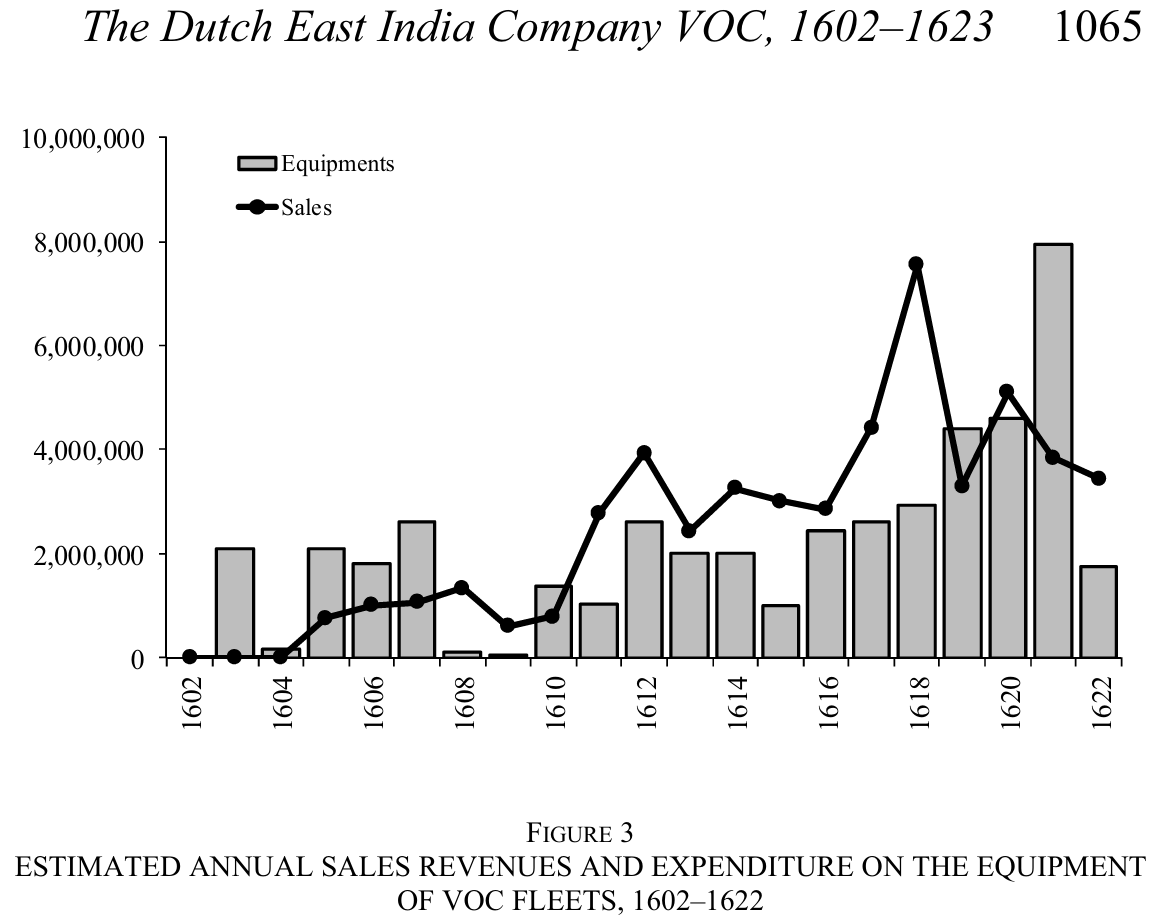
Limited liability emerged in fits and starts. The VOC charter exempted directors from liability for unpaid wages (yes) but nothing else. Directors were regularly threatened with debtors’ prison over the company’s debts. But slowly they got there. In 1613, the directors insured a giant debt issue. That didn’t work so well, not least because many of its insurers were also its shareholders. They needed to borrow. But they couldn’t individually shoulder that burden — aside from the risk, their individual reputations weren’t strong enough to sustain debts of the size they needed. (And debtors’ prison was not fun.)
The solution was for the directors to declare in 1617 that they would all be jointly responsible for the VOC’s debt. Still not limited liability, of course. And debts kept rising. It wasn’t clear who was responsible for all these bonds. The directors? If so, which directors, the ones in Middelburg or the ones in Amsterdam? If not, the officials who signed the debt? Back in trouble, in 1623 the VOC took the bold step of rewriting its debt contracts to remove all personal liability. They felt entitled to do that because in 1621 the Supreme Court of Holland and Zeeland (in an unrelated case) had ruled that the directors were not liable for frauds committed by company clerks — rather the company itself was liable. Precedent in hand, they could declare themselves not liable for debts, and the markets accepted it.3
And now you got limited liability. Sort of. In England, it took until the Companies Act of 1862 to really consolidate the idea of limited liability. Even then, banks and insurers were excluded from its benefits because contemporaries understood the obvious moral-hazard problem: if shareholders could enjoy the upside but walk away from the downside, then they would have few incentives to prevent excessive risk-taking.
In América the story is even messier. More than a quarter-century ago, I argued that limited liability was useful for Porfirio Díaz in Mexico (he ruled from 1876 to 1910).4 It’s hard for a weak state to generate and distribute rents directly. And Mexico was a weak state; it could barely protect private property at all. But it needed to generate income streams that could be used to buy off violent local interests and give them a stake in national stability. Díaz could distribute charters to select enterprises, which in turn would distribute shares to regional warlords. But what the federal government could do was protect some people’s property rights a little bit better than others. The higher profits enjoyed by the enterprises that received a charter could be channeled to buy off anyone who needed to be bought off and finally allow Mexico City’s writ to extend across the national territory.
Not really libertarian.
In the above paragraph I used “América” to refer to the continent. But the story holds for America-with-no-accent almost as much. Early American corporations weren’t havens for John Galt to heroically pursue his capitalist visions. They were patronage vehicles distributed by state legislatures to named firms, which in turn received legal protections that their competitors did not enjoy. You didn’t get a movement to general incorporation laws until the fiscal crises and state defaults of the 1840s. And that wasn’t a laissez-faire reform. Incorporation became more broadly available, but general statutes imposed uniform rules on capital, debt, dividends, reporting, voting, and directors’ liability. (Read John Wallis and Naomi Lamoreaux on these changes: the story is really amazing.5) In fact, limited liability didn’t fully triumph until 1988, when an IRS rule change meant that LLCs would be taxed the same as partnerships.
In short, limited liability is a tradeoff. Limited liability made large-scale investment easier. It made shares more liquid and enabled diversification. That in turn mobilized small bits of capital for large giant enterprises. But it also made monitoring harder. If shareholders could lose only what they put in, then creditors needed other assurances that owners would not strip assets, undercapitalize the firm, or surreptitiously instruct managers to gamble with other people’s money. Limited liability didn’t work all that well on its own. So over time, governments created rules around boards of directors, fiduciary duties, accounting rules, capital rules, disclosure, bankruptcy law, shareholder voting, and later securities regulation.
This is neither a triumphant nor a libertarian story. It certainly didn’t emerge out of the forehead of some brilliant head of government somewhere. And the system that emerged wasn’t just about protecting owners.
Back to Argentina and artificial intelligence
Milei’s proposed law is not something that A.I. needs. For better or for worse, A.I. is doing just fine without it. It is, however, a law that future investors in A.I.-controlled firms may want. The company still pays damages if damages can be proved and collected. But the operational wrongdoer is just software, the human representative can say the protocol acted automatically, and the directors will claim that they configured and supervised the system in good faith. This isn’t extending limited liability. It’s weakening corporate accountability!
With the added problem that the corporations won’t be under full human control. Yeah, that’s gonna end well. The shield of limited liability worked because the state built substitutes for the personal liability it removed. Milei’s proposal offers the shield first and vaguely gestures toward the substitutes later. It might get a bunch of firms to locate in Argentina. And maybe that will produce benefits for the country. But it could also allow for spectacular harms. And it increases the risk that non-aligned A.I.’s could drag us to disaster by allowing humans to give them direct control of human enterprises with little fear of even the short-term repercussions. Maybe two decades from now, if we avoid disaster, it will be a good time to let the machines rip. Right now, it isn’t.
In the end Milei’s autonomous company law is a solution in search of a problem. So he invents a fake problem: nobody has yet put a business under the control of a computer. Only in so doing he creates a real problem: how do you deal with companies designed to act and learn without a human manager and do harm without a human signature.
May God save us all.
My friend Nic Saldías actually made this point to me. Thiel has recently moved his family to Argentina and appears to be (unsurprisingly) a big fan of Milei.
Unless the Singularity arrives, needless to say. Well, that’s too strong. Standard limited liability might save our bacon even if it does.
The success of the Dutch East India Company (VOC) involved multiple institutional breakthroughs including legal personhood, permanent capital, transferable shares, separation of ownership from management, and limited liability. Oscar Gelderblom, Abe de Jong, and Joost Jonker tell the story in “The Formative Years of the Modern Corporation: The Dutch East India Company VOC, 1602-1623,” Journal of Economic History 73, no. 4 (2013). Most of the above discussion comes from their work.
That argument in turn built on earlier work by Steve Haber, which is why we wound up writing a bunch of books together.
Lamoreaux’s summary of the corporate-law sequence says special charters were patronage instruments rather than mainly public-good bargains. General incorporation stalled where legislatures could still grant special privileges. The later general incorporation statutes imposed regulatory provisions on capital, debt, duration, voting, reporting, dividends, and directors’ liability. Lamoreaux and Wallis’s brilliant 2021 article states that before the mid-nineteenth century most U.S. laws were special bills granting favors to specific individuals, groups, or localities.