

It’s economic history week! I was just in Michigan for a (great) conference that had nothing to do with economic history. I did, however, have a lot of interesting discussions about current politics, not least whether the Democratic Party is following the tragic post-2010 path of the Republicans and being taken over by a not-quite-sane radical fringe. Regardless of what you think about the Trump Administration, this specter should depress you. In the words of Shane Massey, the GOP majority leader in the South Carolina senate: “Republicans are stronger when the Democrat Party is vibrant and viable.”
I’m not going to discuss that right now, but with socialism back on the agenda and questions about the end of the Democratic establishment (at least in New York), some recent papers from economic history seemed a bit more relevant than they otherwise might have been. And so, I pronounce Economic History Week, and present to you the following two new findings for your edification.
First up, was there anything redeeming about the Cuban revolution? And second, did the Civil War dislodge the Southern ruling class, even if Reconstruction failed?
The Battle of Cuba(n economic history)
The fight over the economic impact of Mr. Castro continues. John Devereux and Vincent Geloso (with João Pedro Bastos and Jamie Bologna Pavlik of Texas Tech) fired the first salvos. Using different methodologies, they presented evidence that Cubans would have been far better off had the Revolution never happened. Geloso et. al. use synthetic controls where real socialist Cuba is compared to a weighted average of countries that looked a lot like Cuba in the decade before 1959. They find that socialist Cuba fell behind counterfactual Cuba even as the Soviet Bloc pumped in billions of economic aid.
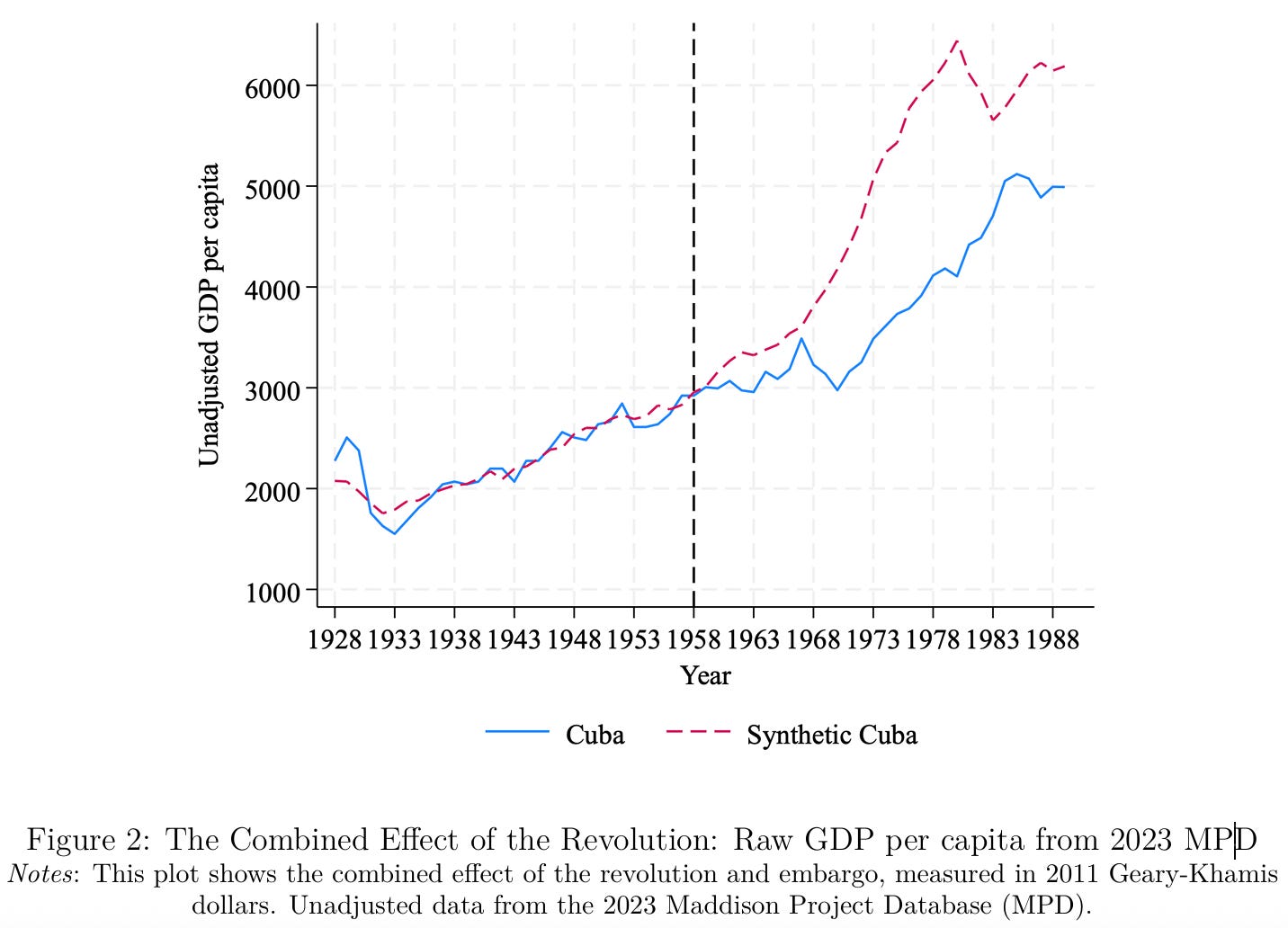
And now Giovanni Mellace (U. of Southern Denmark) and Rok Spruk (U. of Ljubljana) have struck back! They use synthetic controls to show that infant mortality in socialist Cuba falls dramatically and persistently compared to counterfactual Cuba. “Relative to synthetic Cuba, infant mortality falls 15–29 percent and average years of schooling rise 1.5-2 years; both effects are large, persistent, and robust.” Win one for the Revolution!
Or maybe not. In 2010, Devereux noted that Cuba did very well on measures of infant mortality even though the rest of the healthcare system was in terrible shape. Moreover, Devereax uses Cuban government data to measure infant mortality, but the Mellace and Spruk estimates oddly diverge from Devereux’s after the revolution — because they don’t use Cuban data! Instead they use a 1965 benchmark and link it to 1950 data. That produces a nice monotonic fall in infant mortality, whereas the actual Cuban data (shown in the below figure) report a big increase in the decade after the Revolution followed by a fall as the government starts pumping [Soviet] resources into the health service.
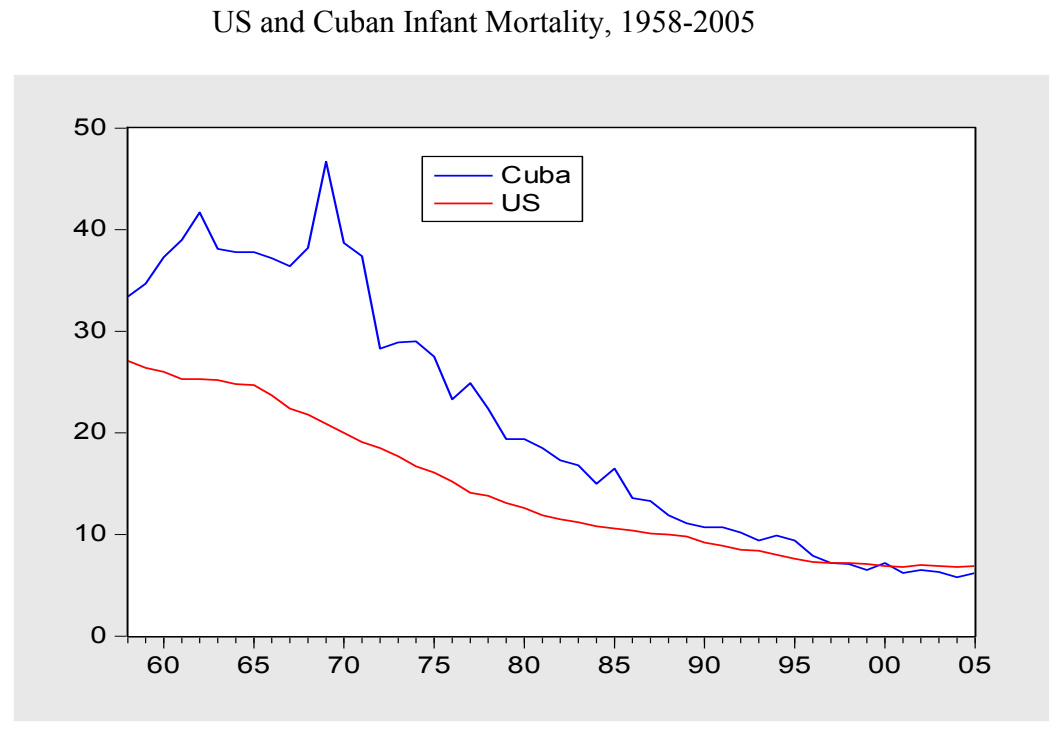
And even then, the 1965 benchmark that Mellace and Spruk claim to use doesn’t match up with the Cuban data. So the whole exercise is really strange, even though nobody seriously doubts that Cuba punched above its weight in reducing infant mortality.
As for education, it’s not entirely implausible that Cubans have two more years of formal education than they would have had. But what is their children learning? Well, UNESCO has the goods, and here’s how Cuban sixth-graders stacked up against other countries in 2019:
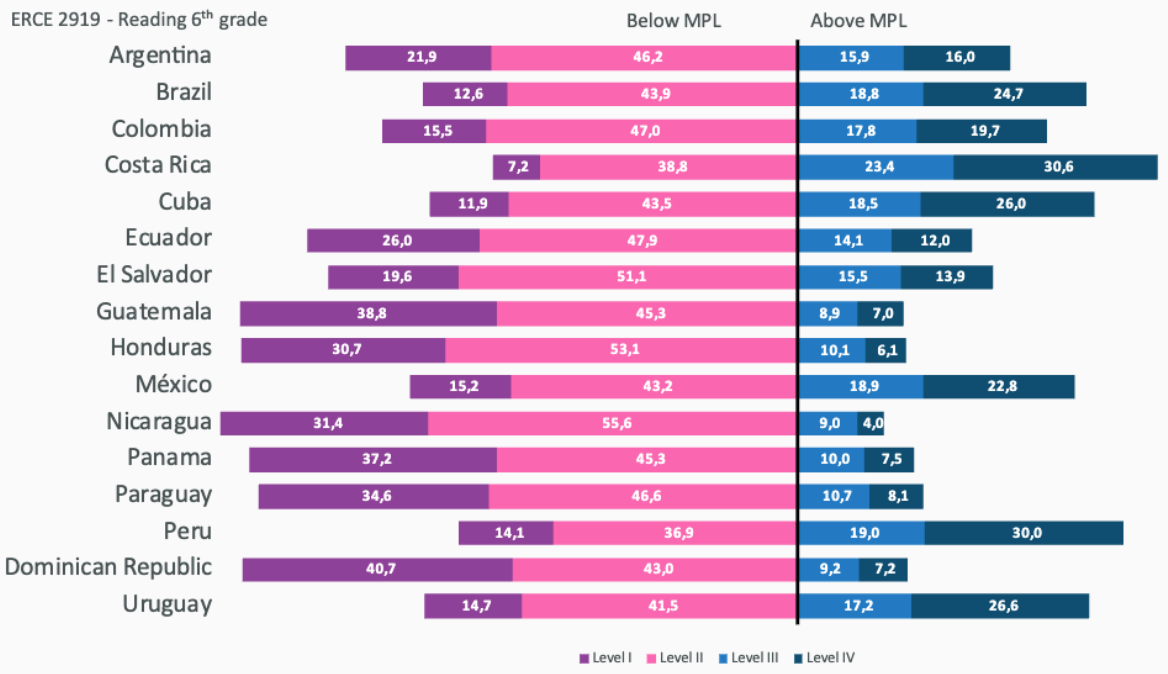
Not terrible, but Brazilians, Costa Ricans, and Peruvians do better than their Cuban counterparts in reading, with Colombian, Mexican, and Uruguayan children breathing down their necks. (Argentina and the D.R. oughta be ashamed of themselves.)
The story in mathematics isn’t that different:
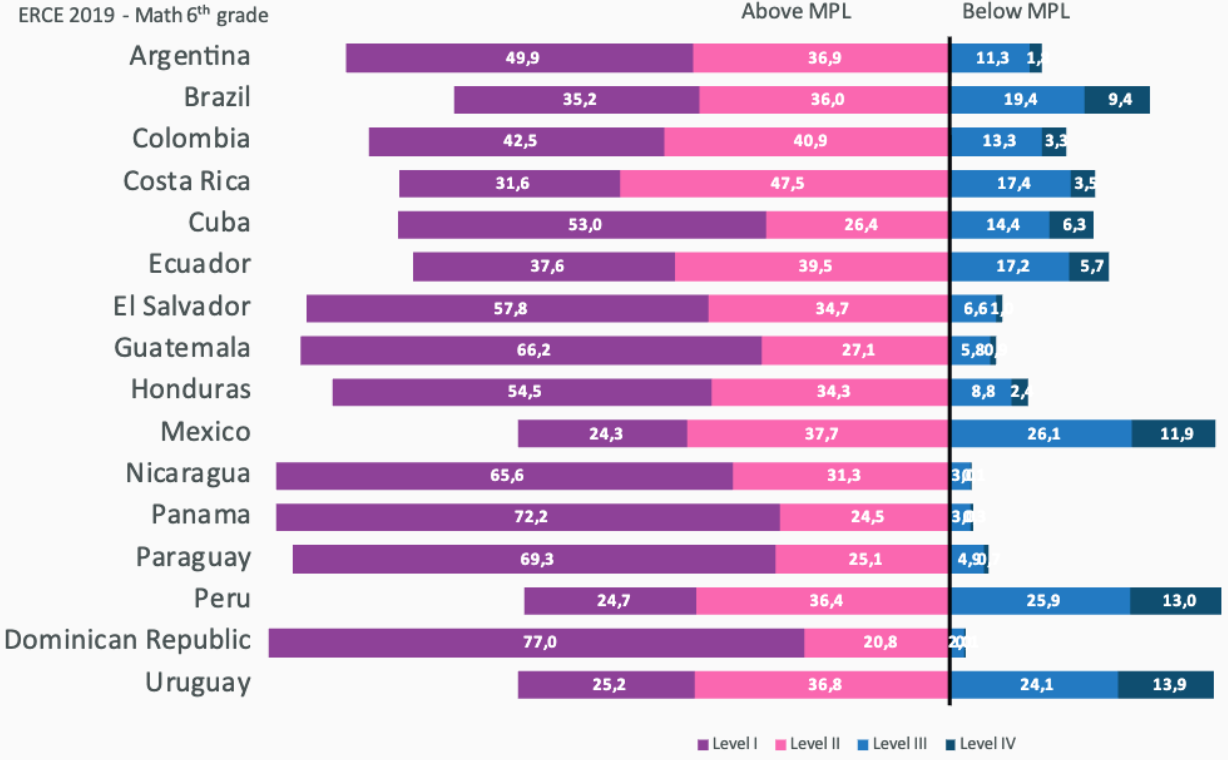
Kids in Brazil, Costa Rica, Ecuador, Mexico, Peru, and Uruguay outperform their Cuban counterparts. I guess it’s remotely possible that a non-Communist Cuba would have lost its 1959 advantages and gone the way of the Dominican Republic, but I doubt it.
I’m gonna give this to John Devereux, the winnuh and still champee-un of the Cuban economic history derby. There really is not much evidence that the Revolution had much upside, but I’m sure that economic historians will keep trying to show that it did. At some point maybe they’ll actually find something. But this paper isn’t that something.
The past is never dead; it’s not even past
And now let’s turn to the American Civil War! One uncontestable result of the war was that the former slaveowners lost their ability to capitalize the labor of the former slaves. They could no longer easily sell or rent their workers (even when they found ways to tie sharecroppers to the land); nor could they take out bank loans against them. In one stroke, Abraham Lincoln and the Radical Republicans wiped out most of the dollar wealth of the Southern elite.
We know that Redemption denied black Southerners the franchise and established white supremacy, but what with the impoverishment of the Southern elite many historians have argued that they lost their social prominence. The money quote is from C. Vann Woodward’s Origins of the New South, 1877-1913 (1951):
No ruling class of our history ever found itself so completely stripped of its economic foundations as did that of the South in this period. Involved in the downfall of the old planter class were the leading financial, commercial, and industrial families of the region.
Woodward’s argument didn’t come out of nowhere. In 1881, writing in Harper’s, Henry Grady wrote that the war uprooted the old planter elite. M.B. Hammond picked up and expanded the argument in his influential 1897 monograph about the Southern cotton industry:
Never perhaps … was there a rural movement, accomplished without revolution or exodus, that equaled in extent or swiftness the partition of the plantations of the ex-slave holders into small farms. As remarkable as was the eagerness of the negroes — who bought in Georgia alone 6,850 farms in three years — the earth hunger of the poor classes of the whites, who had been unable under the slave holding oligarchy to own land, was even more striking.
From there it made its way into Paul Buck’s The Road to Reunion, 1865–1900 (1937), who wrote: “The small, rich landowning aristocracy in whose interest so much of Southern energy had been expended was deprived of its privileged position.”
Now, economic historians have contested the story of wealth turnover — the short version is that there was plenty of turnover in the elite, but many of the old slaveowning families owned land and managed to rebuild their ill-gotten fortunes. But the historians weren’t only talking about wealth; they were talking about the plantocracy’s political control. In this story, white people took violent control of Southern state governments over the course of the 1870s, but the Democratic machines that ran the place after the war were really different from the antebellum elite: James Roark in Masters without Slaves (1977) makes the case most explicitly.
So which was it? Did the slaveowning elite lose influence or did they preserve their social dominance despite emancipation, industrialization, and urbanization? (The latter two transformations were smaller in the South than in the North, but the region still experienced an economic revolution after the war.)

So here come Bellani, Hager, and Maurer with the goods. They gathered data on legislators from four slave states (Alabama, Florida, Kentucky, and Virginia) and two Northern states between 1850 and 1880 (New York and Wisconsin). The Northern states serve as a control: their elites would be affected by all the wrenching social and economic changes of the mid-19th century, but not by Abolition.
And so … Southern elite families managed to maintain their dominant position in Southern state legislatures after the war. In fact, they actually managed to control more choice committee assignments after the war than beforehand. The war might have destroyed most of their nominal “wealth” when they lost their ability to buy and sell human beings, but it didn’t remove their political influence. You can see a bit of a fall during Reconstruction in the below figure (the shaded area is the Civil War) but the former slaveowners are back well before Reconstruction ends in 1877.
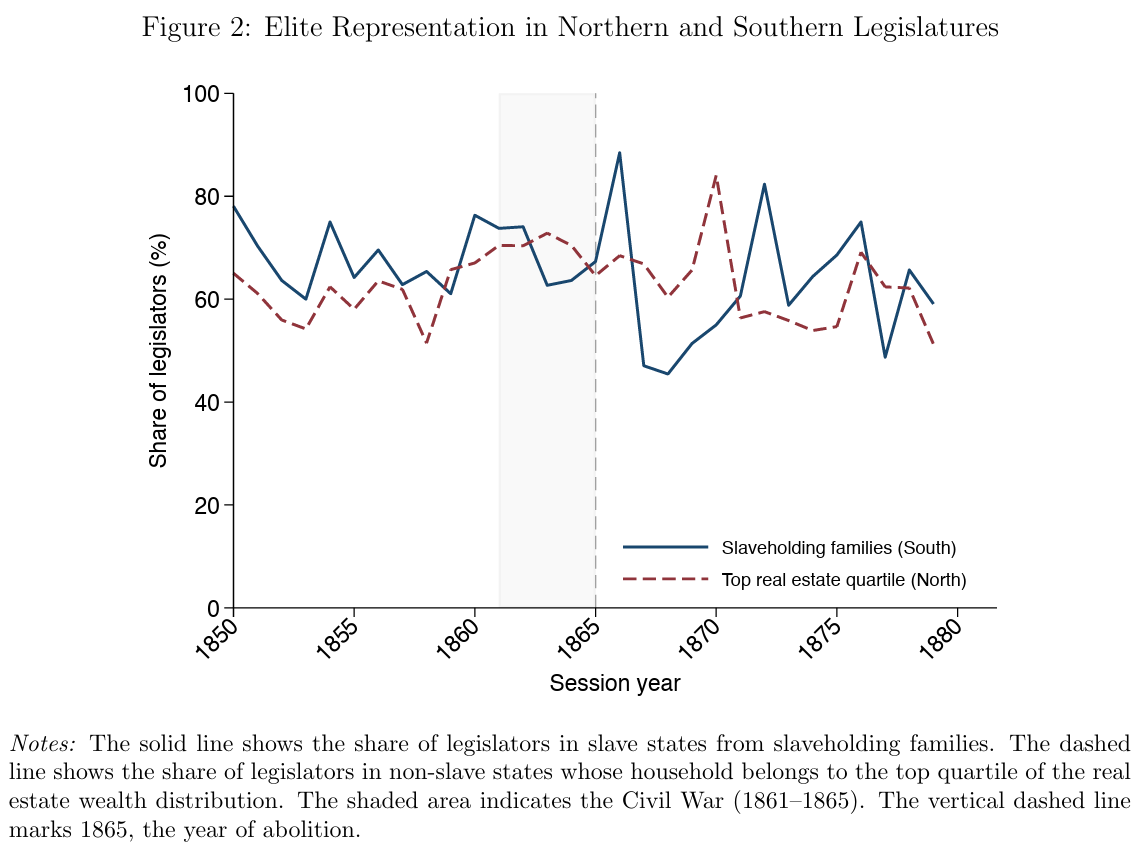
Elite legislative dominance wasn’t just a Southern phenomenon. Since about a quarter of white Southern families owned slaves before the Civil War, the paper uses census data to classify Northern families by the amount of real estate that they owned and tracks the share of legislators who came from the top quartile in 1860. By that definition — and to be fair, it’s a pretty broad one! — Northern elites also retained their political dominance after the war. Still, that’s pretty remarkable, because the top quartile of real estate owners in New York and Wisconsin only did great with the railroad boom gathering pace and explosive manufacturing growth, whereas their Southern counterparts lost their single greatest stock of material wealth.

In fact, you can make an argument that Southern elites increased their influence after the war. Over the 15 years after 1865, members of Southern slaveowning families took control of key committee positions, which did not happen in the North. Whether that means that whether the South was more elite dominated depends on how much weight you give to control over legislative agendas. If you think that’s important, then the Southern slaveocracy increased its power after the Civil War despite the end of slavery. If you don’t, well, maybe it didn’t increase its power but it sure as hell didn’t lose much.
It takes a lot to dislodge a ruling class. The Civil War wiped out their wealth, overturned state institutions, and rewrote the federal constitution, yet just 15 years later there they are, overrepresented in the legislatures and chairing even more committees.
And with that, we can return to our regularly scheduled insanity: burning an effigy of Fernando Muslera and rooting for the Orange.