

There’s been a lot of discussion about whether the new Venezuela oil deal is legal and, more importantly, whether a future administration could simply tear it up. Phillips O’Brien, whom I greatly admire, argues that the answer to the second question is basically yes. The Trump administration’s deal isn’t legal under Venezuelan or American law, O’Brien avers. Therefore the 35% U.S. equity stake can be handed back, the cheap-oil commitment can be unwound, and there isn’t much the current administration can do to bind its successors.
Another commentator whom I deeply respect, Max Boot, likewise writes in notes, “I also don’t see how it’s legal under U.S. law. Where does Trump get the power to do this?”
Neither of these gentlemen are easily dismissed.
Nonetheless, I’m not convinced. I don’t think that the deal is illegal under Venezuelan or American law. I’m also not sure that the deal will be that easy to undo, although that depends on how the administration structures it.
The question is what happens to that 35% American stake. Right now, the structure is that the U.S. government’s (USG’s) stake will take the form of “penny warrants,” i.e. options to buy shares in the Venezuelan oil enterprise (called “Blue Energy”) at pennies on the dollar. If the USG exercises those warrants immediately, however, it will be taking a 35% share of the profits in Blue Energy without putting up any significant share of capital, which will blow holes in the economic viability of the enterprise.
Given that, one of three things will happen. First, Washington leaves the warrants unexercised for a long time. In that case, the deal should be fairly easy for a future administration to reverse. Second, it finds a way to put federal money behind the investment, making the stake economically viable and harder to unwind. Third, the whole equity component turns out to be vaporware, in which case there is nothing to unwind. Note, however, that the equity stake isn’t the whole of the deal; there’s also provision that would require Blue Energy to sell one-fifth of its output to the USG at cost. (Any resemblance to the Spanish quinto real is certainly coincidental.) The 20% at-cost oil provision is a separate matter and will likely prove considerably stickier.
Allow me to make both arguments, if you will.
Regarding Venezuelan law: the Bolivarian Republic retains de jure ownership of the oil; thus the 16% royalty payments. And just as a company in Texas can book ownership of reserves leased from a private landowner, a company in Venezuela can book ownership of reserves leased from the Venezuelan state. There are also barriers to renationalization. If the BRV went that route, it would find itself tied up in international arbitration. If it lost, then a legal nightmare would rapidly descend around its oil exports. And, of course, the U.S. government could reimpose sanctions.
Regarding American law: The numbers, however, make it unlikely that the U.S. will actually take that 35% stake, at least given the information we have. I’ve run through the full analysis at this post. The upshot is that the deal is quite good for Caracas and marginally-investable for private companies — but it won’t make sense for private investors if the USG claims 35% of the profits without putting up any capital.
There is an important distinction, however, between the government having the right to take 35% and actually taking it. Warrants will cost the private investors very little today if everyone expects them to remain unexercised. But the moment Washington converts it into a 35% equity stake without contributing any capital, the private investors have effectively surrendered more than a third of their upside while retaining all the investment costs. That would render the project inviable. So we don’t only have to ask whether the administration legally obtained its 35% option. We also have to ask what needs to happen for the exercise of that option to be compatible with tens of billions of dollars of private investment.
The Trump administration has two obvious tools at its fingertips to make the above happen.
The first is the Development Finance Corporation (DFC), which could take a 35% stake in the enterprise backed by actual equity investment — the law allows the DFC to take stakes up to 40% in an enterprise and it has about $160 billion in statutory capacity. The problem is that it has only a $5 billion equity revolving fund at present. A 35% stake would require about $15 billion, given what we know about the costs of greenfield investments in Venezuela.
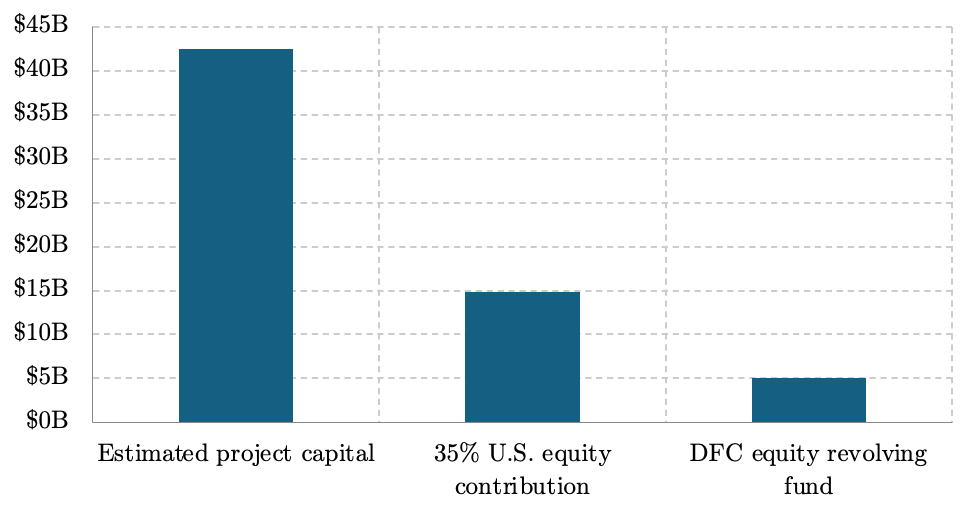
As of right now, there is no sign that the DFC is preparing to take any stakes at all.
A second government agency has been reported to be involved in the deal: the Office of Strategic Capital, located within the Department of War. The OSC has no authority to take equity stakes in private businesses; you can clearly see that in the statute.1 (These things are generally more clearly written than many presume and more people should just check them directly.)
Now, the OSC’s inability to make equity investments is not relevant to the deal — the administration apparently believes that the president can accept penny warrants that don’t cost anything on behalf of the United States. (I suspect that it is correct.) But it is relevant if the government is going to pay for an equity stake; that would have to go through DFC or get Congress to authorize the purchase.
Another alternative would be for the OSC to provide $15 billion in cheap loans to the enterprise. In fact, if it wanted to, the OSC could lend at zero percent! Note the following two clauses in the law:
(aa) Except as provided under item (bb), the interest rate on a loan provided under clause (i) shall be not less than the yield on marketable United States Treasury securities of a similar maturity to the maturity of the loan on the date of execution of the loan agreement.
(bb) The Director may waive the requirement under item (aa) with respect to an investment if the investment is determined by the Secretary of Defense to be vital to the national security of the United States.
Low or no cost loans would (probably, I haven’t run these numbers yet) make the investment attractive even if the United States grabbed 35% of the pretax profits.
But that strategy will run into two problems. First, OSC loans can’t finance more than 20% of the project, although that might be enough to get the 35% government stake to pencil out for private investors if the interest rate is low enough. Second and more seriously, 10 U.S.C. §149(h)(2)(A) lists the sectors that OSC can lend to and petroleum fuels aren’t on that list.
There may be workarounds, however. Maybe the administration could make a tendentious claim that it somehow falls into one of the categories in the law (advanced bulk materials, perhaps) and dare anyone to sue? Alternatively, the statute includes the following language: “Each agreement for a loan or loan guarantee executed by the Director under paragraph (3)(A) shall be conclusively presumed to be issued in compliance with the requirements of this section.” The administration might take this to mean that the law precludes judicial review, and the courts might back them up — it’s not an unreasonable interpretation.
So if the government manages to make the stake happen, Article 4, Section 3, of the U.S. Constitution will make it hard to unwind without Congressional approval. If the United States gets an equity stake in an enterprise, then that stake automatically becomes “property belonging to the United States,” and the Constitution clearly states: “The Congress shall have power to dispose of and make all needful rules and regulations respecting the territory or other property belonging to the United States.” If the Democrats control both houses that might be easy, assuming that you can work the provision into a reconciliation bill and avoid the filibuster. But even then, don’t underestimate the political hay that Republicans could make over a Democratic giveaway of our hard earned property to foreign socialists. And if the OSC does make a loan to Blue Energy, the political argument becomes easier — “How are you going to protect the taxpayers’ hard-earned money, President Ocasio?”
I wrote a whole book about just how easy it was in the past to make such hay, and considering that the entire 21st Century has seemed like one giant rush back to the future I don’t see why that would no longer be true.
If the warrants haven’t been exercised, then an administration determined to undo the deal could find a way to work around the Constitution. In that scenario, it would be extremely unclear who if anybody would have standing to sue. Yes, the President just handed an option for 35% of Blue Energy over to the Bolivarian Republic. But who was harmed? A plaintiff would have to demonstrate that the transfer created concrete economic damage, and that won’t be easy. So a future administration could simply act a lot like the current one and give the warrants to the BRV on the (likely correct) assumption that no one will have standing to sue.
But if the U.S. somehow pays for its stake (say via the DFC, or some other pot of money of which I am unaware), then Article 4 will make undoing the deal much harder. Avoid Congress and you’ll have a whole lot of interests with plausible standing depending on how the investment is structured. Involve Congress and you could find yourself in some sticky politics, no matter how unpopular Donald J. Trump happens to be come January 20, 2029. Worse yet, the current administration could structure the equity deal so as to deliberately harm third parties in the event that its share is transferred. I can’t say whether they will do so; only that they could, and that would throw a lot of sand into the gears of a future administration.
Such sand-throwing is even easier in the case of the 20% share of production that the USG is allowed to acquire at-cost. If the administration signs offtake agreements, then those offtakers will probably have obvious standing to sue if the agreements are abrogated. But even if the oil goes straight into the Strategic Petroleum Reserve (which as a commentator on O’Brien’s substack pointed out, would probably require additional blending) there would still be a very real chance that the courts would grant standing to someone who could claim damage from the cut-off of below-market supplies.
In short, absent congressional action, it looks like one of three things will happen.
The U.S. waits a long time to exercise the warrants. That makes a lot of the above moot and probably makes the equity stake part of the deal easy to undo. The ease of undoing the cost-oil part will depend on how the administration structured it but I don’t think it will be that easy.
We see signs of a large and very low cost OSC loan to Blue Energy Partners (or whomever) in the next year or so. If that happens, then the deal will become politically (and to a lesser extent legally) hard to undo.
The whole equity stake was just more vaporware that will disappear before anyone cuts any checks. In that case, see (1) above.
I hope this is helpful! Some eggs aren’t as easy to unbreak as they seem.
The statute empowers the OSC to provide “capital assistance” to eligible entities, and §149(h)(1) states clearly, “The term ‘capital assistance’ means a loan, loan guarantee, or technical assistance.”